Technology and innovation
Technology and innovation have become inseparable forces driving transformation across every sector of modern society. From the way we learn and work to how we conduct scientific research and solve global challenges, technological advancement reshapes our possibilities and redefines what we consider achievable. Understanding these dynamics is no longer optional for students, professionals, or curious minds—it’s essential for navigating a world where change accelerates constantly.
This comprehensive resource explores the fundamental mechanisms that drive technological innovation, examines the emerging technologies currently reshaping our landscape, and investigates their profound impact on education, employment, and scientific discovery. Whether you’re a student preparing for tomorrow’s job market, an educator adapting teaching methods, or a professional seeking to understand industry transformation, this article provides the foundational knowledge you need to engage confidently with our technology-driven era.
What Drives Technological Innovation?
Innovation doesn’t emerge from a vacuum—it follows recognizable patterns and requires specific conditions to flourish. Understanding these underlying drivers helps demystify how breakthrough technologies move from conceptual ideas to transformative real-world applications.
The Innovation Cycle
Technological progress typically follows a cyclical pattern beginning with basic research, moving through applied development, reaching commercialization, and eventually sparking new questions that restart the cycle. Consider how fundamental research into quantum mechanics eventually enabled the development of transistors, which led to integrated circuits, personal computers, and ultimately the smartphone revolution. Each stage builds upon previous discoveries while creating foundations for future breakthroughs.
This cycle requires patient investment in foundational science, often with no immediate practical application. Universities and research institutions play a crucial role here, generating knowledge that commercial entities later transform into products and services. The timeframe from discovery to market impact can span decades, making sustained commitment essential.
Key Enablers of Progress
Several factors consistently accelerate innovation across different technological domains:
- Cross-disciplinary collaboration that combines expertise from different fields to solve complex problems
- Access to computational power enabling simulation, modeling, and data analysis at unprecedented scales
- Open knowledge sharing through publications, conferences, and increasingly through open-source platforms
- Regulatory frameworks that balance safety concerns with the need to experiment and iterate
- Availability of venture capital and funding mechanisms willing to support high-risk, high-reward projects
Emerging Technologies Reshaping Our World
While innovation occurs across countless domains, several technological families currently demonstrate particularly significant potential to transform education, work, and scientific research. These aren’t isolated developments but interconnected advances that often amplify each other’s impact.
Artificial Intelligence and Machine Learning
Artificial intelligence has transitioned from science fiction to everyday tool remarkably quickly. Machine learning algorithms now power everything from personalized learning platforms that adapt to individual student needs to diagnostic systems that assist medical professionals in identifying diseases from imaging data. The technology excels at recognizing patterns within vast datasets—a capability humans possess but cannot scale effectively.
In educational contexts, AI enables intelligent tutoring systems that provide immediate feedback, identify knowledge gaps, and adjust difficulty levels automatically. For researchers, machine learning accelerates hypothesis testing and reveals correlations that might remain hidden in traditional analysis approaches. However, these systems require careful implementation to avoid perpetuating biases present in training data.
Internet of Things and Connectivity
The proliferation of interconnected devices creates unprecedented opportunities for data collection and system optimization. Sensor networks in educational facilities can monitor environmental conditions to optimize learning environments, while wearable devices track physiological indicators relevant to both health research and performance optimization.
This connectivity enables real-time monitoring and adjustment across complex systems. Smart laboratories can automatically log experimental conditions, reducing manual record-keeping errors. Manufacturing facilities equipped with IoT sensors provide hands-on training environments where students can learn advanced production techniques. The challenge lies in managing the massive data streams these systems generate and protecting privacy within always-connected environments.
Biotechnology and Life Sciences
Advances in genetic sequencing, gene editing, and synthetic biology are revolutionizing our understanding of living systems. Technologies like CRISPR-Cas9 have democratized genetic engineering, making techniques that were recently exclusive to elite laboratories accessible to undergraduate students in well-equipped university programs.
These capabilities raise exciting possibilities for addressing food security, developing personalized medicine, and understanding complex biological processes. They also introduce ethical questions that require thoughtful consideration—topics that increasingly feature prominently in science curricula as educators prepare students to navigate both the technical and moral dimensions of these powerful tools.
Innovation in Education and Skill Development
Educational technology represents one of the most significant applications of innovation, fundamentally changing how knowledge transfers between generations and how learners develop competencies.
Digital Learning Platforms
Online learning environments have evolved far beyond simple video lectures. Contemporary platforms incorporate interactive simulations, collaborative workspaces, peer assessment mechanisms, and sophisticated analytics that help both learners and instructors understand progress and identify areas needing additional attention. These systems make quality educational resources accessible regardless of geographic location, potentially addressing educational inequality.
Virtual and augmented reality technologies add another dimension, enabling students to explore environments—from inside a human cell to the surface of distant planets—that would be impossible or impractical to access physically. Medical students practice surgical procedures in risk-free virtual environments, while engineering students manipulate three-dimensional models of complex machinery to understand mechanical principles.
Adaptive Learning Technologies
Perhaps the most significant innovation in educational technology involves systems that personalize learning pathways for individual students. By continuously assessing understanding through embedded assessments and analyzing response patterns, these platforms identify optimal next steps for each learner—something impractical for human instructors managing dozens or hundreds of students simultaneously.
This adaptive approach recognizes that learners progress at different rates and benefit from different explanatory approaches. A concept that one student grasps immediately through visual representation might require hands-on experimentation for another. Technology enables customization at scale, potentially combining the benefits of personalized tutoring with the efficiency of classroom instruction.
The Changing Landscape of Work and Employment
Technological innovation continually reshapes employment markets, eliminating some roles while creating others and transforming the skills required for professional success. Understanding these dynamics helps students and professionals make informed career decisions and educational investments.
Automation increasingly handles routine, repetitive tasks—both physical and cognitive. Manufacturing robots perform assembly operations, while software algorithms process insurance claims, reconcile financial records, and screen job applications. This shift doesn’t necessarily mean fewer jobs overall, but it does mean different jobs requiring different competencies. Roles emphasizing creativity, complex problem-solving, emotional intelligence, and adaptability become increasingly valuable precisely because these capabilities remain difficult to automate.
The skills landscape evolves accordingly. Technical literacy becomes foundational across professions that previously required little technological engagement. A marketing professional now needs data analysis capabilities; a journalist benefits from understanding how algorithms surface content; even traditional craftspeople increasingly use computer-aided design tools. This creates demand for continuous learning throughout careers rather than front-loading education early in life.
Remote work technologies—accelerated by recent global events—demonstrate how innovation can fundamentally restructure work arrangements. Video conferencing, collaborative document editing, project management platforms, and cloud computing enable distributed teams to function effectively across time zones and continents. This geographical flexibility creates opportunities but also intensifies competition as talent pools expand globally.
Building Effective Innovation Ecosystems
Breakthrough innovations rarely emerge from isolated individuals working alone. Instead, they typically arise from collaborative ecosystems where diverse participants contribute complementary capabilities and perspectives.
Successful innovation hubs generally combine several elements: research universities generating foundational knowledge and training talent, established companies providing resources and market access, startup ventures willing to take risks on unproven concepts, investors supplying capital, and supportive regulatory environments. Geographic clusters form where these elements concentrate, though digital connectivity increasingly enables virtual collaboration across distances.
The concept of open innovation challenges traditional models where organizations jealously guarded intellectual property. Companies increasingly recognize that valuable ideas exist both inside and outside their boundaries. Sharing research findings, publishing datasets, and collaborating with competitors on pre-competitive foundational technologies can accelerate progress for all participants while reserving competition for market-facing applications.
Educational institutions play a crucial bridging role, connecting academic research with practical application while preparing students to navigate collaborative, interdisciplinary environments. Project-based learning that brings together students from different specializations mirrors real-world innovation processes where engineers, designers, business analysts, and domain experts must communicate effectively to solve complex problems.
Navigating Ethical Challenges in Technology
Every powerful technology introduces ethical dimensions that society must address thoughtfully. Privacy concerns intensify as data collection becomes ubiquitous and analytical capabilities grow more sophisticated. Educational institutions collecting detailed learning analytics must balance the benefits of personalized instruction against student privacy rights. Employers using monitoring technologies face similar tensions between productivity optimization and employee autonomy.
Algorithmic bias represents another critical challenge. Machine learning systems trained on historical data can perpetuate and amplify existing inequalities, affecting everything from loan approvals to hiring decisions to criminal justice risk assessments. Addressing this requires diverse development teams, transparent algorithms, regular auditing, and willingness to prioritize fairness even when it might slightly reduce predictive accuracy.
Environmental sustainability considerations increasingly influence innovation priorities. Computing infrastructure consumes significant energy; manufacturing processes for electronic devices involve resource extraction and waste generation. Responsible innovation frameworks encourage assessing long-term environmental and social impacts alongside technical capabilities and economic viability.
These ethical dimensions aren’t obstacles to avoid but essential considerations that, when addressed thoughtfully, strengthen technologies and increase their beneficial impact. Educational programs increasingly incorporate ethics across technical curricula rather than treating it as a separate, optional topic—recognizing that tomorrow’s innovators need both technical competence and ethical reasoning capabilities.
Technology and innovation will continue reshaping education, employment, and scientific discovery in ways we cannot fully predict. By understanding the fundamental drivers of innovation, familiarizing yourself with emerging technologies, and appreciating both the opportunities and responsibilities they create, you position yourself to participate actively in this transformation rather than simply experiencing it passively. The knowledge areas explored here provide starting points for deeper investigation based on your specific interests and professional goals.

How to Ensure Secure Clinical Operations Against Rising Ransomware Attacks?
Ransomware in a clinical setting is not an IT problem; it’s a direct threat to patient care that basic security protocols can no longer prevent. Granular network segmentation to isolate critical medical devices is no longer optional, it’s the first…
Lire la suite
How to Adapt Telemedicine Tools for Seniors With Low Tech Literacy?
Senior telehealth failure is not a patient problem; it’s a design problem that can be systematically solved. Successful adoption hinges on radically reducing cognitive load with one-touch interfaces and pre-configured, cellular-enabled devices. True accessibility requires building empathy into the entire…
Lire la suite
Who Is Liable When Artificial Intelligence and Clinical Assisted Diagnosis Fail?
The primary liability for AI diagnostic failure currently defaults to the supervising physician, but the true financial and legal vulnerabilities for a hospital are silently embedding themselves in technology contracts, data hosting agreements, and clinical workflows. Distinguishing between « Clinical Decision…
Lire la suite
How Cutting-Edge Robotic Surgery Systems Improve Tumor Resection Margins?
The key to superior tumor margins isn’t just the robot’s steady hand; it’s the adoption of a complete, data-driven surgical operating model that the technology enables. Achieving negative margins consistently relies on a system of scalable surgeon proficiency, optimized workflows,…
Lire la suite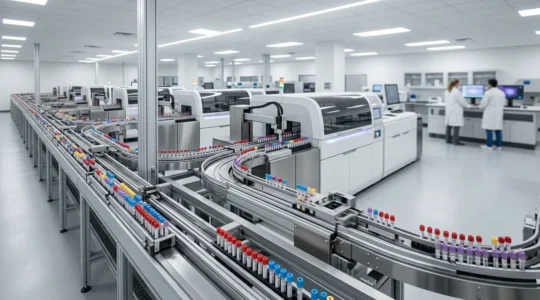
How Automated Laboratory Tests Reduce Pre-Analytical Errors
The integration of laboratory automation is not merely a strategy for efficiency; it is a fundamental shift in quality management, moving the focus from policing individual human mistakes to auditing systemic failure points within automated processes. The vast majority of…
Lire la suite
How to Obtain Detailed Images of Internal Organs Using Advanced 3D Reconstruction?
Achieving truly detailed and diagnostically useful 3D images of internal organs goes far beyond simply converting 2D scans. The key lies in mastering the post-processing pipeline. This involves leveraging superior source data from spectral CT, applying AI-driven segmentation with rigorous…
Lire la suite
Frugal MedTech: How to Adapt High-End Innovations for Rural Clinics
The success of medical technology in rural settings depends less on its sophistication and more on its resilience to real-world failure points. True adaptation goes beyond cost-reduction; it requires designing for environmental hostility (humidity, dust, unstable power) and supply chain…
Lire la suite
How to Convert Theoretical Medical Tech into Practical Clinical Applications?
The primary reason medical technology fails is not a lack of innovation, but a failure to integrate into the high-friction, messy reality of clinical workflows. Clinician rejection is often driven by minor usability issues and workflow disruptions, not a dismissal…
Lire la suite
How AI-Assisted Diagnostics Reduce Pathology Identification Time by 40%?
AI integration is not just about speed; it’s a strategic shift that enhances diagnostic precision and operational efficiency when implemented with clear human oversight. AI algorithms now surpass human accuracy in specific tasks, like identifying skin lesions, by detecting subtle…
Lire la suite
How to Cut Hospital Operational Costs by 20% with a Modern Tech Stack
The widely-cited 20% cost reduction in healthcare doesn’t come from buying new technology, but from systematically dismantling the ‘technical debt’ of legacy systems. Legacy systems consume up to 75% of IT budgets in maintenance and pose a multi-million dollar security…
Lire la suite