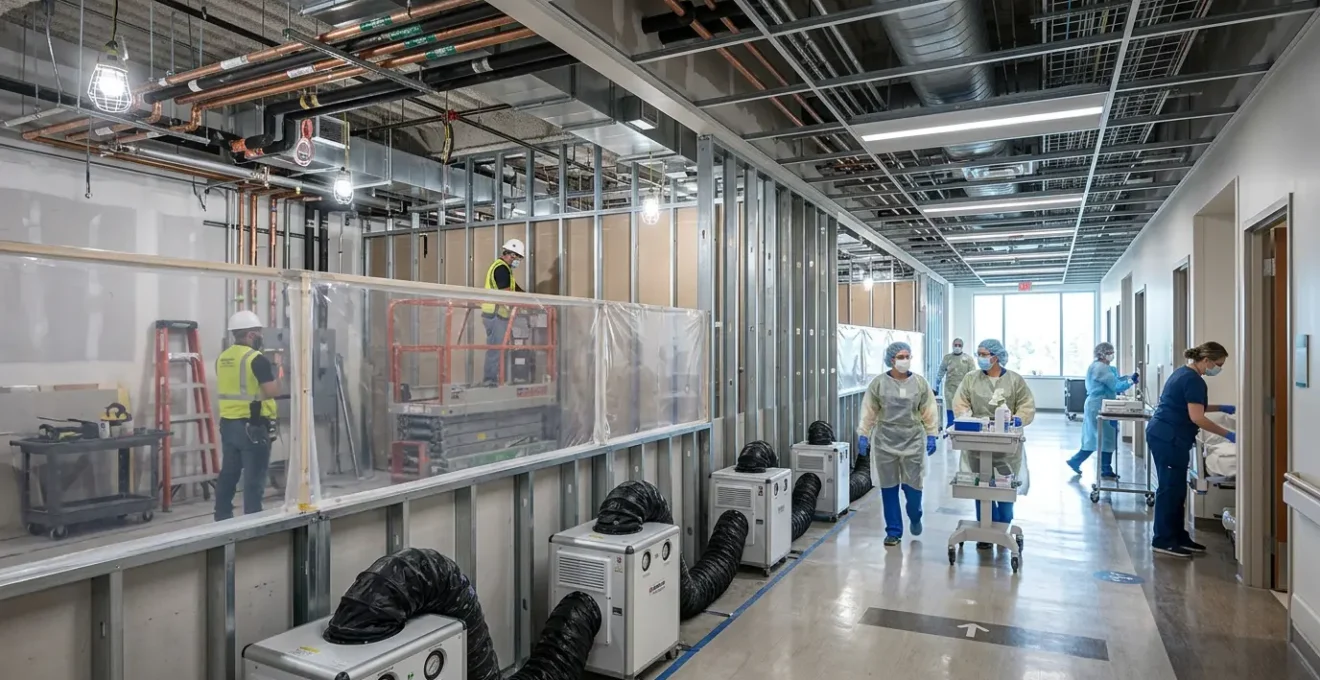
The key to pandemic resilience isn’t new construction, but the surgical, data-driven retrofitting of your existing facility’s core systems.
- Upgrading HVAC to HEPA standards and creating pressure cascades is more critical than just adding rooms.
- Acuity-adaptable spaces and decentralized layouts directly reduce staff burnout and improve patient outcomes.
Recommendation: Start by creating a digital twin of your facility to simulate changes and identify the highest-impact interventions before committing capital.
For healthcare facility managers and architects, the last global health crisis was a trial by fire. The sudden, overwhelming demand for isolation capacity, airborne infection control, and adaptable care spaces exposed the vulnerabilities of even the most modern hospitals. The knee-jerk reaction in the industry is often to talk about massive, ground-up construction projects—a solution that is slow, prohibitively expensive, and simply not feasible for most operational facilities. The common advice to « improve ventilation » or « create more isolation rooms » barely scratches the surface of the complex operational challenges involved.
But what if the answer isn’t about wholesale replacement? What if the path to resilience lies in a more intelligent, surgical approach? The true challenge isn’t building new structures, but strategically upgrading the operational DNA of the buildings we already have. This involves looking beyond walls and floors to the interconnected systems of space, airflow, and workflow that dictate a hospital’s ability to respond to a surge. It requires a shift in mindset from a builder to that of a surgeon—making precise, data-driven interventions that yield maximum impact with minimum disruption.
This guide moves beyond the platitudes. We will explore the specific, evidence-based retrofitting strategies that transform existing infrastructure into a flexible, resilient asset. We will delve into acuity-adaptable ward design, advanced HVAC upgrades, and workflow optimizations that have been proven to save lives, protect staff, and ensure your facility is ready for the next challenge, all without laying a single new foundation.
To navigate these critical retrofitting strategies, this article breaks down the essential interventions into distinct, actionable components. The following sections provide a detailed roadmap for enhancing your facility’s resilience, covering everything from ward design and system upgrades to workflow and energy management.
Summary: Retrofitting Hospitals for Future Pandemics
- Why Flexible Ward Designs Saved 30% More Lives During the Last Health Crisis?
- How to Upgrade HVAC Systems to ISO Class 7 Standards in Existing Buildings?
- Single Patient Rooms or Multi-Bed Wards: Which Maximizes Bed Occupancy Rates?
- The Layout Error That Increases Nurse Walking Time by 2 Miles per Shift
- How to Phased Renovations in 4 Steps While Keeping the ER Fully Operational?
- Why Negative Pressure Rooms Are Essential for Airborne Pathogen Control?
- Where to Place Supply Rooms to Reduce Daily Walking Distance by 1 Mile?
- How Modern Hospital Infrastructure Uses IoT to Cut Energy Costs by 15%?
Why Flexible Ward Designs Saved 30% More Lives During the Last Health Crisis?
The rigid distinction between ICU, step-down, and medical-surgical units became a critical bottleneck during the last pandemic. Facilities were forced into slow, costly conversions while patient needs changed by the hour. The solution lies in moving away from fixed-function spaces and toward acuity-adaptable room design. An acuity-adaptable room is a universal care space, pre-wired and pre-plumbed to function as anything from a standard med-surg room to a full ICU. This eliminates the need for patient transfers within the hospital—a process that is not only inefficient but also increases the risk of cross-contamination and adverse events.
By designing rooms that can adapt to the patient’s changing acuity level, hospitals can flex their critical care capacity almost instantly. This strategy not only improves patient outcomes but also optimizes staff workflow by keeping nurses and specialists in a consistent geographic area. The core principle is simple: move the necessary equipment and care level to the patient, not the patient to a different part of the hospital. Implementing this requires forward-thinking infrastructure investment. According to design experts at Perkins-Will, successful acuity-adaptable design hinges on several key elements built in from the start.
The fundamental components of a successful acuity-adaptable space include:
- Reinforced Foundations and MEP Systems: Building in the capacity for future vertical expansion and higher-intensity mechanical, electrical, and plumbing (MEP) needs during initial construction or major retrofits.
- Universal Procedural Platforms: Designing flexible super-floors or pods that can integrate surgery, imaging, and cardiac procedures, allowing spaces to be reconfigured based on demand.
- Modular Room Designs: Utilizing prefabricated, duplicate headwalls and retractable partitions that allow for rapid conversion of rooms from semi-private to single-patient or from standard to ICU.
- Centralized Clean Cores: Creating restricted corridors and centralized supply areas that can be quickly zoned off to support a converted block of rooms during a surge event.
Adopting this model transforms the hospital from a static collection of specialized units into a dynamic, responsive organism capable of absorbing and managing patient surges effectively.
How to Upgrade HVAC Systems to ISO Class 7 Standards in Existing Buildings?
If flexible wards are the new skeleton of a resilient hospital, then the HVAC system is its respiratory system. During the pandemic, it became painfully clear that most existing hospital ventilation systems were not designed to control airborne pathogens effectively. Upgrading HVAC infrastructure is not just a recommendation; it is a fundamental requirement for patient and staff safety. The goal is to achieve air quality standards comparable to cleanrooms, specifically targeting ISO Class 7 standards in critical areas. This involves significant upgrades, most notably the integration of HEPA filtration systems.
These advanced systems are remarkably effective; HEPA filter systems capture 99.97% of airborne particles, including viruses. However, retrofitting them into an existing building presents challenges. HEPA filters create a higher pressure drop, demanding more powerful fans and potentially larger ductwork. This can have a significant impact on energy consumption if not managed properly. The key is a holistic approach: upgrade fans, implement variable frequency drives (VFDs) to match airflow to demand, and use advanced building automation systems (BAS) to monitor and control pressure, temperature, and air change rates dynamically.
As the image shows, the installation is a work of precision engineering, where the seal and fit are as critical as the filter media itself. While the initial investment for such an upgrade can be substantial, the return on investment extends beyond infection control. A well-designed HVAC retrofit can lead to dramatic energy savings and operational cost reductions, helping to offset the capital expenditure.
Case Study: Wexham Park Hospital’s Energy-Saving Retrofit
Wexham Park Hospital undertook a £7.5 million energy infrastructure upgrade that included a 1.5 MWe Combined Heat and Power (CHP) plant. This surgical intervention displaced 90% of grid electricity and provided 75% of the hospital’s heat. The results were staggering: the retrofit reduced annual carbon emissions by 1,621 tonnes and generated annual energy cost savings of £475,000—exceeding initial projections by 50% and demonstrating that safety and sustainability can be mutually reinforcing goals.
Single Patient Rooms or Multi-Bed Wards: Which Maximizes Bed Occupancy Rates?
The debate between single-patient rooms and multi-bed wards has long been a central topic in healthcare design, traditionally focused on patient preference and initial construction cost. However, the pandemic has reframed this argument entirely around two new, critical metrics: infection control and surge capacity flexibility. The common assumption is that single-patient rooms are unequivocally safer. While they offer superior isolation for known infectious cases, they can paradoxically lead to lower overall bed occupancy during a crisis if not every room is needed for isolation.
When a hospital with 100% single rooms has to cohort patients with the same illness, it can be forced to leave rooms empty to maintain separation, effectively reducing its usable bed count. Multi-bed wards, while carrying a higher intrinsic risk, offer greater flexibility for cohorting large numbers of patients. The key, therefore, is not an « either/or » solution but a strategic mix. The most resilient facilities will feature a majority of single-patient rooms for baseline safety and a smaller number of flexible, multi-bed wards or acuity-adaptable rooms that can be quickly converted to handle surge and cohorting scenarios.
The risk of airborne transmission is directly tied to spatial configuration. As data from a comprehensive analysis of hospital design and infection risk shows, the distance between patients is a critical factor, making poorly designed multi-bed wards a significant liability.
| Room Type | Infection Risk Ratio | Distance Impact | Optimal Application |
|---|---|---|---|
| Single Patient Room | 0.55 (45% reduction) | N/A – isolated patient | ICU, immunocompromised, isolation cases |
| Multi-bed (>1m spacing) | 1.0 (baseline) | Standard risk | General medical wards, stable patients |
| Multi-bed (≤1m spacing) | 3.36 (236% increase) | Significant SARS transmission risk | Not recommended for airborne pathogens |
This data from a peer-reviewed study clearly illustrates that while single rooms reduce risk by nearly half compared to a well-spaced ward, cramming patients into close quarters increases risk by over 200%. The lesson for retrofitting is clear: if multi-bed wards must be used, ensuring adequate spacing and ventilation is non-negotiable.
The Layout Error That Increases Nurse Walking Time by 2 Miles per Shift
In a hospital, time is the most valuable and non-renewable resource. Yet, a common and often overlooked layout error silently robs clinical staff of this resource every day: centralized support services. The traditional « racetrack » or radial ward design, with a single, large nursing station and distant supply rooms, forces nurses to walk excessive distances. This travel time, spent retrieving supplies or walking to patient rooms, is time not spent on direct patient care. Studies have shown this can add up to two miles or more to a nurse’s daily journey, leading to fatigue, burnout, and reduced efficiency.
The solution is a shift toward a decentralized model. This involves breaking down large units into smaller « pods » or « neighborhoods » of 8-12 patient rooms. Each pod is supported by its own smaller, sub-station and, most importantly, its own dedicated supply and utility rooms. By placing resources closer to the point of care, this model drastically reduces walking distances, improves response times, and can even limit cross-contamination between pods. Retrofitting this model into an existing footprint requires careful spatial analysis to identify underutilized areas that can be converted into these decentralized support zones.
Modern technology offers a powerful tool for planning such a significant workflow redesign before a single wall is moved. Using virtual design and construction (VDC) allows teams to identify and eliminate these layout errors in a simulated environment.
Case Study: Wrangell Hospital’s Virtual Workflow Optimization
During its renovation, Wrangell Critical Access Hospital in Alaska leveraged a « digital twin » of its facility using virtual design tools. The project team used Autodesk Revit and Enscape to create a real-time rendered model of the proposed changes. This allowed clinical staff to « walk through » the new spaces virtually, simulating daily tasks and patient flows. This immersive pre-renovation analysis enabled the team to identify potential workflow bottlenecks and optimize the placement of nurse stations and supply rooms, ensuring the final design was efficient from day one.
This approach embodies the « measure twice, cut once » philosophy, using data and simulation to validate design decisions and ensure that the retrofitted space actively supports, rather than hinders, the work of clinical staff. It’s a surgical intervention at the scale of the entire floor plate.
How to Phased Renovations in 4 Steps While Keeping the ER Fully Operational?
The greatest challenge in retrofitting an active hospital is the need to perform complex surgery on a patient who must remain awake and fully functional. Shutting down an entire wing or, critically, the Emergency Room, is not an option. This is where phased renovation with swing space infrastructure becomes the most important strategy in the architect’s toolkit. A phased renovation breaks a large project into a sequence of smaller, manageable steps, allowing the hospital to maintain continuity of care throughout the construction process.
The key to success is meticulous planning, often orchestrated through a « digital twin » of the facility. This virtual model allows the team to simulate every phase of the project, from demolition to commissioning, ensuring that life-saving services are never compromised. The physical component of this strategy is the use of temporary, prefabricated modular units. These high-quality « swing spaces » can be deployed adjacent to the main building to temporarily house critical functions—like an ER triage or a small procedural suite—while their permanent spaces are being renovated. This allows the hospital to maintain its operational capacity without sacrificing safety or quality of care.
As illustrated, these modern modular units can be seamlessly integrated with the existing facility through covered walkways, creating a patient- and staff-friendly environment. This approach transforms a logistical nightmare into a choreographed dance of construction and care. To ensure a successful phased renovation in a high-stakes environment like a hospital, a rigorous audit and planning process is essential.
Your Action Plan: Phased Renovation Readiness Audit
- Points of Contact: Map all critical patient, staff, and supply pathways that intersect with the proposed renovation zones to establish a baseline operational flow.
- Collect: Inventory existing structural, mechanical, and electrical documentation and create a high-fidelity 3D laser scan (Digital Twin) of the target areas.
- Coherence: Confront the renovation plan with infection control protocols. Simulate dust/debris containment and airflow changes for each phase to ensure patient safety is never compromised.
- Memorability/Emotion: Identify the most disruptive phases for staff and patients (e.g., noise, re-routing). Plan enhanced communication, wayfinding, and staff support for these critical periods.
- Integration Plan: Develop a detailed logistics plan for the deployment, connection, and eventual removal of modular swing space, prioritizing seamless utility hookups and minimal disruption to adjacent departments.
Why Negative Pressure Rooms Are Essential for Airborne Pathogen Control?
The term « negative pressure room » became common parlance during the pandemic, but its underlying principle is a cornerstone of hospital infection control. These rooms, also known as Airborne Infection Isolation (AII) rooms, are designed to contain airborne pathogens and protect the rest of the hospital. They work by maintaining a lower air pressure inside the room than in the surrounding areas. This means that when a door is opened, clean air from the corridor flows into the room, and contaminated air from inside the room is prevented from escaping. The air from the room is then exhausted directly to the outdoors, often after being passed through a HEPA filter.
The challenge for most hospitals was not a lack of understanding, but a catastrophic lack of capacity. Before the crisis, a typical hospital might have had only one or two such rooms. The surge in infectious patients required a massive and rapid expansion. As healthcare engineering reports show, many facilities expanded from 1-2 to 10+ negative pressure rooms during the height of COVID-19, often by converting standard patient rooms. This is not a simple conversion; it requires re-routing ductwork, upgrading exhaust fans, and ensuring the room is properly sealed to maintain pressure. The most sophisticated designs employ a cascading pressure hierarchy, creating buffer zones like anterooms to provide an even greater level of containment.
This tiered approach creates a pressure gradient that ensures pathogens are progressively contained, with the patient room being the most negative zone. This is the gold standard for managing highly infectious airborne diseases.
| Zone | Pressure Level | Air Changes/Hour | Filtration Requirement |
|---|---|---|---|
| Patient Room (Infected) | -2.5 Pa (Most Negative) | 12 ACH minimum | HEPA exhaust required |
| Anteroom | -1.0 Pa | 10 ACH | Standard + UV-C optional |
| Corridor | 0 Pa (Neutral) | 4-6 ACH | MERV 14 minimum |
| Clean Supply Areas | +2.5 Pa (Positive) | 4 ACH | MERV 13 minimum |
As the table demonstrates, it’s a system of systems. Not only is the patient room negative, but clean areas are actively kept at a positive pressure to push potential contaminants away. Retrofitting an entire wing to meet this standard is a complex but vital task for pandemic readiness.
Where to Place Supply Rooms to Reduce Daily Walking Distance by 1 Mile?
The efficiency of a clinical unit can be measured in steps. Specifically, the steps a nurse takes away from the patient’s bedside to retrieve supplies. Every trip to a distant, centralized supply room is a moment not spent on patient monitoring, care, or consultation. The architectural solution is surprisingly simple in concept, yet powerful in impact: decentralize the supplies. By moving away from a single, large central storage room and instead creating smaller, distributed supply closets within each patient care pod, we bring the resources directly to the point of care.
This design philosophy directly attacks the « waste » of motion that plagues so many hospital workflows. Placing clean supplies, linens, medications, and even soiled utility rooms closer to the 8-12 patient rooms they serve can have a dramatic effect on staff efficiency and satisfaction. The goal is to ensure that 80% of the most frequently used supplies are available within a few feet of the patient care zone, eliminating the long treks that fragment a nurse’s day and contribute to fatigue.
This isn’t just a theoretical benefit. Facilities that have implemented this model have seen significant, measurable improvements in their operational efficiency.
Case Study: Impact of Decentralized Supply Distribution
An analysis of medical-surgical units that retrofitted their layout to implement a pod-based supply distribution model showed remarkable gains. By embedding clean supply rooms, soiled utility rooms, and equipment storage within each 8-10 bed patient care pod, facilities reduced the average nurse walking distance by a staggering 40% per shift. This not only improved response times but also reduced the risk of cross-contamination between different units of the hospital.
Retrofitting an existing unit to accommodate this model can be a challenge of finding space. It often involves converting underutilized spaces, such as an obsolete procedure room or a former patient room, into a new supply hub. In cases where major construction isn’t feasible, a hybrid approach using automated dispensing cabinets and highly organized mobile supply carts can achieve a similar, though less dramatic, effect. The guiding principle remains the same: shorten the distance between the caregiver and the tools they need to do their job.
Key Takeaways
- True pandemic readiness comes from upgrading core systems (like HVAC) and workflows, not just adding space.
- Data must precede construction. Using digital twins and workflow analysis to simulate changes allows for surgical, high-impact interventions that save money and time.
- The future of hospital design is flexible and decentralized. Acuity-adaptable rooms and pod-based layouts create a more resilient and efficient care environment.
How Modern Hospital Infrastructure Uses IoT to Cut Energy Costs by 15%?
Hospitals are among the most energy-intensive buildings in the world, operating 24/7 with a vast array of life-sustaining equipment. This makes them prime candidates for significant efficiency gains through smart technology. The « Internet of Things » (IoT) is no longer a buzzword but a practical tool for retrofitting intelligence into a building’s core infrastructure. By deploying a network of sensors connected to a central building automation system (BAS), facility managers can gain unprecedented visibility and control over their energy consumption.
These IoT sensors can monitor everything in real-time: occupancy in rooms, CO2 levels, temperature, humidity, and the operational status of major equipment like chillers and air handlers. This data stream allows the BAS to make intelligent, automated decisions. For example, instead of ventilating a whole wing at maximum capacity around the clock, the system can reduce airflow to unoccupied rooms. It can dim lights when a space is empty or adjust thermostat setpoints based on the time of day and solar gain. This granular level of control moves the building from a static, brute-force state of operation to a dynamic, responsive one that precisely matches energy use to real-time demand.
The results of these digital retrofits are not just marginal. They are substantial and proven. In the United Kingdom, recent NHS implementation studies demonstrate an average of 18% energy consumption reduction through the deployment of these smart building technologies. This translates into millions of dollars in annual savings, which can be reinvested into patient care, while also dramatically lowering the facility’s carbon footprint. The surgical intervention here is not in the physical plant, but in the digital nervous system that controls it.
By viewing your facility not as a fixed monument but as a high-performance system that can be continuously tuned and upgraded, you unlock the path to resilience. The process begins not with a hammer, but with a plan. Start by auditing your facility’s current capabilities, identifying the most critical vulnerabilities, and using data to model the impact of these surgical interventions. This strategic approach is the most effective way to prepare your institution for the challenges of tomorrow.
Frequently Asked Questions on How to Retrofit Medical Infrastructure for Pandemic Readiness Without Rebuilding?
How much space should be allocated for decentralized supply rooms?
Each pod-based supply area typically requires 80-120 square feet for clean supplies, 60-80 square feet for soiled utility, and 100-150 square feet for equipment storage, totaling approximately 240-350 square feet per care pod.
What is the optimal distance between supply rooms and patient areas?
Supply rooms should be located within 50-75 feet of the furthest patient room in the pod, with visual sightlines maintained for efficient workflow and reduced travel time.
How can existing hospitals retrofit for decentralized supplies without major construction?
Convert underutilized spaces like defunct patient rooms or obsolete procedure areas into supply zones, implement mobile supply carts with par-level systems, and use automated dispensing units for high-turnover items.