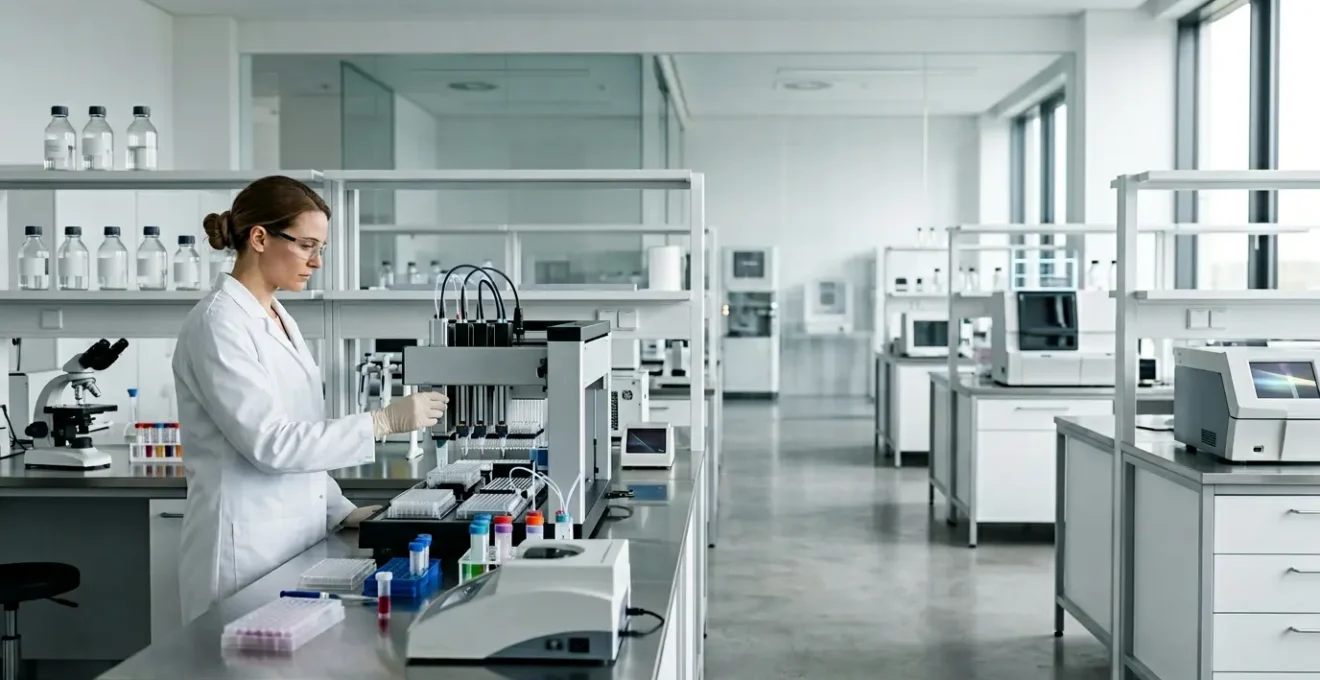
The reproducibility crisis in biomedical research isn’t a problem of individual skill, but of systemic failure; the solution is to re-engineer your lab for ‘Reproducibility-by-Design’.
- Irreproducibility stems from operational friction in key areas like reagent variability, sample management, and manual processes.
- Implementing modular automation, adopting a risk-adjusted cost model for supplies, and establishing robust cryo-logistics are critical systemic changes.
Recommendation: Shift focus from correcting one-off errors to building integrated systems where reliable data is the default, not an occasional achievement.
The pressure on biomedical research labs has never been greater. Principal Investigators and lab managers are caught between shrinking funding and a pervasive « reproducibility crisis » that undermines scientific progress and wastes valuable resources. The common refrain points to a ‘publish or perish’ culture, leading to rushed, often unrepeatable work. While this pressure is real, blaming the culture offers no practical path forward for the manager on the ground tasked with delivering reliable data.
Many labs react by doubling down on conventional wisdom: more training, stricter SOPs, or simply buying the most expensive equipment. While well-intentioned, these are often isolated fixes for systemic problems. They patch symptoms without addressing the underlying operational friction that erodes data integrity. True optimization requires a paradigm shift. It’s about moving away from troubleshooting individual failures and toward architecting a holistic laboratory environment where reproducibility is an engineered outcome.
This is the principle of ‘Reproducibility-by-Design’. The key is not to work harder, but to build a smarter, more resilient system. This guide abandons platitudes and instead provides a systematic framework for lab optimization. We will deconstruct the lab into its core operational pillars—from automation and reagents to sample logistics and funding strategy—to show you how to build a cohesive system that produces trustworthy data by default.
This article provides a detailed roadmap for lab managers and PIs to implement a ‘Reproducibility-by-Design’ framework. We will explore the root causes of irreproducibility and present concrete, systemic solutions for each challenge.
Table of Contents: A Guide to Engineering a Reproducible Lab
- Why 50% of Pre-Clinical Studies Cannot Be Replicated by Other Labs?
- How to Integrate Liquid Handling Robots into Low-Budget Academic Labs?
- Premium Reagents vs. Generic Brands: Is the Cost Difference Worth the Risk?
- The Freezer Maintenance Oversight That Ruins Years of Biological Samples
- When to Start Writing an NIH Grant: A Reverse Timeline for Success
- Total Lab Automation vs. Modular Workcells: Which Fits Mid-Sized Hospitals?
- Why Phenotypic Screening is Making a Comeback Against Target-Based Approaches?
- How Automated Laboratory Tests Reduce Pre-Analytical Errors by 40%?
Why 50% of Pre-Clinical Studies Cannot Be Replicated by Other Labs?
The scale of the reproducibility crisis is staggering. It’s not a minor issue affecting a few fringe studies; it’s a systemic failure at the heart of biomedical research. Some of the largest meta-analyses conclude that 50% of all preclinical biomedical research is not reproducible. This figure represents a colossal waste of funding, time, and scientific potential, eroding public trust and slowing the development of new therapies. The problem is so widely acknowledged that, in a 2024 survey of biomedical researchers, 72% agreed a reproducibility crisis exists, with 62% pointing to the ‘publish or perish’ culture as a primary driver of poor-quality work.
The causes are multifaceted, extending beyond academic pressure. They are woven into the very fabric of daily lab operations. These sources of operational friction include poor documentation, insufficient statistical power, and, critically, variability in reagents and manual techniques. The issue is so pervasive that it affects even the original researchers. A landmark survey in the journal Nature revealed the depth of the problem from the inside:
More than 70% of researchers reported that they had trouble replicating experiments published by others, and more than 50% reported that they sometimes could not repeat their own results.
– Nature Survey, Nature journal survey of 1,576 scientists
This internal inconsistency is a red flag. It shows that the problem isn’t merely about poorly written methods sections in papers; it’s about a lack of robust, standardized systems within the labs themselves. When a researcher cannot reliably replicate their own findings, it points directly to uncontrolled variables in their workflow. Addressing this crisis requires moving beyond blame and focusing on building systems that minimize these variables from the outset.
How to Integrate Liquid Handling Robots into Low-Budget Academic Labs?
One of the biggest sources of experimental variability is the human hand. Manual pipetting, especially in high-throughput assays, introduces subtle inconsistencies that accumulate into significant errors. Automation is the obvious solution, but the high cost of traditional, all-in-one robotic systems puts them out of reach for most academic labs. The answer is not to abandon automation, but to adopt a strategy of phased automation, starting with affordable, high-impact tools and scaling up.
This approach focuses on identifying the most repetitive, error-prone tasks and targeting them with modular, often open-source, solutions. The goal is to reduce manual variability systematically, rather than attempting to eliminate human involvement entirely. A phased strategy allows labs to see a return on investment at each stage, building both a culture of automation and the internal expertise needed to manage it. This begins with simple tools like electronic multi-channel pipettes and can progress to deploying small-footprint liquid handlers for specific protocols like PCR setup or ELISAs.
As shown in the workflow above, modular automation isn’t about replacing scientists; it’s about augmenting their capabilities. By offloading the most monotonous tasks to a robot, technicians can focus on more complex work like data analysis and experiment design. This human-robot collaboration is key to making automation practical and effective in a budget-constrained environment.
Action Plan: Implementing Phased Automation in Your Lab
- Standardize Processes Manually: Before any automation, establish rigid SOPs and reduce manual variability by adopting electronic multi-channel pipettes.
- Identify High-Impact Targets: Pinpoint repetitive tasks that consume over 20% of a technician’s time (e.g., plate replication, serial dilutions) as your first automation goals.
- Deploy Modular Platforms: Implement affordable, open-source platforms like OpenTrons for specific, high-volume protocols to get an early win and build momentum.
- Conduct a Readiness Audit: Formally assess upstream and downstream process standardization and designate a lab ‘automation champion’ to take ownership of programming and troubleshooting.
- Calculate Total Cost of Ownership (TCO): Analyze the full financial impact beyond the initial purchase, including specialized consumables, service contracts, and essential training time.
Premium Reagents vs. Generic Brands: Is the Cost Difference Worth the Risk?
In the quest to stretch limited grant money, the temptation to opt for cheaper, generic reagents is immense. However, this is often a false economy. Inconsistent or poorly validated reagents are a primary driver of irreproducible results, turning potential savings into wasted experiments and lost time. Indeed, research published in PLOS Biology demonstrates that 36% of irreproducible research is attributed to problems with antibodies, cell lines, and other critical reagents. This statistic forces a critical rethinking of purchasing decisions.
The correct framework is not initial cost, but risk-adjusted cost per valid data point. A premium reagent may cost three times as much upfront, but if it prevents even one failed experiment, it has likely already paid for itself. Reputable suppliers invest heavily in quality control and provide extensive batch-to-batch validation data. This documentation is not a luxury; it is a critical part of a reproducible workflow. Generic brands, on the other hand, often provide minimal validation, shifting the burden of quality control onto the researcher—a task that consumes time and resources that could be spent on discovery.
The choice between premium and generic reagents is a strategic decision that directly impacts a lab’s efficiency and the reliability of its output. A systematic evaluation considering batch consistency and failure risk is essential.
| Factor | Premium Reagents | Generic Reagents |
|---|---|---|
| Initial Cost | 3-5x higher | Baseline |
| Batch-to-Batch Consistency | ≥95% reproducibility | 70-85% reproducibility |
| Validation Documentation | Comprehensive COA | Basic or limited |
| Risk of Experiment Failure | 5-10% | 15-30% |
| Cost per Valid Data Point | Lower overall | Higher when failures included |
Ultimately, investing in well-validated reagents is a core principle of ‘Reproducibility-by-Design’. It is a proactive measure to eliminate a major source of experimental variability before it can derail a project. Skimping on the foundational materials of an experiment is a high-risk gamble that rarely pays off in the long run.
The Freezer Maintenance Oversight That Ruins Years of Biological Samples
A lab’s -80°C freezer is more than an appliance; it’s a biological library containing years of work and irreplaceable assets. Yet, its management is often a chaotic afterthought, relying on handwritten logs and the collective memory of lab members. This lack of systemization is a ticking time bomb. A single freezer failure, a misplaced sample box, or repeated improper freeze-thaw cycles can silently degrade or destroy precious samples, rendering future experiments invalid before they even begin. This is not just an organizational problem; it’s a critical threat to data reproducibility.
The solution is to treat sample management with the same rigor as experimental design, by implementing a comprehensive Cryo-Logistics system. This means moving beyond passive storage to active, data-driven management. Modern systems integrate digital inventories with barcode tracking, allowing any sample to be located in seconds. More importantly, they track vital metadata like freeze dates, thaw cycles, and user access history. This creates an unbroken chain of custody for every single vial.
The most advanced cryo-logistics systems incorporate IoT sensors for predictive maintenance. By monitoring compressor cycles, temperature fluctuations, and even how often the door is opened, these systems can alert managers to potential failures before they become catastrophic. This transforms freezer maintenance from a reactive crisis-response to a proactive, data-informed process, ensuring the long-term integrity of the lab’s most valuable biological assets.
- Establish a digital inventory with barcode tracking for all samples, including their precise location, creation date, and complete thaw history.
- Implement IoT sensors to monitor temperature, compressor health, and door openings, enabling predictive maintenance alerts.
- Create a mandatory two-person « buddy system » for accessing or moving irreplaceable primary samples to prevent individual errors.
- Develop a pre-defined disaster recovery plan that triages samples based on scientific value and irreplaceability.
- Standardize all freeze/thaw protocols and enforce maximum cycle limits documented for each sample type.
When to Start Writing an NIH Grant: A Reverse Timeline for Success
Grant writing is often seen as the final step: do the research, get the data, then write the proposal. In the context of the reproducibility crisis, this approach is backward and risky. With funding agencies like the NIH placing increasing emphasis on rigor and reproducibility, a grant application is no longer just a sales pitch; it’s an audit of your scientific process. The time to start « writing » your grant is months before you type a single word of the application, by embedding reproducibility into the generation of your preliminary data.
The financial stakes are immense. A comprehensive economic analysis reveals that $28 billion per year is spent on irreproducible preclinical research in the United States alone. Grant reviewers are acutely aware of this, and they are now trained to spot applications built on a shaky foundation. A successful grant must demonstrate not just a compelling hypothesis, but also an impeccably robust process for testing it. This means having preliminary data that is fully documented, statistically sound, and—ideally—replicated internally by a second lab member before the application is even drafted.
A « Reproducibility-First » grant timeline works backward from the submission deadline, scheduling key validation and documentation steps far in advance. This ensures that the Rigor and Reproducibility Plan required by the NIH is not a hastily written add-on, but a genuine reflection of work already completed.
- T-9 Months: Finalize and lock-down the SOPs that will be used to generate all key preliminary data for the grant.
- T-8 Months: Complete the initial set of experiments, with all methods and raw data fully documented in an Electronic Lab Notebook (ELN).
- T-6 Months: Achieve successful replication of the key findings by a second lab member, demonstrating internal robustness.
- T-5 Months: Conduct a full statistical power analysis for all proposed aims to ensure the experimental design is sound.
- T-3 Months: Draft the Rigor and Reproducibility Plan, detailing blinding, randomization, and data handling strategies.
- T-1 Month: Perform a final review of all data, figures, and documentation to ensure every claim is backed by traceable, reproducible evidence.
Total Lab Automation vs. Modular Workcells: Which Fits Mid-Sized Hospitals?
For mid-sized clinical or hospital labs facing pressure to increase throughput and reduce errors, the question of automation is not « if » but « how. » The decision often boils down to two competing philosophies: Total Lab Automation (TLA) and modular workcells. TLA involves a large, single-vendor, track-based system that automates the entire testing process from sample arrival to archiving. It’s an impressive but rigid solution, optimized for massive, predictable sample volumes.
Modular workcells, in contrast, offer a more flexible, « à la carte » approach. This strategy involves connecting standalone automated instruments (e.g., for chemistry, immunoassay) with robotic arms or smaller conveyors, often from different vendors. This creates specialized « islands » of automation. While requiring more integration effort, this approach provides superior workflow elasticity, allowing the lab to adapt to changing test mixes and fluctuating demand. It also carries a significantly lower initial investment and reduces the risk of vendor lock-in.
The choice depends entirely on the lab’s specific operational profile. A lab with a consistent, high volume of a limited menu of tests may benefit from the raw efficiency of TLA. However, a lab with a diverse and unpredictable test mix will likely find the adaptability and lower entry cost of modular workcells to be a more strategic fit. The decision framework below highlights the key trade-offs.
| Criteria | Total Lab Automation | Modular Workcells | Best For |
|---|---|---|---|
| Peak Throughput | Optimized for constant high volume | Flexible scaling capacity | Predictable high-volume labs |
| Workflow Elasticity | Limited adaptability | High adaptability to demand changes | Variable test mix environments |
| Initial Investment | $2-5 million | $200k-1 million modular | Budget-conscious implementations |
| Vendor Lock-in Risk | High – single vendor ecosystem | Low – mix and match vendors | Future flexibility needs |
| Human-in-Loop Philosophy | Minimize human touchpoints | Augment skilled technicians | Complex problem-solving needs |
For most mid-sized facilities, the agility and scalability of modular workcells align better with operational realities. This approach embodies the ‘phased automation’ principle, allowing for incremental investment and adaptation over time, which is a more resilient strategy in a constantly evolving healthcare landscape.
Why Phenotypic Screening is Making a Comeback Against Target-Based Approaches?
For decades, drug discovery was dominated by the target-based approach: identify a single protein target believed to cause a disease, then screen for molecules that modulate it. This highly rational method was elegant but often failed. A drug could hit its target perfectly yet have no effect on the disease, or the target itself was not as critical as initially thought. This fundamental weakness has contributed to high failure rates in clinical trials and has fueled a resurgence of a much older, more holistic method: phenotypic screening.
Instead of betting on a single target, phenotypic screening asks a more direct question: « Which molecule makes a diseased cell look healthy again? » Researchers treat diseased cells with thousands of compounds and use high-content imaging and analysis to identify the ones that reverse the disease phenotype (the observable characteristics), without necessarily knowing the mechanism of action beforehand. This « results-first » approach is inherently less biased and has a proven track record of discovering first-in-class drugs with novel mechanisms.
The comeback of phenotypic screening is powered by modern technology. Advances in automated microscopy, cellular imaging, and AI-driven image analysis now allow scientists to conduct these screens at a massive scale and extract subtle quantitative data from cell images. This method aligns perfectly with a ‘Reproducibility-by-Design’ philosophy because the primary endpoint—a measurable change in cell morphology—is a direct, functional outcome. It sidesteps the risk of being wrong about a specific molecular target and focuses on what truly matters: a demonstrable therapeutic effect at the cellular level.
This shift doesn’t mean target-based approaches are obsolete. The ideal modern drug discovery pipeline is a hybrid, using phenotypic screening for initial discovery and then employing target-based methods to deconstruct the mechanism of the « hit » compounds. This powerful combination leverages the unbiased discovery potential of phenotypic screening with the mechanistic precision of target-based validation, creating a more robust and ultimately more reproducible path to new medicines.
Key Takeaways
- The reproducibility crisis is a systemic issue costing over $28 billion annually in the U.S. and requires a systems-based solution, not just better training.
- ‘Reproducibility-by-Design’ means engineering the lab environment—through phased automation, risk-adjusted reagent purchasing, and robust cryo-logistics—to make reliable data the default output.
- Shifting to a results-first mindset, as seen in the comeback of phenotypic screening, reduces bias and focuses resources on compounds with a demonstrable functional effect.
How Automated Laboratory Tests Reduce Pre-Analytical Errors by 40%?
While much of the focus on reproducibility is on the analytical phase of an experiment, a huge number of errors occur before a sample ever reaches an instrument. These pre-analytical errors—such as mislabeling, incorrect sample volume, or hemolysis from poor handling—are a major source of costly and misleading results. They represent a significant point of operational friction that can be systematically reduced through automation. The impact is not trivial; it is a measurable, dramatic improvement in data quality.
Automated sample handling systems, from simple barcode readers to full pre-analytical processors, tackle this problem at its source. They enforce standardization by design. A robotic system cannot be « distracted » or « in a rush »; it performs each step, from decapping a tube to aliquoting a sample, with machinelike consistency. This eliminates the human variability that is the root cause of most pre-analytical mistakes. The data confirms the effectiveness of this approach in clinical settings, where the stakes for accuracy are highest.
For instance, clinical laboratory studies demonstrate that automated systems reduce pre-analytical errors by 40% overall. The effect on specific error types is even more pronounced, with hemolysis rates—a common problem from improper blood collection or handling—dropping by as much as 65% when automated sample processing is implemented. This isn’t just an incremental improvement; it’s a fundamental enhancement of the entire data generation pipeline. By ensuring that the sample entering the analytical phase is of the highest possible integrity, automation provides a solid foundation for reproducible results. It is the final, critical piece in a ‘Reproducibility-by-Design’ system.
To truly embed data integrity into your lab’s culture, the next logical step is to move from understanding these principles to implementing them. Begin by conducting a systematic audit of your own lab’s operational friction points, from reagent purchasing to sample storage, to identify the highest-impact areas for initial intervention.