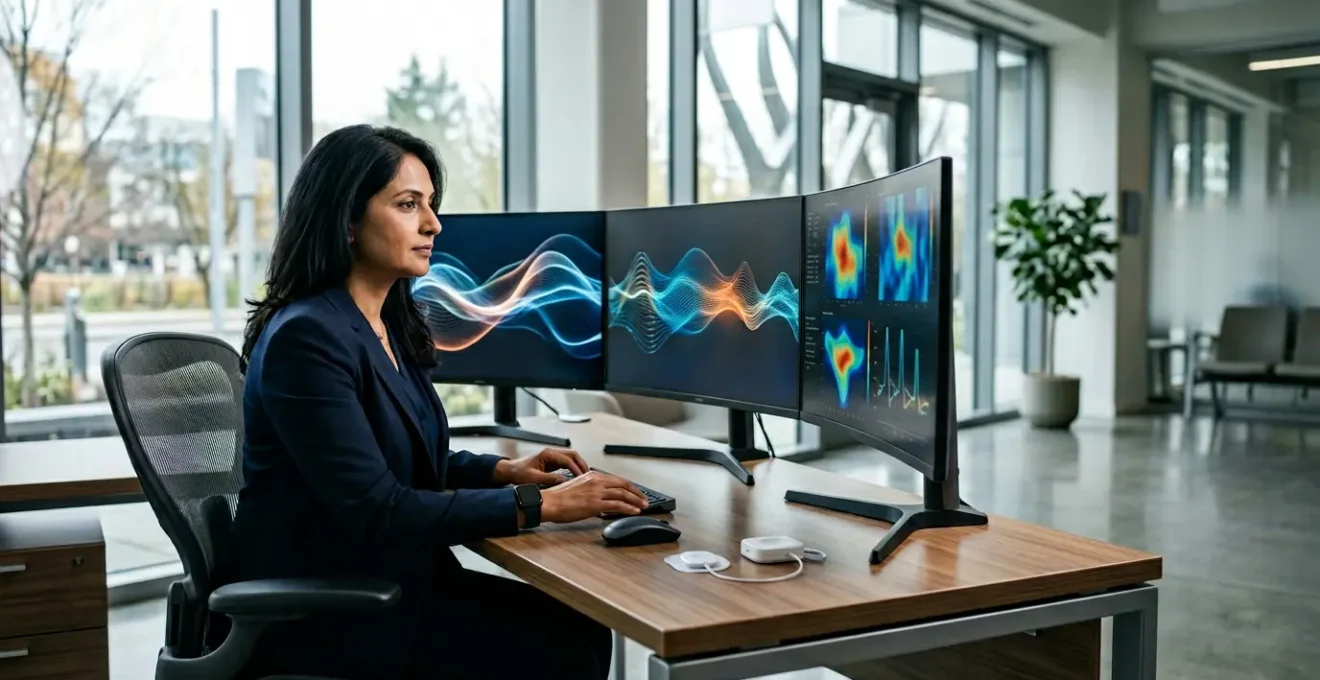
Integrating wearable ECG data isn’t a volume problem; it’s a data governance failure that leaves clinical teams drowning in low-quality noise.
- Most « noise » from consumer devices stems from predictable technical limitations, such as single-lead sensors and motion artifacts, which can be pre-filtered.
- A tiered alert system, managed by a « human firewall » of trained technicians, is essential to protect cardiologists from debilitating alarm fatigue.
Recommendation: Implement a robust data governance framework that qualifies, routes, and verifies every incoming signal *before* it ever reaches the EMR or a physician’s attention.
The scenario is increasingly familiar in cardiology departments: a patient arrives, not with a referral, but with a smartwatch ECG strip showing a potential arrhythmia. This flood of patient-generated health data (PGHD) promises a new era of proactive cardiac care but delivers a tidal wave of unverified, low-quality information that threatens to overwhelm clinical workflows. The common discussion revolves around buzzwords like ‘interoperability’ and ‘AI’, treating the issue as a technical problem of connecting pipes and analyzing a data deluge.
However, this perspective misses the fundamental point. The challenge isn’t merely managing a flood, but rather engineering a sophisticated dam with controlled, intelligent floodgates. The true solution lies in shifting from a reactive data management mindset to a proactive data governance framework. This framework treats incoming data not as an undifferentiated stream, but as a series of discrete signals to be qualified, verified, and routed based on clinical relevance and data provenance. Without this structure, even the most advanced AI tools will simply amplify the noise, leading to clinician burnout and potential diagnostic errors.
This guide provides a practical, workflow-oriented roadmap for cardiology and health IT leaders. We will deconstruct the technical reasons for data noise, outline a tiered alert system to protect clinical staff, navigate the critical interoperability and contractual pitfalls that trap data, and explore the financial models that make remote monitoring sustainable. The goal is to build a system that transforms wearable data from a liability into a powerful clinical asset.
This article provides a detailed breakdown of the strategies and technical considerations required to build a sustainable and clinically effective wearable data integration program. Explore the sections below to understand each critical component of this framework.
Summary: A Framework for Integrating Wearable ECG Data
- Why Consumer Wearables Generate 30% More False Positives Than Clinical Holters?
- How to Configure Remote Monitoring Alerts to Reduce Alarm Fatigue by 50%?
- Bluetooth vs. Cellular Transmission: Which is More Reliable for Rural Cardiac Patients?
- The Interoperability Mistake That Traps Patient Heart Data in Proprietary Apps
- When to Bill CPT Codes for Remote Cardiac Monitoring: A Guide for Private Practices
- The Patient Matching Error That Creates Dangerous Duplicate Medical Records
- Why AI Detects Silent Afib 24 Hours Earlier Than Standard Telemetry?
- How AI Algorithms Detect Clinical Cardiac Abnormalities That Human Eyes Miss?
Why Consumer Wearables Generate 30% More False Positives Than Clinical Holters?
The primary reason EMR integration projects fail is an underestimation of the « noise » generated by consumer-grade devices. Unlike clinical Holter monitors, which are designed for diagnostic specificity in a controlled context, consumer wearables are optimized for sensitivity to avoid liability. This leads to a significantly higher rate of false positives. In fact, recent validation research shows an 8% false positive rate for atrial fibrillation detection in some devices, a figure corroborated by other studies. This « noise » is not random; it stems from specific, predictable technical limitations.
Understanding these root causes is the first step in designing an effective signal qualification workflow. The key factors that differentiate consumer from clinical-grade data quality include:
- Single-lead ECG limitation: Most wearables use a single lead, providing a one-dimensional view of the heart’s electrical activity. This is in stark contrast to the 3-12 leads on clinical devices, which offer a multi-dimensional perspective necessary for accurate diagnosis.
- Motion artifact susceptibility: Wrist-worn devices are highly prone to interference from daily activities like typing or walking. The resulting noise can easily mimic arrhythmias, whereas chest-attached Holters remain relatively stable.
- Algorithm sensitivity trade-offs: To avoid missing a potentially serious event and facing liability, consumer device algorithms are intentionally biased towards high sensitivity, often at the expense of specificity.
- Electrode contact variability: Achieving consistent, high-quality skin contact with wrist-based electrodes or optical sensors is far more challenging than with the adhesive medical-grade electrodes used for Holter monitoring.
- User positioning errors: Simple mistakes like incorrect finger placement or poor arm posture during an ECG recording can introduce significant baseline wander and other artifacts that fool automated interpretation algorithms.
By recognizing that this noise is a product of device physics and design, not random chance, IT and clinical teams can build pre-processing filters that identify and flag low-quality signals based on these known artifact patterns, preventing them from ever triggering a clinical alert.
How to Configure Remote Monitoring Alerts to Reduce Alarm Fatigue by 50%?
Once you accept that a significant portion of wearable data will be noise, the next logical step is to prevent that noise from reaching clinicians. Unfiltered alerts are the direct cause of alarm fatigue, a dangerous condition where overwhelmed staff begin to ignore or disable alerts, leading to missed critical events. A robust data governance framework must include a multi-layered alert management system. The goal is not just to reduce alerts, but to ensure the right information gets to the right person at the right time.
This workflow moves away from a simple « alert/no alert » binary and toward a sophisticated, tiered approach. The visual below illustrates how data can be stratified and managed before ever reaching a cardiologist.
As shown, a dedicated team of cardiac data technicians acts as a « human firewall, » pre-screening non-critical events. This strategy is built on evidence-based practices designed to dramatically cut down on low-acuity alerts. Key configuration strategies include:
- Implement tiered alerting: Configure distinct levels for alerts. For example, « Informational » events are logged for review but trigger no notification, « Action Required » alerts are routed to a nurse or technician for verification, and only « Critical » alerts trigger an immediate physician notification.
- Customize alarm thresholds by population: One size does not fit all. For certain patient populations, adjusting SpO2 limits to 88% with a 15-second delay has been shown to reduce alarms by as much as 80% without clinical impact.
- Enable smart snooze logic: Repetitive, low-acuity alerts from the same patient within a defined timeframe should be temporarily suppressed to prevent staff desensitization.
- Set patient-specific dynamic thresholds: The system should be able to adjust alert parameters for an individual based on their unique clinical baseline, comorbidities, and recent history, making the alerts more meaningful.
This structured approach transforms the alert system from a source of constant interruption into a valuable clinical decision support tool, protecting your most valuable resource: your clinicians’ attention.
Bluetooth vs. Cellular Transmission: Which is More Reliable for Rural Cardiac Patients?
The reliability of your remote monitoring program is only as strong as its weakest link: data transmission. For patient populations in rural areas or « data deserts » with inconsistent connectivity, the choice between Bluetooth-dependent and cellular-enabled devices is a critical strategic decision with significant workflow implications. There is no single best answer; the optimal choice depends on patient demographics, technical proficiency, and program scale.
Bluetooth devices are typically lower-cost and have better battery life but introduce a significant point of failure: the patient’s smartphone. They require proximity to a paired phone with a data connection, and troubleshooting pairing issues can be a major support burden. Cellular devices, while more expensive and power-hungry, offer « zero-touch » activation and operate independently, transmitting data whenever they have a network signal. This simplifies deployment and fleet management significantly. The following comparison, based on recent analysis of medical device integration, breaks down the key trade-offs.
| Factor | Bluetooth | Cellular |
|---|---|---|
| Coverage in Data Deserts | Requires smartphone proximity (30 feet) | Works independently with network coverage |
| Data Buffering Capability | Limited to device memory (typically 7-14 days) | Continuous transmission when connected |
| Battery Life Impact | Low power consumption (weeks of use) | High drain (daily charging needed) |
| Setup Complexity | Requires pairing troubleshooting | Zero-touch activation |
| Total Cost (Device + Service) | Lower (no monthly fees) | Higher ($30-50/month data plans) |
| Fleet Management Scale | Complex individual pairing | Centralized remote management |
For health systems managing large-scale RPM programs for post-surgical or chronic care patients in rural settings, cellular devices often provide a more reliable and scalable solution despite the higher upfront cost. The reduction in support calls for pairing issues and the assurance of continuous data flow can outweigh the monthly data fees. For smaller practices or more tech-savvy patient groups, the cost savings of Bluetooth devices may be more attractive, provided the institution has a clear workflow for managing connectivity-related data gaps.
The Interoperability Mistake That Traps Patient Heart Data in Proprietary Apps
True interoperability is not just about getting data from a device to an EMR; it’s about ensuring you have legal and technical ownership of that data in a usable, standardized format. The single biggest mistake health systems make is signing contracts with wearable vendors without scrutinizing the data access clauses. This leads to data lock-in, where patient ECGs are trapped in the vendor’s proprietary application, and the EMR only receives a simplified, often unbillable, summary. With 33% of US adults now use wearables for health tracking, the scale of this trapped data problem is massive.
To prevent this, IT and legal teams must work together to ensure that vendor contracts explicitly guarantee the health system’s rights to the raw data. Your data governance framework must extend to procurement and contracting, treating data as a strategic asset. Before signing any agreement, your team must have a clear plan for data extraction, standardization, and integration. This requires a proactive approach to defining your technical and legal rights from the outset.
Action Plan: Key Contract Clauses to Prevent Cardiac Data Lock-In
- Data Ownership Clause: Explicitly state that all patient-generated cardiac data remains the property of the healthcare institution, not the vendor.
- Raw Data Export Rights: Mandate access to full, high-fidelity ECG waveform data in standard formats like HL7 or DICOM, not just interpreted PDF summaries.
- API Documentation Requirements: Require the vendor to provide comprehensive, versioned API documentation and a sandboxed testing environment for your integration team.
- Bi-directional Data Flow: Ensure the system architecture allows your EMR to push relevant clinical context (e.g., medications, diagnoses) to the vendor’s platform to inform their algorithms.
- Termination Data Transfer: Include a provision that guarantees the complete, bulk export of all patient data in a non-proprietary format within 30 days of contract termination.
By embedding these requirements into your procurement process, you shift the power dynamic. Instead of being a passive recipient of whatever data a vendor chooses to share, you become an active owner of a valuable clinical data stream, free to use it across different platforms and for future research and analytics initiatives.
When to Bill CPT Codes for Remote Cardiac Monitoring: A Guide for Private Practices
A remote monitoring program is only sustainable if it is financially viable. For private practices and health systems, this means establishing a meticulous workflow for documenting activities that correspond to specific Current Procedural Terminology (CPT) codes for remote patient monitoring (RPM). Simply collecting data is not a billable event; reimbursement depends on demonstrating that the data was reviewed, interpreted, and used for clinical decision-making.
Optimizing reimbursement requires a workflow that creates a clear and defensible audit trail. This involves integrating time-tracking and documentation directly into the data review process. The image below symbolizes the careful organization and time-stamping required for successful billing.
As third-party platforms have shown, standardizing this workflow is key to maximizing revenue and improving outcomes. The process must differentiate between general RPM codes and more specific cardiac monitoring codes. A well-designed workflow ensures every billable minute is captured.
A step-by-step process for compliant CPT coding should include:
- Initial Setup (CPT 99453): Document the one-time event of device setup and patient education on its use.
- Data Transmission (CPT 99454): Track and confirm that a minimum of 16 days of data were transmitted within a 30-day period.
- Clinical Staff Time (CPT 99457): Record at least 20 minutes of time spent by clinical staff reviewing and managing the data within a calendar month.
- Additional Time (CPT 99458): For complex cases, document each additional 20-minute increment of clinical staff time.
- Patient Communication: Create a clear audit trail showing interactive communication with the patient (e.g., phone call, portal message) regarding the data and any necessary actions.
- Code Differentiation: Ensure billers correctly distinguish between general RPM codes (99453, 99454, 99457, 99458) and specific long-term cardiac monitoring codes (e.g., 93297-93299 for implantable devices).
By building these documentation steps directly into the EMR or monitoring platform, practices can ensure compliance and capture revenue that is often lost due to poor record-keeping, making the entire program financially sound.
The Patient Matching Error That Creates Dangerous Duplicate Medical Records
The most dangerous and costly error in EMR integration is patient misidentification. When incoming wearable data is incorrectly matched to the wrong patient—or creates a duplicate record for an existing patient—it can lead to catastrophic clinical decisions based on faulty data. This problem is exacerbated by data streams originating outside the hospital’s direct control, where patient names might be misspelled or demographic data is incomplete. A robust data governance framework must include a stringent, multi-factor patient identity protocol.
Relying on a single identifier like a patient’s name or date of birth is insufficient. A modern integration engine must use a probabilistic matching algorithm that weighs multiple factors to create a unique « patient identity fingerprint. » According to healthcare technology assessments, real-time ECG integration reduces diagnostic delays, but this benefit is nullified if the data is assigned to the wrong chart. The system must be designed to « fail safely » by quarantining any data that cannot be matched with a high degree of confidence.
An effective patient matching protocol should incorporate several layers of validation:
- Create a Patient Identity « Fingerprint »: Combine the EMR’s Master Patient Index (MPI), the unique ID of the wearable device, and the patient’s smartphone identifier to create a composite key that is highly unique.
- Establish an Unmatched Data Queue: Any incoming data that doesn’t meet a high-confidence match threshold (e.g., 95%) should be automatically routed to a dedicated review queue for a data steward to resolve manually.
- Deploy Probabilistic Matching: Use an algorithm that weighs multiple demographic fields (DOB, MRN, phone number, address) and device identifiers to calculate a match score, rather than relying on exact matches for all fields.
- Implement Known Alias Synchronization: Regularly synchronize all known name variations (e.g., « Bill » for « William ») from the EMR’s MPI to the wearable integration platform to improve match rates.
- Define a Manual Reconciliation Workflow: Assign clear roles and responsibilities to data stewards for investigating and resolving ambiguous matches within a defined timeframe (e.g., 72 hours) before data is archived.
This rigorous approach ensures that data not only flows into the EMR but flows into the *correct* patient record, preserving data integrity and patient safety.
Why AI Detects Silent Afib 24 Hours Earlier Than Standard Telemetry?
Artificial intelligence is not magic; it is mathematics and massive data sets. The reason AI-powered algorithms in wearables can detect conditions like silent atrial fibrillation (Afib) earlier than traditional methods is their ability to perform continuous, tireless vigilance at a scale no human team can match. While standard telemetry might involve periodic reviews of ECG strips, a wearable AI algorithm analyzes every single heartbeat, 24/7, looking for subtle patterns that precede a clinical event.
This continuous monitoring capability is particularly effective for paroxysmal Afib, which occurs sporadically and is often missed during a 24-hour Holter study or a brief hospital stay. The wearable device acts as a long-term sentinel, waiting to catch an event. The efficacy of this approach was famously demonstrated in large-scale studies. For example, the landmark Apple Heart Study revealed that 84% of irregular pulse notifications were confirmed as atrial fibrillation on subsequent clinical evaluation. This high positive predictive value is a direct result of the algorithm’s ability to analyze vast amounts of data over time.
Furthermore, AI models are trained on millions of ECG recordings, allowing them to recognize the faint, pre-symptomatic signatures of an impending arrhythmia. They can detect subtle changes in heart rate variability or an increase in premature atrial contractions (PACs) that, while not clinically significant on their own, are known precursors to Afib. A human reviewer might dismiss these as noise or minor fluctuations, but an AI algorithm, having seen this pattern thousands of times before in its training data, can flag it as a risk factor for an event in the next 24-48 hours. This predictive capability, born from continuous analysis and pattern recognition at scale, is what gives AI its edge in early detection.
Key Takeaways
- Data governance is more critical than data volume. A framework to qualify, route, and verify signals is the foundation of a successful program.
- Protect clinicians from alarm fatigue with a tiered alert system and a « human firewall » of trained technicians to pre-screen data noise.
- Prevent data lock-in by embedding raw data export rights and adherence to standards like FHIR directly into vendor contracts.
How AI Algorithms Detect Clinical Cardiac Abnormalities That Human Eyes Miss?
While early detection of known conditions like Afib is a major benefit of AI, its true power lies in its ability to perceive patterns in ECG data that are physiologically significant but literally invisible to the human eye. Cardiologists are trained to recognize morphological patterns and rhythm abnormalities based on decades of established clinical knowledge. AI operates on a different level, using mathematical and statistical analysis to uncover subtle, sub-perceptual markers of cardiac dysfunction.
These capabilities go far beyond simply automating what a human can do. AI can analyze relationships between data points at a speed and precision that is biologically impossible for a person. It is in this « super-human » analysis that the next generation of cardiac diagnostics is being born. The system is not just faster; it is seeing the heart in a fundamentally new way.
Some of the key AI capabilities that extend beyond human interpretation include:
- Micro-variability analysis: AI can analyze beat-to-beat interval changes with sub-millisecond precision. This allows it to detect subtle shifts in autonomic nervous system tone that are predictive of cardiac events but are far too small for a human to see on a standard ECG grid.
- Fractal dimension calculation: Algorithms can identify complex, repeating mathematical patterns in heart rate variability over time. A loss of this « fractal » complexity is a powerful marker of autonomic dysfunction and increased mortality risk, a concept that is purely mathematical.
- Multi-sensor fusion: Advanced AI models correlate ECG data with simultaneous inputs from accelerometers (patient activity), SpO2 sensors (oxygenation), and even skin temperature to build a more holistic, hemodynamic assessment rather than just an electrical one.
- Atypical signature recognition: Trained on millions of examples, AI can identify novel or highly atypical arrhythmia signatures that do not fit textbook patterns but are statistically correlated with adverse outcomes, effectively discovering new diagnostic markers.
– Overnight vigilance: AI can tirelessly monitor nocturnal ECG recordings for sleep-related arrhythmias or ST-segment changes that are often missed during standard daytime reviews but are critical for diagnosing conditions like sleep apnea-induced cardiac stress.
Integrating these capabilities requires a new mindset. It’s not about replacing cardiologists but about augmenting them with a new kind of « microscope » that can see the hidden mathematical and statistical realities of cardiac function.
Ultimately, a successful wearable ECG integration strategy is not a single IT project but a continuous program of clinical, technical, and financial governance. It requires moving beyond reactive problem-solving and establishing a framework that anticipates challenges and builds resilience into the workflow. By treating data with discipline—from contractual ownership and patient matching to signal qualification and tiered alerting—health systems can harness the power of this technology without succumbing to its noise. Begin by auditing your current data intake process against this framework to identify critical gaps and build a more resilient and clinically valuable remote monitoring program.