In summary:
- Electrical interference is not random; it’s physics. Mastering its sources, like ventilator power supplies, is the first step to a clean signal.
- Consumables are active components. The choice between wet and solid gel electrodes and a strict cable lifecycle protocol directly impacts signal fidelity.
- Advanced techniques, such as the Mason-Likar placement for obese patients and standardized « Golden Configuration » for calibration, are essential for consistent accuracy.
- Systematic protocols for managing hardware and incoming data are critical to prevent alert fatigue and physician burnout.
In the controlled chaos of an Intensive Care Unit (ICU), a clean, stable electrocardiogram (ECG) is not a luxury—it’s a lifeline. Yet, for any Biomedical Equipment Technician (BMET) or ICU clinician, the all-too-familiar sight of a wandering baseline, a snowy trace, or a cascade of false alarms is a constant source of frustration. We’re told to check the basics: re-gel the electrode, check the expiration date, ensure good skin prep. While essential, these steps often feel like applying a band-aid to a problem that requires surgical precision.
The ICU is an electromagnetically hostile environment. Between ventilators, infusion pumps, and other high-power equipment, the diagnostic signal we’re trying to capture is often drowned out by a sea of noise. The standard troubleshooting checklist is a starting point, but it’s insufficient for the complex challenges we face. It’s easy to blame patient movement or a faulty monitor, but what if the real culprits are more subtle and systematic?
This guide moves beyond the basics. We will not rehash the common knowledge. Instead, we will adopt an engineering mindset to deconstruct the core challenges to ECG signal fidelity in the ICU. The real key to a pristine trace lies not just in troubleshooting alerts, but in mastering the physics of interference, the material science of consumables, and the lifecycle management of every component in the signal chain. It’s a game of inches, where understanding the ‘why’ behind the artifact is the only way to implement a definitive ‘how’ to fix it.
This article provides a detailed, technician-focused approach to mastering ECG signal acquisition. We will explore the specific challenges posed by common ICU equipment and patient populations, and provide evidence-based protocols to systematically improve signal quality and diagnostic accuracy.
Summary: How to Ensure Accurate Electrical Heart Activity Measurement in High-Interference ICU Environments?
- Why Electrical Interference from Ventilators Distorts ECG Readings in the ICU?
- How to Position Electrodes on Obese Patients for Clear Signal Capture?
- Wet Gel vs. Solid Gel Electrodes: Which Maintains Conductivity Longer for 24h Monitoring?
- The Cable Maintenance Oversight That Causes Intermittent Signal Loss During Codes
- How to Calibrate ECG Machines to AHA Standards Across Multiple Hospital Sites?
- Why Consumer Wearables Generate 30% More False Positives Than Clinical Holters?
- The Ferromagnetic Detection Oversight That Leads to Projectile Accidents
- How to Integrate Wearable ECG Data into EMRs Without Overloading Cardiologists?
Why Electrical Interference from Ventilators Distorts ECG Readings in the ICU?
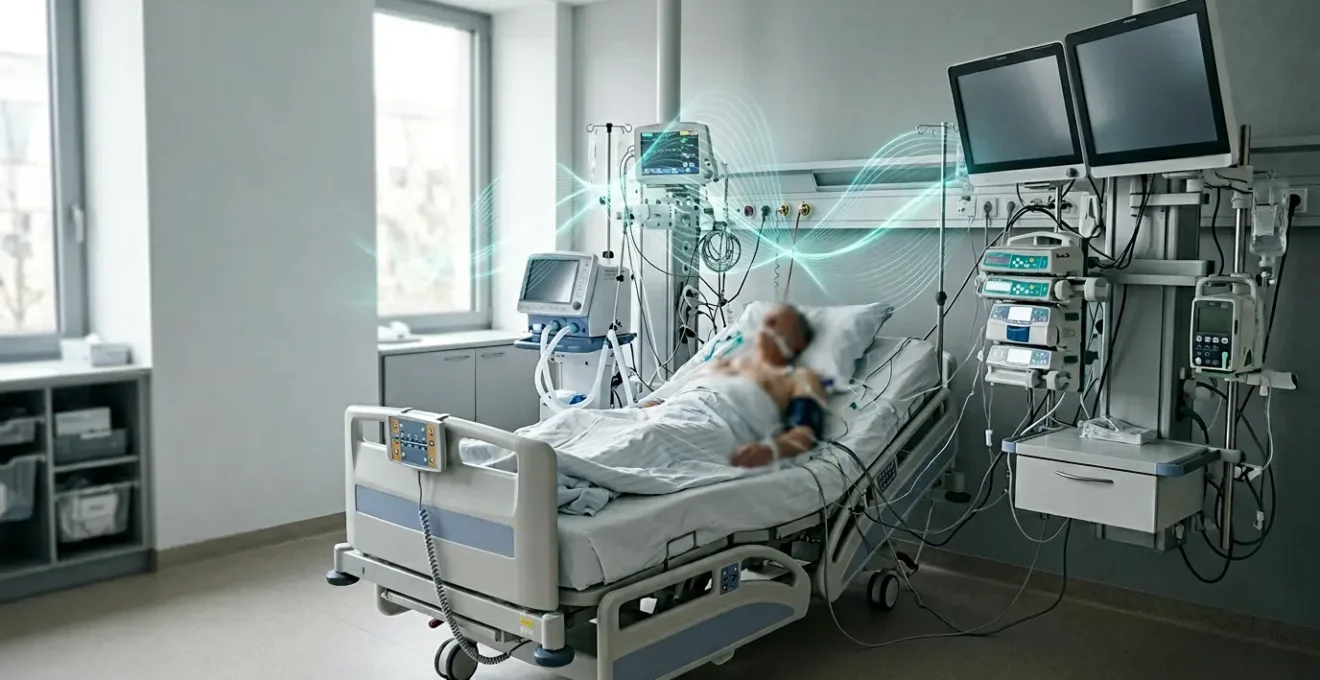
The most common and frustrating source of ECG artifact in the ICU is the 60 Hz (or 50 Hz in many countries) hum emanating from AC power lines. While all powered devices contribute to this electromagnetic interference (EMI), ventilators are often the primary culprits due to their high-power motors and proximity to the patient. The motor’s power supply creates a strong electromagnetic field that can induce a current in the ECG leads, superimposing a perfectly regular, « picket-fence » artifact onto the physiological signal. This isn’t random noise; it’s a specific physical phenomenon.
The physiological ECG signal is incredibly faint, measured in millivolts. The electrical noise from a ventilator, however, can be orders of magnitude stronger. Research shows that ventilator-induced electromagnetic interference can generate oscillations at 3,600 times per minute, perfectly masking or mimicking cardiac arrhythmias and leading to false alarms. The monitor’s notch filter is designed to remove this specific frequency, but a strong interference source can easily overwhelm it, resulting in a distorted waveform that is clinically useless.
Thinking in terms of the bed space’s electromagnetic topography is key. The strength of EMI decreases with the square of the distance from the source. Therefore, a core troubleshooting strategy is physical separation. Routing ECG lead wires, particularly the patient cable, directly over or bundled with a ventilator’s power cord is a guaranteed recipe for signal degradation. A systematic approach to equipment placement, creating a « safe zone » for sensitive monitoring cables, is a non-negotiable first step in engineering better signal fidelity.
How to Position Electrodes on Obese Patients for Clear Signal Capture?
Acquiring a clean ECG signal on obese or bariatric patients presents a unique set of challenges rooted in basic electrical principles. Adipose tissue (body fat) has a much higher electrical impedance than muscle or other tissues, acting as an insulator that weakens the cardiac signal before it even reaches the electrode. Furthermore, standard anatomical landmarks can be obscured or displaced, making traditional electrode placement unreliable. Simply placing electrodes on the chest can result in a faint, noisy signal that is highly susceptible to motion artifact as the electrodes shift on the soft tissue.
This paragraph introduces the challenge and prepares for a specific, advanced technique. To overcome this, technicians must move beyond standard placement and adopt specialized methods. The Mason-Likar 12-lead limb lead modification is a well-established and highly effective technique for this population. Instead of placing the limb leads on the extremities, they are moved to the torso: the arm electrodes are placed in the left and right infraclavicular fossae, and the left leg electrode is positioned on the lower left abdomen. This placement puts the electrodes over areas with less adipose tissue and closer to the heart, significantly improving signal strength.
As the image suggests, for even greater precision in locating optimal sites with minimal subcutaneous fat, some advanced centers use bedside ultrasound. This allows the technician to visualize the tissue layers and place the electrode directly over areas with better muscle proximity, ensuring the lowest possible impedance mismatch. While not always practical, it highlights the principle: for bariatric patients, successful ECG acquisition is about finding a clearer, more direct electrical path to the heart.
Wet Gel vs. Solid Gel Electrodes: Which Maintains Conductivity Longer for 24h Monitoring?
The choice of ECG electrode is not a trivial supply chain decision; it’s a critical engineering choice that directly impacts signal stability, especially for monitoring durations exceeding a few hours. The two primary types, wet gel and solid gel electrodes, have distinct performance characteristics that a BMET must understand. Wet gel electrodes contain a liquid electrolyte that provides very low initial skin impedance, often resulting in an excellent initial trace. However, this same liquid consistency makes them prone to drying out and to « gel bridging, » where sweat or pressure causes the gel to spread and short-circuit adjacent electrodes, creating a flat line artifact.
Solid gel electrodes, conversely, use a more stable, conductive adhesive polymer. While they may have a slightly higher initial impedance, their performance over time is far more consistent. They are less susceptible to drying out and the risk of gel bridging is minimal, making them superior for long-term monitoring (24-72 hours). The data, as highlighted in a comparative analysis from the American Heart Association, clearly illustrates this trade-off.
| Parameter | Wet Gel Electrodes | Solid Gel Electrodes |
|---|---|---|
| Initial Impedance | 5-10 kΩ | 10-15 kΩ |
| Impedance at 24h | 20-40 kΩ | 12-18 kΩ |
| Impedance at 48h | 50-100 kΩ | 15-25 kΩ |
| Gel Bridging Risk | High in diaphoretic patients | Minimal |
| Cost per electrode | $0.25-0.50 | $1.00-2.00 |
| Signal Stability | Degrades after 12-16 hours | Stable for 48-72 hours |
For a BMET, the key takeaway is clear: while wet gel electrodes may be cheaper and suitable for short-term diagnostics like a 10-second stat ECG, they are a poor choice for continuous ICU monitoring. The gradual increase in impedance of wet gel electrodes is a primary cause of deteriorating signal fidelity over a 24-hour period. Standardizing on solid gel electrodes for all long-term monitoring applications is a proactive step that can drastically reduce artifact-related service calls and improve diagnostic reliability.
The Cable Maintenance Oversight That Causes Intermittent Signal Loss During Codes
During a code blue, the last thing anyone needs is an intermittent or lost ECG signal. When this happens, the monitor is often blamed, but a far more common culprit is hiding in plain sight: the patient cable and lead wires. These components are subjected to constant stress—they are rolled over by carts, cleaned with harsh chemicals, and tightly coiled for storage. This abuse leads to micro-fractures in the internal conductors, creating an intermittent connection that may only fail under specific conditions, like patient movement or the chaos of a resuscitation effort.
This is not an anecdotal problem; it is a well-documented hardware failure mode. In fact, studies on hospital ECG monitoring equipment reveal that up to 40% of ECG cables show micro-fractures after 2 years of typical use. This is a staggering failure rate for a critical diagnostic tool. The solution is not to simply replace cables when they fail, but to implement a proactive Cable Lifecycle Management protocol. This shifts the perspective from viewing cables as disposable supplies to treating them as a critical piece of capital equipment with a defined service life.
A robust protocol involves regular testing, proper care, and scheduled replacement. Instead of waiting for a catastrophic failure during a critical event, a lifecycle approach identifies and retires aging cables before they can compromise patient care. This systematic approach is a cornerstone of maintaining high signal fidelity across an entire facility.
Your Action Plan: Cable Lifecycle Management Protocol
- Test cable continuity monthly using a multimeter. The end-to-end resistance for each lead wire should be consistently less than 5 ohms. Any reading higher or that fluctuates with wiggling indicates internal damage.
- Implement a color-coded tagging system for service age: Green (new-1 year), Yellow (1-2 years), and Red (2+ years). All red-tagged cables should be scheduled for replacement, regardless of function test results.
- Ensure proper cleaning techniques are used. Only use 70% isopropyl alcohol. Avoid quaternary ammonium compounds, which can degrade the cable jacket and make it brittle.
- Educate staff on proper storage. Cables should always be stored in loose loops, never tightly coiled, kinked, or wrapped around the monitor, which stresses the connectors.
- Maintain a log for each trunk cable, documenting its in-service date and replacement schedule in the equipment management database.
How to Calibrate ECG Machines to AHA Standards Across Multiple Hospital Sites?
Ensuring that every ECG monitor in a health system performs identically is a monumental task, but it’s essential for consistent patient care. The American Heart Association (AHA) provides clear standards for monitor configuration, but drift can occur due to software updates, user-made changes, or inconsistent service procedures. A monitor in the ED having a different QRS alarm sensitivity or filter setting than one in the ICU can lead to missed events or a deluge of nuisance alarms, contributing to alarm fatigue.
The key to multi-site standardization is moving away from device-by-device manual calibration to a centralized, protocol-driven approach. Top-performing healthcare networks have successfully implemented a « Golden Configuration » protocol. This involves creating a single, evidence-based, expert-approved configuration file that aligns with AHA standards for filter settings (e.g., 0.05-150 Hz for diagnostic mode), gain adjustments (10 mm/mV), and alarm parameters. This master file is then pushed to every compatible monitor in the network, often using cloud-based management tools. This approach has been shown to achieve over 95% compliance with standards across multiple hospitals, ensuring a patient’s ECG looks the same regardless of their location within the system.
This level of standardization is crucial because, as the American Heart Association points out in its practice standards, the algorithms are intentionally designed for a specific balance of sensitivity and specificity. As they state in the Practice Standards for Electrocardiographic Monitoring in Hospital Settings:
Cardiac monitor algorithms are intentionally set for high sensitivity at the expense of specificity. As a result, numerous false alarms occur that must be evaluated by healthcare professionals.
– American Heart Association
By ensuring every monitor adheres to the Golden Configuration, we ensure that this « high sensitivity » is at least consistent and predictable. This allows clinical staff to develop a reliable mental model for alarm response and helps BMETs troubleshoot deviations from a known, trusted baseline. It transforms calibration from a periodic task into a continuous quality assurance process.
Why Consumer Wearables Generate 30% More False Positives Than Clinical Holters?
The rise of consumer wearables with ECG capabilities has created a new stream of data and a new set of challenges. While these devices can be valuable for screening, clinicians frequently report a higher rate of false positives for conditions like atrial fibrillation compared to traditional clinical Holter monitors. The statistic that they can generate over 30% more false positives isn’t just a number; it’s the result of fundamental engineering and design trade-offs.
First and foremost is the difference in data acquisition. A clinical 12-lead ECG or a multi-channel Holter monitor captures the heart’s electrical activity from multiple vectors, providing a rich, three-dimensional view. Most consumer wearables, by contrast, function as a single-lead ECG (typically Lead I). This single perspective is more susceptible to misinterpretation. A P-wave that is clearly visible in Lead II on a Holter might be nearly invisible in Lead I on a watch, causing an algorithm to misclassify the rhythm.
Second is the hardware itself. Clinical Holters use high-fidelity, wet or solid gel electrodes with robust skin preparation to ensure a low-impedance connection. Wearables rely on dry, stainless steel or titanium contacts that have inherently higher skin impedance and are far more sensitive to poor contact, skin moisture, and patient movement. Their signal processing algorithms are heavily optimized to filter out motion artifact, but this aggressive filtering can sometimes distort the underlying ECG morphology, leading to diagnostic errors.
Finally, the diagnostic algorithms in consumer devices are tuned for high sensitivity to avoid missing a potential event, often at the cost of specificity. They are designed for a lay user and an uncontrolled environment. Clinical Holter analysis, on the other hand, is typically reviewed by a certified technician or cardiologist who can apply clinical context and distinguish a true arrhythmia from a motion-induced artifact, a skill the consumer algorithm has yet to master. Understanding these trade-offs is crucial for clinicians and technicians asked to interpret this new wave of data.
The Ferromagnetic Detection Oversight That Leads to Projectile Accidents
While the primary focus of this guide is on electrical signal fidelity, a critical aspect of patient monitoring involves safe transport to and from diagnostic areas, particularly the MRI suite. An oversight in this process doesn’t just lead to a bad signal; it can lead to catastrophic projectile accidents. The powerful magnetic field of an MRI scanner can turn any unsecured ferromagnetic object—an oxygen tank, an IV pole, or even a forgotten telemetry pack in a patient’s gown—into a high-velocity missile.
The term « MR-Safe » is often misunderstood. It does not mean an item is invisible to the magnet; it means it is non-metallic and poses no risk. « MR-Conditional, » however, means an item is safe only under very specific conditions (field strength, position). Many ECG electrodes and lead wires are MR-Conditional, but their cables can still heat up to dangerous levels (thermal burns) if not routed correctly as specified by the manufacturer. A critical oversight is assuming any equipment used in the ICU is safe to bring into Zone IV (the magnet room).
To prevent these accidents, a « hard stop » protocol or a « Pre-MRI Safety Handshake » is essential. This is not just a checklist; it’s a formal, time-stamped, dual-signature verification between the ICU/transport staff and the MRI staff. Key verification points in such a protocol must include:
- Visual and physical confirmation of the removal of all non-essential equipment.
- Use of ferromagnetic detection wands on the patient and all equipment crossing the threshold, not just relying on visual inspection.
- Explicit verification that all remaining necessary items, like ECG electrodes, are not just « MR-Safe » but are the correct « MR-Conditional » model for the specific scanner’s field strength.
- Confirmation of the removal of all telemetry packs. These small devices contain batteries and ferromagnetic components and are a common source of projectile accidents when forgotten in a pocket or bedding.
This rigorous, multi-layered approach is the only way to mitigate the risk. A simple « Did you check for metal? » is insufficient. The process must be treated with the same gravity as a surgical timeout, because the consequences of an oversight are just as severe.
Key Takeaways
- Interference is physics, not random noise. Understanding the electromagnetic topography of the ICU bed space is the first step to mitigating it.
- Consumables are active components. The material science of electrodes and the physical integrity of cables are as critical as the monitor’s software.
- System-level protocols for calibration, maintenance, and data management are more effective than reactive, device-by-device troubleshooting.
How to Integrate Wearable ECG Data into EMRs Without Overloading Cardiologists?
The final frontier in cardiac monitoring is not just acquiring a clean signal, but managing the sheer volume of data being generated, particularly from consumer wearables. The challenge is no longer a technical one of signal acquisition, but a systemic one of data integration and workflow management. If every single-lead ECG strip from every patient’s smartwatch is dumped directly into the Electronic Medical Record (EMR) for physician review, the result is predictable: an unmanageable data deluge that dramatically increases cardiologist workload and leads to burnout.
A brute-force approach is doomed to fail. The solution, much like the « Golden Configuration » for monitors, lies in a systematic, tiered workflow. Instead of sending all data to the most expensive resource (the cardiologist), a triage system can filter and escalate events intelligently. A major healthcare system demonstrated the power of this approach by implementing a three-tier review system. In their model, AI algorithms perform the initial pre-screening of all incoming wearable ECG data, flagging any strips that meet criteria for potential arrhythmia. This first pass filters out the vast majority of normal readings.
In the second tier, the AI-flagged events are reviewed by a dedicated team of cardiac nurses or certified technicians who are trained to distinguish true arrhythmias from common artifacts. They apply a human layer of validation, discarding obvious false positives and annotating the clinically relevant strips. Through this process, only the most complex or concerning cases—a small fraction of the original total—are escalated to the third tier: the cardiologist. A study on this workflow showed it can reduce the data burden on physicians by as much as 85% while maintaining high diagnostic accuracy.
This intelligent workflow transforms an overwhelming stream of raw data into a manageable flow of actionable clinical information. It ensures that expert human oversight is applied where it’s needed most, preventing both physician burnout and the risk of a critical event being lost in the noise. It’s a model of how to engineer not just signal fidelity, but workflow fidelity.
To implement these advanced protocols and truly engineer signal fidelity in your facility, the logical next step is to conduct a full audit of your current equipment, consumables, and maintenance schedules. Evaluate your procedures against these evidence-based best practices today.