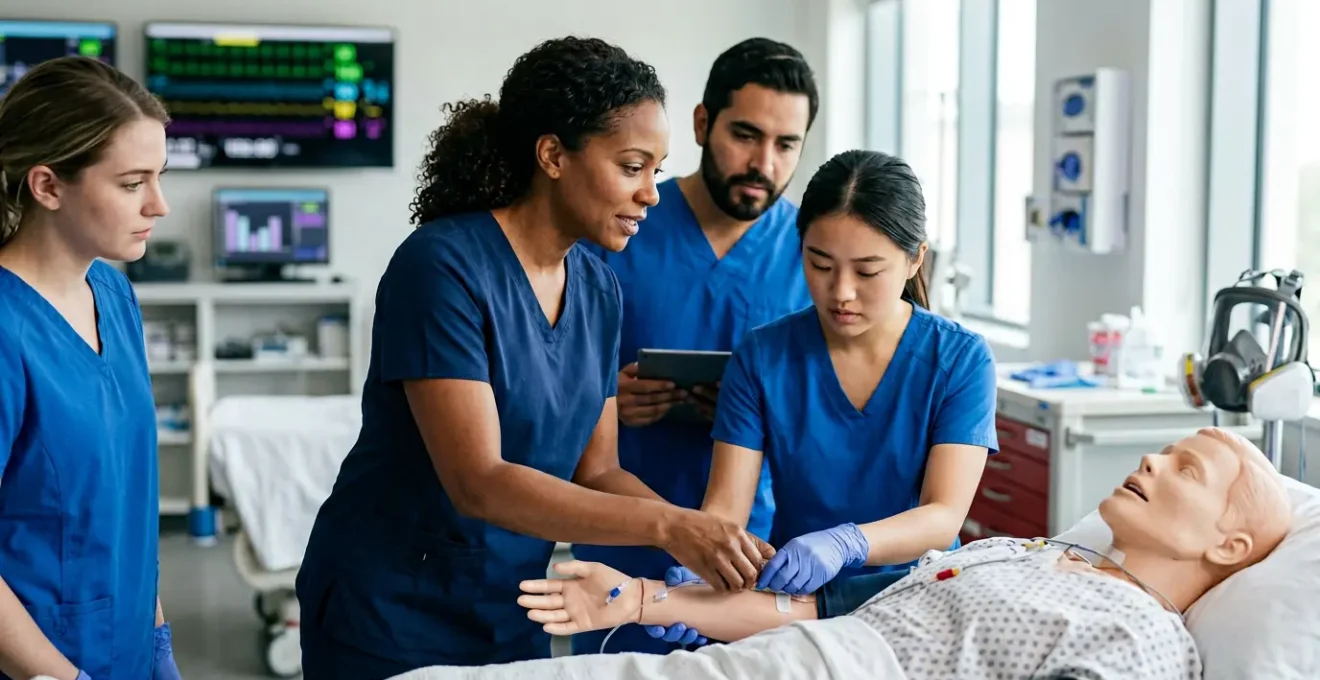
Achieving measurable improvements in clinical outcomes requires shifting from traditional, event-based training to a system of continuous, workflow-embedded learning.
- Traditional lectures fail because they create high « learning friction » and don’t fit into the clinical workflow.
- Modern tools like micro-learning apps, in-situ simulation, and on-demand video drastically improve knowledge retention and skill transfer by reducing cognitive load.
Recommendation: Audit your current educational programs for sources of learning friction and replace them with high-yield, asynchronous resources that support clinicians at the point of care.
For medical education directors and hospital training coordinators, the ultimate goal is not just to disseminate information but to tangibly improve clinical outcomes. Yet, many continuing medical education (CME) programs fall short of this objective. We invest heavily in expert lectures, comprehensive seminars, and detailed learning modules, only to see minimal change in physician behavior and patient results. The common response is to refine the existing model: create more interactive presentations, add more case studies, or update the content more frequently. These are the standard platitudes of instructional design.
But what if the fundamental model is flawed? The core issue isn’t the quality of the content but the high learning friction associated with its delivery. Clinicians operate in a high-stress, time-scarce environment. Expecting them to disengage from their workflow for lengthy, scheduled training sessions is a systemic error. The true key to unlocking a 15% or greater improvement in clinical outcomes lies in a paradigm shift: moving away from event-based education and toward engineering a system of continuous, asynchronous learning that is seamlessly embedded into the clinical workflow.
This article provides a strategic framework for this transformation. We will deconstruct why traditional methods fail and explore practical, evidence-based strategies to build educational programs that drive real, measurable behavioral change. By focusing on reducing cognitive load, leveraging modern technology, and optimizing the learning process itself, you can create a training ecosystem that not only educates but also empowers clinicians and directly combats burnout.
This guide will navigate through the critical components of modern medical education design. From establishing low-cost simulation environments to selecting the right digital tools, each section provides actionable insights to help you build a more effective and engaging learning culture.
Summary: A Practical Guide to High-Impact Medical Education
- Why Traditional Lecture-Based CME Fails to Change Physician Behavior?
- How to Set Up a Low-Cost Clinical Simulation Lab for Nursing Staff?
- LMS or Micro-Learning App: Which Tool Engages Millennial Residents Better?
- The Training Frequency Error That Leads to Staff Burnout and Disengagement
- How to Pair Junior Residents with Mentors for Maximum Skill Transfer?
- How to Certify Surgeons on Robotic Consoles in Under 3 Months?
- How to Achieve Competency in Cardiac POCUS with a 2-Day Intensive Course?
- How Optimization of Workforce Flow Using RTLS Prevents Staff Burnout?
–
Why Traditional Lecture-Based CME Fails to Change Physician Behavior?
The cornerstone of traditional Continuing Medical Education (CME) has long been the lecture. However, its effectiveness in altering established clinical practice is notoriously low. The primary reason is not a lack of quality content, but the inherent structure of the format, which creates immense learning friction for busy clinicians. A one-hour lecture demands a complete disengagement from patient care, creating a significant opportunity cost. This model fundamentally misunderstands the reality of clinical work, where attention is fragmented and time is the most valuable commodity.
Furthermore, the passive nature of lectures leads to poor knowledge retention. The « forgetting curve » is steep; without immediate application or reinforcement, the vast majority of information is lost within days. This passive learning model fails to create the deep, procedural memory required to change ingrained habits. True behavioral change requires active recall and practice, elements that are absent in a standard lecture hall setting. It treats education as a one-time event rather than a continuous process.
A more effective approach focuses on delivering high-yield information in a format that respects the clinician’s time and cognitive load. For instance, a study on increasing the dissemination of heart failure management guidelines found that a simple, 3-minute YouTube video presented to clinical staff served as an effective tool. This « micro-learning » strategy delivers essential knowledge precisely and efficiently, allowing it to be consumed during brief moments of downtime without disrupting the clinical workflow. It replaces the high-friction, hour-long commitment with a low-friction, high-impact learning moment.
The goal, therefore, is not to create better lectures, but to dismantle the lecture-based paradigm in favor of a system that provides workflow-embedded learning. By breaking down complex topics into digestible, on-demand assets like short videos, we can deliver the right information at the right time, dramatically increasing the likelihood of adoption and genuine behavioral change.
How to Set Up a Low-Cost Clinical Simulation Lab for Nursing Staff?
Clinical simulation is a powerful tool for building competency and improving patient safety, but the perception of high cost often deters hospitals from implementing it. The key to a low-cost simulation lab is to move away from dedicated, high-fidelity centers and embrace in-situ simulation. This approach involves conducting training directly in the actual clinical environment—a patient room, an ICU, or an emergency bay—using the equipment and resources already present.
This paragraph introduces the concept of in-situ simulation. To understand its practical application, it’s helpful to visualize the environment. The illustration below shows how an actual patient room can be transformed into a dynamic training space with minimal additional investment.
As this image demonstrates, the focus is on realism and process, not expensive technology. By using existing hospital beds, monitors, and medical carts, the training directly replicates the challenges of the real environment. This method not only reduces costs but also helps teams identify latent safety threats in their own workspace, such as misplaced equipment or unclear protocols. The primary investment shifts from technology to the faculty’s time in designing and facilitating realistic scenarios, such as a code blue or a sepsis alert, using low-fidelity manikins or even standardized patients (actors).
To start, identify a « simulation champion » within the nursing staff and begin with simple, high-frequency scenarios. The goal is to build a culture of practice and continuous improvement. The « lab » is no longer a specific room but a mobile concept that can be deployed wherever learning is needed, making asynchronous competency development both affordable and highly effective. This approach turns the entire hospital into a potential learning environment.
LMS or Micro-Learning App: Which Tool Engages Millennial Residents Better?
The digital learning landscape in medicine is dominated by two competing models: the traditional Learning Management System (LMS) and the modern micro-learning app. For engaging Millennial and Gen Z residents, who are digital natives accustomed to on-demand content, the choice is critical. A traditional LMS, often a desktop-focused platform built around lengthy courses and PDF documents, creates significant learning friction. It forces learners into a rigid, sequential structure that is disconnected from their fast-paced, mobile-centric lives.
In contrast, micro-learning apps are designed for the reality of clinical life. They deliver content in the form of short videos (typically under 10 minutes), flashcards, and daily quizzes, all optimized for mobile devices. This approach aligns perfectly with the principles of cognitive load management, making it possible for a resident to review a key concept on their phone between patient encounters. Features like spaced repetition algorithms and gamification actively combat the forgetting curve and make learning a continuous, engaging habit rather than a burdensome task.
The following table, based on an analysis of modern learning platforms, starkly contrasts the two approaches and highlights why micro-learning is superior for resident engagement.
| Feature | Traditional LMS | Micro-Learning App (Osmosis) |
|---|---|---|
| Content Format | Long lectures, PDFs | 10-minute videos, flashcards |
| Accessibility | Desktop-focused | Mobile-optimized, offline access |
| Learning Approach | Sequential courses | Spaced repetition, adaptive pacing |
| Engagement Tools | Forums, assignments | Daily quizzes, gamification |
| Clinical Integration | Separate from workflow | Decision trees, point-of-care resources |
The difference is clear: while an LMS acts as a static repository of information, a micro-learning app functions as a dynamic, intelligent learning partner. It integrates learning directly into the workflow, providing decision-support resources at the point of care. This « just-in-time » knowledge is what ultimately translates into behavioral change and improved clinical practice, making it the far more effective tool for training the next generation of physicians.
The Training Frequency Error That Leads to Staff Burnout and Disengagement
A common but critical mistake in designing educational programs is focusing on duration over frequency. We schedule mandatory all-day training sessions or multi-hour modules, believing that more time equals more learning. This is the « training frequency error. » In reality, these long, infrequent sessions overload clinicians’ cognitive capacity, lead to rapid knowledge decay, and contribute significantly to burnout and disengagement. They signal that learning is a burdensome, periodic event to be endured, not an integrated part of professional practice.
This approach ignores the science of memory and attention. The human brain learns best through short, repeated exposures to information—a principle known as spaced repetition. Forcing a clinician to sit through an eight-hour seminar on a Saturday is not only disrespectful of their time but also neurologically inefficient. The stress and fatigue associated with such events actively hinder learning. The feeling of « wasted time » is a direct path to disengagement, as clinicians feel their most valuable resource is being squandered on ineffective training.
A far more effective and respectful model involves high-frequency, low-duration learning. This means replacing the all-day workshop with a series of 10-minute videos, daily quiz questions, and weekly case reviews. This method of cognitive load management breaks down complex topics into manageable chunks that can be easily integrated into the daily workflow. As one medical student from the University of Wollongong noted when comparing learning methods:
An hour sitting at my desk going through Osmosis videos, and quizzing my knowledge with flashcards resulted in better learning outcomes versus just sitting in on lectures.
– Morgan (Medical Student), Osmosis Blog – University of Wollongong
This testimony highlights the power of self-paced, frequent engagement. By shifting from long, mandatory sessions to a library of on-demand, high-yield resources, we empower clinicians to learn on their own terms. This reduces stress, increases engagement, and ultimately leads to better retention and real behavioral change, creating a culture of continuous improvement rather than one of educational fatigue.
How to Pair Junior Residents with Mentors for Maximum Skill Transfer?
Effective mentorship is crucial for skill transfer, but traditional models—where a senior physician is formally assigned to a junior resident—often struggle due to time constraints. The key to maximizing this relationship is not to schedule more meetings, but to equip both mentor and mentee with tools that facilitate asynchronous competency development. This transforms the mentor’s role from a primary instructor into a high-level coach and guide.
The foundation of this modern mentorship model is a shared library of high-quality, standardized learning resources. Instead of the mentor spending an hour demonstrating a basic procedure from scratch, they can assign a 5-minute, expert-vetted video for the resident to watch beforehand. This « flipped classroom » approach reserves precious face-to-face time for clarifying nuances, discussing challenging cases, and honing advanced decision-making skills. The mentor is no longer bogged down in repetitive teaching; they are free to focus on higher-order thinking.
This model is powered by the same on-demand learning platforms that residents are already using independently. Data shows that medical education videos on platforms like YouTube have sustained popularity, with one study logging 1.75 million views on clinical skills videos in their first 33 months. By curating and integrating these resources into a formal mentorship program, we are meeting residents where they already are. Mentors can create playlists of essential videos or use a platform’s analytics to see where a resident is struggling, enabling highly targeted and efficient feedback.
This approach also fosters a culture of collaborative learning that extends beyond a single mentor-mentee pair. As seen in the growth of platforms like Osmosis, which was designed by medical students for peer-to-peer learning, providing access to excellent content empowers learners to teach and support each other. A mentor’s role, then, is to facilitate this ecosystem, guiding residents to the best resources and creating a psychological safe space for them to practice, ask questions, and grow.
How to Certify Surgeons on Robotic Consoles in Under 3 Months?
Certifying surgeons on complex equipment like robotic consoles traditionally involves a lengthy process of lectures, observation, and proctored cases. However, by applying principles of accelerated learning and asynchronous competency, this timeline can be safely compressed to under three months. The strategy hinges on deconstructing the skill into modules and leveraging simulation for high-frequency practice, moving learning outside the time-constrained operating room.
The first step is to front-load all theoretical knowledge using a micro-learning approach. Instead of multi-hour didactic sessions on the robot’s functions, this information is delivered via a library of short, on-demand video modules. This allows a surgeon to master the system’s interface and safety protocols at their own pace, before ever sitting at the console. This pre-learning phase is crucial for maximizing the value of hands-on time.
The core of the accelerated program is intensive, deliberate practice on a simulation console. This allows for a volume of repetition that is impossible to achieve in live surgeries. The goal is to build muscle memory and automaticity for fundamental tasks like instrument clutching, camera control, and energy application. The combination of virtual reality drills and practice on physical models provides a safe environment to make and learn from mistakes.
This photograph captures the essence of this focused training, where a surgeon hones their skills in a controlled environment, preparing them for the complexities of a live procedure.
By combining a structured digital curriculum with intensive simulation, the surgeon arrives at their first proctored case with a high degree of technical proficiency. The live surgery portion then becomes about integrating those skills into the dynamic, unpredictable environment of the OR. This efficient, front-loaded model not only accelerates certification but also enhances safety and confidence.
Action Plan for Accelerated Robotic Surgery Certification
- Modularize Didactics: Condense traditional 1-hour lectures into a curriculum of 10-minute video modules to cover theoretical material faster and on-demand.
- Implement Spaced Repetition: Use a digital platform with thousands of assessment items (quizzes, flashcards) to ensure critical information about the system is locked into long-term memory.
- Adopt a Blended Learning Model: Shift from purely observational learning to a problem-based learning (PBL) approach, where surgeons solve simulated clinical challenges on the console.
- Create Curated Learning Paths: Develop custom playlists of videos and simulation exercises that align with specific learning objectives, syllabus topics, or procedural steps, creating a clear roadmap to certification.
How to Achieve Competency in Cardiac POCUS with a 2-Day Intensive Course?
Achieving competency in a hands-on skill like Cardiac Point-of-Care Ultrasound (POCUS) through a short, two-day intensive course seems challenging, but it is achievable with a carefully designed blended learning strategy. The key is not to cram all the information into 48 hours, but to use the in-person time exclusively for what it’s best for: supervised, hands-on practice. All didactic content must be offloaded to a pre-course, self-paced learning phase.
Weeks before the course, participants should be given access to a curated library of micro-learning resources. This includes short videos on ultrasound physics, knobology, standard cardiac views, and pathology recognition. This « flipped classroom » approach ensures that every participant arrives with the same foundational knowledge, allowing the instructors to skip introductory lectures and dive straight into scanning on day one. This dramatically increases the number of scans each learner can perform under supervision, which is the single most important factor in skill acquisition.
This strategy is particularly effective for the younger generation of clinicians, who are already accustomed to using video for learning. For example, a UK-based study revealed that 46% of all YouTube users are 18-24 year olds, a demographic that heavily overlaps with medical students and junior residents. Leveraging platforms they already use reduces learning friction and increases engagement with the pre-course material. The course itself becomes the capstone experience, solidifying knowledge through practice.
Post-course, competency is maintained through a portfolio of supervised scans and continued access to the digital library for reinforcement. The two-day course is not the end of the learning, but rather a powerful catalyst. By combining efficient, workflow-embedded learning for the theory with an intensive, hands-on workshop for the practice, this model provides a rapid and effective path to POCUS competency.
Key Takeaways
- Traditional, lecture-based CME is ineffective because it creates high learning friction and does not fit the clinical workflow.
- Effective educational design focuses on high-frequency, low-duration « micro-learning » moments that reduce cognitive load.
- Combining asynchronous digital tools (videos, apps) with hands-on simulation (in-situ or virtual) provides a powerful, flexible, and cost-effective model for competency-based training.
How Optimization of Workforce Flow Using RTLS Prevents Staff Burnout?
The term « workforce flow » often brings to mind Real-Time Location Systems (RTLS) used to track equipment and patients. However, the most critical flow to optimize is the flow of knowledge and confidence within the workforce, as this is directly linked to staff burnout. Burnout is often not a result of working hard, but of feeling ineffective, unsupported, or constantly overwhelmed. An educational system that creates friction, wastes time, and fails to build confidence is a direct contributor to burnout.
Optimizing this « knowledge flow » means engineering a learning ecosystem that reduces frustration and empowers clinicians. This is where a shift to asynchronous, on-demand learning becomes a powerful anti-burnout strategy. When a resident can clarify a doubt with a quick 3-minute video instead of searching for a senior physician, their workflow is smoother, and their autonomy and confidence grow. This is confirmed by studies on the impact of modern learning tools; as one case study on medical student stress noted, a well-designed digital platform can foster a greater understanding of topics, help form links with other curriculum areas, and instill self-confidence.
Case Study: Digital Platform Impact on Medical Student Stress
Students using the Osmosis learning tool reported that it fostered a greater understanding of complex topics, allowing them to form connections with other areas of the curriculum and instilling a strong sense of self-confidence. The platform’s features, such as subtitles and its asynchronous nature, were highlighted for enhancing accessibility and inclusivity, with one student noting it helped them overcome a specific health challenge during their studies.
The efficiency of this model is a core component of its success in preventing burnout. It respects the clinician’s time. Evidence consistently shows that shorter, focused content is more effective. For example, it has been demonstrated that for many topics, 8-minute videos are often more helpful than 1-hour lectures on the same subject. By eliminating wasted time and reducing the cognitive load of learning, we free up mental energy that clinicians can devote to patient care. Optimizing the flow of knowledge is, therefore, a direct investment in the well-being and resilience of the entire clinical workforce.
By re-engineering your educational strategy around the principles of low friction, workflow integration, and cognitive load management, you can move beyond simply delivering information. You can build a resilient, confident, and continuously learning workforce, creating the foundation for a sustainable 15% improvement in clinical outcomes. The first step is to audit your current training programs and ask a simple question: are they serving the needs of your clinicians, or are they a source of friction?