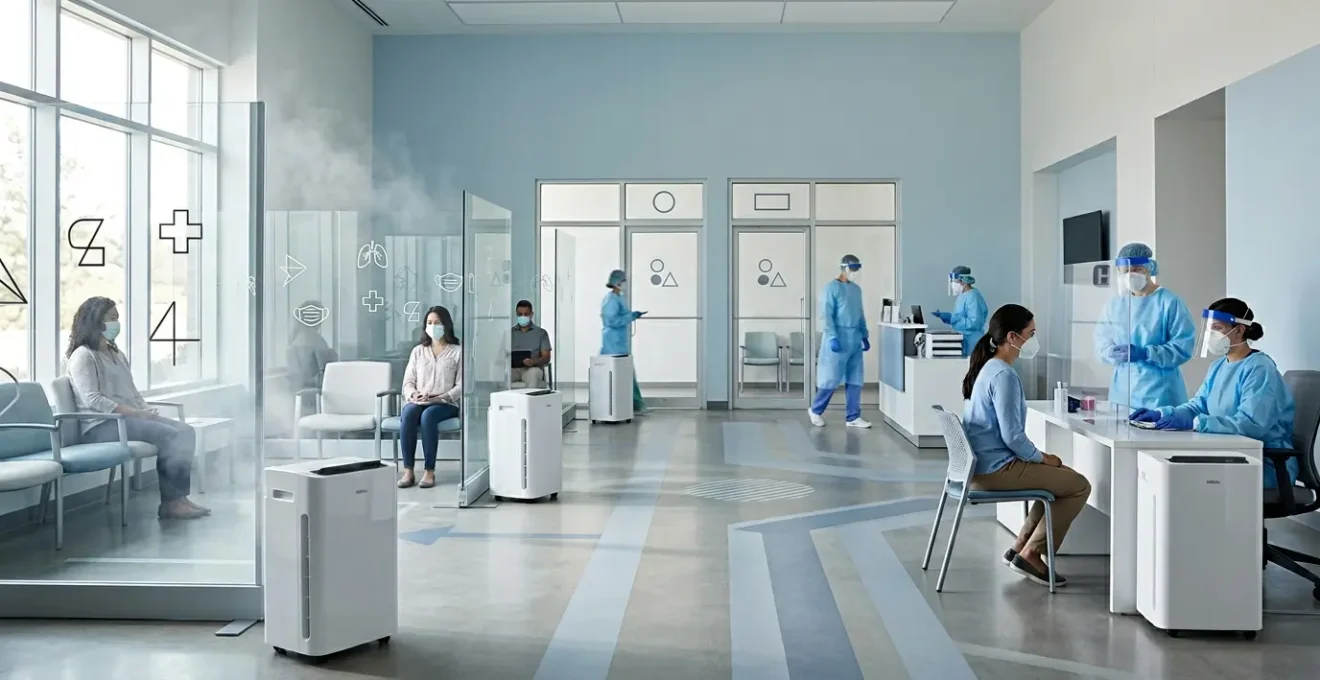
During a patient surge, standard infection control measures are insufficient; the waiting room inevitably becomes a high-risk transmission vector.
- Effective containment requires moving beyond basic hygiene to an engineered, systems-based approach that integrates rapid screening, advanced environmental controls, and data-driven response triggers.
- Staff safety and endurance during long shifts depend on superior personal protective equipment and protocols that minimize cognitive load and physical stress.
Recommendation: The goal is not simply to react to infections but to engineer a high-reliability environment that anticipates and contains airborne and surface threats before they can escalate into a facility-wide outbreak.
The first cough in a crowded Emergency Department waiting room during peak flu season is not just a sound; it is a countdown. For Infection Control Practitioners and ED Directors, this moment marks the start of a critical race against time to prevent a single infectious patient from triggering a nosocomial outbreak. The standard advice—hand hygiene, patient masking, and routine surface cleaning—forms the necessary baseline of any infection prevention strategy. However, these measures alone represent a porous defense, easily overwhelmed by high patient volume, protocol fatigue, and the invisible threat of airborne pathogens like influenza, RSV, or tuberculosis.
The critical failure point in most ERs is not a lack of effort but the absence of a robust, engineered system designed for high-stress conditions. The solution is not to perform basic tasks harder, but to build a high-reliability framework that makes containment the default state, not a frantic reaction. This involves a fundamental shift in thinking: from relying solely on human behavior to implementing hard-wired environmental controls, data-driven decision protocols, and rapid response mechanisms. This approach transforms the waiting room from a liability into a controlled environment.
This guide provides the operational and engineering protocols necessary to build such a system. It details the non-negotiable components required to effectively contain contagious infections, from the moment a patient arrives through to the potential triggering of hospital-wide response measures. We will examine the critical systems—triage, environmental controls, personal protective equipment, and command protocols—that function together to protect patients, safeguard staff, and ensure operational continuity during the most challenging periods.
Summary: A Systems-Based Guide to Containing Pathogens in the ER
- Why Negative Pressure Rooms Are Essential for Airborne Pathogen Control?
- How to Screen and Isolate Potentially Infectious Patients in Under 5 Minutes?
- N95 vs. PAPR: Which Respiratory Protection is Best for Long Shifts?
- The Surface Disinfection Mistake That Spreads Norovirus in 24 Hours
- When to Trigger Hospital-Wide Lockdown Protocols: 3 Key Indicators?
- How to Upgrade HVAC Systems to ISO Class 7 Standards in Existing Buildings?
- How to Use RTLS Badges to Locate Staff Under Threat in Seconds?
- How to Promote Awareness of Sanitary Practices That Sticks Long-Term?
Why Negative Pressure Rooms Are Essential for Airborne Pathogen Control?
For any pathogen transmitted via the airborne route, passive measures are inadequate. An Airborne Infection Isolation Room (AIIR), commonly known as a negative pressure room, is not a luxury but a fundamental engineering control for containment. These rooms use a specialized ventilation system to generate negative pressure relative to adjacent areas, ensuring that air flows from the corridor into the room, not the other way around. This mechanism effectively traps infectious droplets and aerosols inside the room, where they can be safely exhausted to the outside or passed through high-efficiency particulate air (HEPA) filtration.
The necessity for adequate AIIR capacity is not theoretical. The resurgence of diseases once thought to be in decline underscores this imperative. For instance, recent CDC surveillance data confirms an 8.3% increase in tuberculosis cases from 2019 to 2023, a disease that mandates the use of negative pressure isolation. Without sufficient AIIR capacity, an ER is forced into suboptimal solutions, such as cohorting patients or using portable filtration units, which lack the reliability of a built-in, properly maintained negative pressure system.
An AIIR is the definitive barrier against the spread of agents like *Mycobacterium tuberculosis*, measles, and varicella. It is also the primary containment space for initial assessment of patients with novel respiratory viruses of unknown transmission characteristics. Relying on surgical masks and distance alone is a high-risk gamble. The presence of at least one, and ideally several, properly functioning AIIRs is a non-negotiable requirement for any emergency department preparing for seasonal surges or pandemic threats. Verifying their function with daily smoke tests or pressure monitoring is a critical component of operational readiness.
How to Screen and Isolate Potentially Infectious Patients in Under 5 Minutes?
The single most effective strategy to prevent an outbreak in the waiting room is to minimize the time an infectious individual spends within it. This requires a rapid triage and isolation protocol with a target of « door-to-isolation » in under five minutes for any patient presenting with symptoms of a contagious respiratory or gastrointestinal illness. This is not about rushing the clinical assessment but about executing a hyper-efficient initial screening process focused exclusively on identifying potential transmission risk. Success hinges on a pre-defined, drilled protocol that every member of the triage team can execute flawlessly under pressure.
This process, often completed in 60-90 seconds, begins with an « across-the-room » visual survey as the patient approaches, noting signs of distress, cough, or use of ambulation devices. The triage nurse then conducts a rapid ABCDE assessment: Airway, Breathing, Circulation, Disability (consciousness), and Exposure (checking for rashes). This is immediately followed by a targeted symptom questionnaire focused on fever, cough, shortness of breath, vomiting, or diarrhea. The goal is not diagnosis, but risk stratification. A study of over 32,000 patients confirmed the feasibility of this speed, showing that 98% of triage processes were completed in under 5 minutes using a standardized system.
Based on this rapid assessment, a patient meeting pre-determined criteria is immediately given a mask and escorted directly to a designated isolation space, bypassing the main waiting area entirely. This requires having pre-positioned « grab-and-go » isolation kits at the triage station and clear, color-coded pathways to isolation rooms. The protocol must be drilled through regular simulations to identify bottlenecks and ensure every team member knows their role. Efficiency here is not for convenience; it is a primary infection control measure.
N95 vs. PAPR: Which Respiratory Protection is Best for Long Shifts?
Standard N95 respirators are the minimum requirement for staff interacting with patients with known or suspected airborne diseases. However, during a prolonged patient surge or for staff working extended 12-hour shifts, the N95 presents significant challenges. The tight seal required for efficacy can cause facial bruising and skin breakdown, while high breathing resistance leads to physical exhaustion and heat stress. These factors not only impact staff well-being but can also lead to compliance failures as staff may inadvertently adjust their masks for comfort, compromising the seal.
For high-tempo, long-duration operations, the Powered Air-Purifying Respirator (PAPR) is a demonstrably superior form of personal protective equipment. A PAPR uses a battery-powered fan to draw air through a filter (often a HEPA filter) and deliver a continuous stream of clean air into a loose-fitting hood or helmet. This eliminates breathing resistance, provides a cooling effect, and avoids the facial injuries associated with N95s. A case study from ProHealth Care highlights the impact of this switch. As one healthcare worker noted after the system adopted PAPRs from RPB Safety, it created « a sense of relief for everyone… We felt safer, less tired, and most importantly the patients felt more comfortable. » This positive feedback underscores the significant morale and safety benefits.
While the initial investment in PAPRs is higher, the operational advantages are compelling. They do not require annual fit testing like N95s, and some models allow for clearer communication and visibility of the wearer’s face, which can reduce patient anxiety. The following table, based on data regarding extended use of N95s versus PAPRs, outlines the key differences.
| Factor | N95 Respirator | PAPR |
|---|---|---|
| Breathing Resistance | High – user draws air through filter | Low – battery-powered fan delivers filtered air |
| Heat Stress | Significant – mask becomes hot and moist quickly | Minimal – continuous airflow provides cooling |
| Facial Injuries | Common – bruising, red marks from tight seal | None – loose-fitting design |
| Usage Duration | Limited – designed for single use | 8-12+ hours with battery backup |
| Fit Testing Required | Yes – annual fit testing mandatory | No – loose-fitting hoods/helmets |
| Communication Impact | Muffled speech, no lip reading | Clearer speech, face visible with some models |
Before that, we’d go home each day worried that the masks we were wearing wasn’t doing enough… But when the PAPRs from RPB were rolled out, that changed everything.
– Healthcare worker, ProHealth Care System
For any department planning for surge capacity, investing in a cache of PAPRs for frontline staff is a critical strategic decision that enhances both safety and operational endurance.
The Surface Disinfection Mistake That Spreads Norovirus in 24 Hours
During flu season, respiratory pathogens are the primary concern, but gastrointestinal viruses like norovirus represent a potent and often mishandled threat in the ER. The single most common and dangerous mistake in surface disinfection is relying on the wrong class of chemical agent. Many standard hospital-grade disinfectants, particularly those based on quaternary ammonium compounds (quats), are not effective against norovirus. This highly resilient, non-enveloped virus can survive on surfaces for days and requires a specific protocol for eradication.
Using a quat-based wipe on a surface contaminated with norovirus provides a false sense of security. It may clean visible soil, but it leaves the infectious virions behind, ready to be picked up by the next person who touches the surface. An outbreak can spread through an entire department within 24 hours from a single contaminated bed rail, call button, or keyboard. The only reliable agents for killing norovirus are a bleach-based solution (typically a 1:10 dilution for high-risk areas) or an EPA-registered product specifically approved for use against norovirus.
The second critical failure is ignoring contact time, also known as dwell time. This is the amount of time the disinfectant must remain visibly wet on a surface to be effective. For bleach solutions, this is often several minutes. Simply wiping a surface and letting it dry immediately is not disinfection; it is merely moving contaminants around. Staff must be trained to apply the disinfectant liberally enough to meet the required contact time. This mistake is particularly common on high-touch electronic devices where staff are hesitant to apply liquids, yet these are major vectors for transmission. Protocols must specify the use of appropriate, norovirus-effective wipes and strict adherence to the manufacturer’s specified dwell time for all surfaces in any area occupied by a patient with gastroenteritis.
When to Trigger Hospital-Wide Lockdown Protocols: 3 Key Indicators?
Moving from departmental containment to a hospital-wide response, including a potential lockdown or diversion of ambulances, is a significant decision with major operational consequences. This decision cannot be based on intuition or a « gut feeling » of being overwhelmed. It must be triggered by pre-defined, data-driven indicators that provide an objective measure of system stress and imminent failure. Establishing these triggers in advance removes ambiguity and allows for a swift, coordinated response when needed.
There are three key categories of indicators that should be monitored in the hospital command center:
- ER Saturation Index: This metric provides a real-time measure of capacity strain. It can be calculated as [(Patient Arrivals/hr) x (Avg. Wait Time)] / (Number of Open Beds). When this index exceeds a predetermined threshold, it signals that patient inflow is overwhelming the department’s ability to process them, increasing transmission risk.
- Community Transmission Velocity: The hospital does not exist in a vacuum. The command center must monitor data from local public health departments, tracking the rate of change (velocity) in reported flu-like or other syndromic illnesses. A trigger could be set at a >50% increase in community cases within a 48-hour period, indicating an imminent surge.
- Protocol Failure Cascade: This involves tracking concurrent internal system failures. A single failure is manageable, but a cascade is a sign of collapse. A trigger might be activated when multiple conditions are met simultaneously, such as: PPE stock falling below a 24-hour supply, AND more than two AIIRs being unavailable, AND the staff call-out rate exceeding 15%.
When these data-driven triggers are hit, it initiates a pre-planned hospital-wide response protocol. This removes the burden of a high-stakes decision from a single individual in the heat of the moment and replaces it with a logical, defensible, and pre-approved action plan. This is a hallmark of a high-reliability organization.
How to Upgrade HVAC Systems to ISO Class 7 Standards in Existing Buildings?
A building’s Heating, Ventilation, and Air Conditioning (HVAC) system is one of the most powerful, yet often overlooked, tools for infection control. For critical areas like isolation wings and triage, upgrading the system to meet stringent air quality standards is a crucial engineering control. ISO Class 7, a cleanroom standard, specifies a maximum number of airborne particles and requires a high number of air changes per hour (ACH), effectively diluting and removing airborne contaminants. While a full HVAC overhaul in an existing building is a major capital project, a phased approach can achieve significant risk reduction.
The urgency for such upgrades is highlighted by the unreliability of existing systems. A sobering study found that 45% of designated negative pressure rooms had positive airflow when tested, rendering them ineffective and dangerous. This demonstrates that simply designating a room for isolation is not enough; the engineering must be sound and continuously verified. The goal is to create zones of high-purity air that actively protect patients and staff. A key target is achieving a minimum of 12 ACH in high-risk areas and ensuring a pressure differential of at least -2.5 Pascals relative to corridors for all AIIRs.
For facilities where a full retrofit is not immediately feasible, the NIOSH expedient patient isolation strategy offers a powerful alternative. This approach uses a portable HEPA filtration system to create a « room-within-a-room, » establishing a clean air zone around the patient that achieves an air-cleaning equivalency to a traditional AIIR. By containing contaminated air in an inner zone where it is captured and cleaned, the outer zone of the room remains safe. This, combined with a phased upgrade plan, provides a pragmatic pathway to enhanced environmental safety.
Your Phased Implementation Checklist: ISO Class 7 HVAC Upgrades
- Assess high-risk areas: Identify triage, isolation wings, and other critical zones to prioritize for upgrades.
- Conduct CFD modeling: Use computational fluid dynamics to map airflow, optimize vent placement, and eliminate stagnant « dead zones. »
- Install continuous monitoring: Deploy electronic pressure monitors that integrate with the building management system for 24/7 tracking of pressure differentials.
- Establish ACH targets: Implement a minimum of 12 ACH for new construction and target at least 6 ACH for retrofits in existing structures.
- Verify system performance: After installation, verify a minimum -2.5 Pa pressure differential relative to corridors and regularly test and maintain the system.
How to Use RTLS Badges to Locate Staff Under Threat in Seconds?
In the chaotic environment of a crowded ER, staff safety is paramount. Real-Time Locating Systems (RTLS), often deployed via staff badges, offer a powerful security tool. The most immediate benefit is the ability to locate a staff member under threat. By integrating a discreet panic button into the badge, a nurse or physician facing a volatile patient can summon security with a simple press. The RTLS instantly provides security personnel with the exact location—down to the specific room—of the event, enabling a response in seconds rather than minutes and dramatically reducing the risk of injury.
Beyond this critical security function, the same RTLS infrastructure is an invaluable asset for infection control, particularly for automated contact tracing. In the event a patient is later diagnosed with a highly contagious disease, the RTLS data can instantly generate a report of every staff member and patient who came within a predefined proximity (e.g., 6 feet for 15+ minutes) of the index case. This replaces days of manual interviews and fallible memory with an automated, data-driven report, allowing for the rapid quarantine and testing of potentially exposed individuals.
The system’s capabilities can be further enhanced through geofencing. By digitally designating « clean » and « dirty » zones within the ER, the RTLS can automatically log every time a staff member crosses a boundary. It can issue alerts for protocol violations, such as entering a clean area from a dirty one without passing a hand hygiene station. The system can also be used to track the real-time location of critical equipment like ventilators or infusion pumps, reducing search times during a surge. Deploying RTLS is a multi-faceted investment in both staff security and a more intelligent, responsive infection control program.
Key Takeaways
- Effective infection containment is not a single action but an engineered system integrating rapid triage, environmental controls (HVAC/AIIRs), and superior PPE.
- Data, not intuition, must drive critical decisions. This includes using metrics for ER saturation, community transmission velocity, and protocol failures to trigger hospital-wide responses.
- Investing in superior technology like PAPRs and RTLS provides compounding benefits for staff safety, operational endurance, and intelligent infection control.
How to Promote Awareness of Sanitary Practices That Sticks Long-Term?
Even the most advanced engineering controls can be undermined by poor adherence to basic sanitary practices like hand hygiene. However, traditional awareness campaigns—posters, emails, and training sessions—suffer from rapid decay in effectiveness. To create lasting behavioral change, departments must move beyond simple reminders and implement strategies from behavioral science known as « nudges. » A nudge is a subtle change in the environment that guides people toward a desired behavior without forbidding any options or significantly changing their economic incentives.
Instead of a simple « Wash Your Hands » sign, a behavioral nudge makes the desired action the easiest and most obvious choice. For example, installing brightly colored, vinyl floor decals that create a clear visual pathway from the triage desk to the nearest hand sanitizer station can dramatically increase usage. The path doesn’t force anyone, but it draws the eye and makes the action feel like a natural part of the check-in process. Similarly, positioning sanitizer dispensers at natural « pause points » in patient flow—such as next to the registration kiosk or at the entrance to the seating area—increases opportunities for compliance.
Technology can also be used to create powerful nudges. Audio-triggered digital reminders that are activated by a cough-detection algorithm near a sanitizing station can prompt behavior at the exact moment of need. Displaying a real-time compliance dashboard in a staff-only area (e.g., « 98% Hand Hygiene Compliance Today ») leverages social proof and a sense of collective effort to encourage adherence. Another effective strategy is creating a peer-to-peer ambassador program, using respected non-clinical staff (like registrars or transporters) to champion and model correct behavior. These methods are more effective long-term because they integrate the desired practice into the physical environment and social fabric of the department, rather than relying on an individual’s memory or willpower.
The time for reactive, piecemeal infection control measures is over. The protocols and systems outlined here provide a roadmap for engineering a high-reliability environment resilient to seasonal surges and emerging threats. Begin the process of evaluating and implementing these strategies in your department to build a safer, more prepared emergency service.