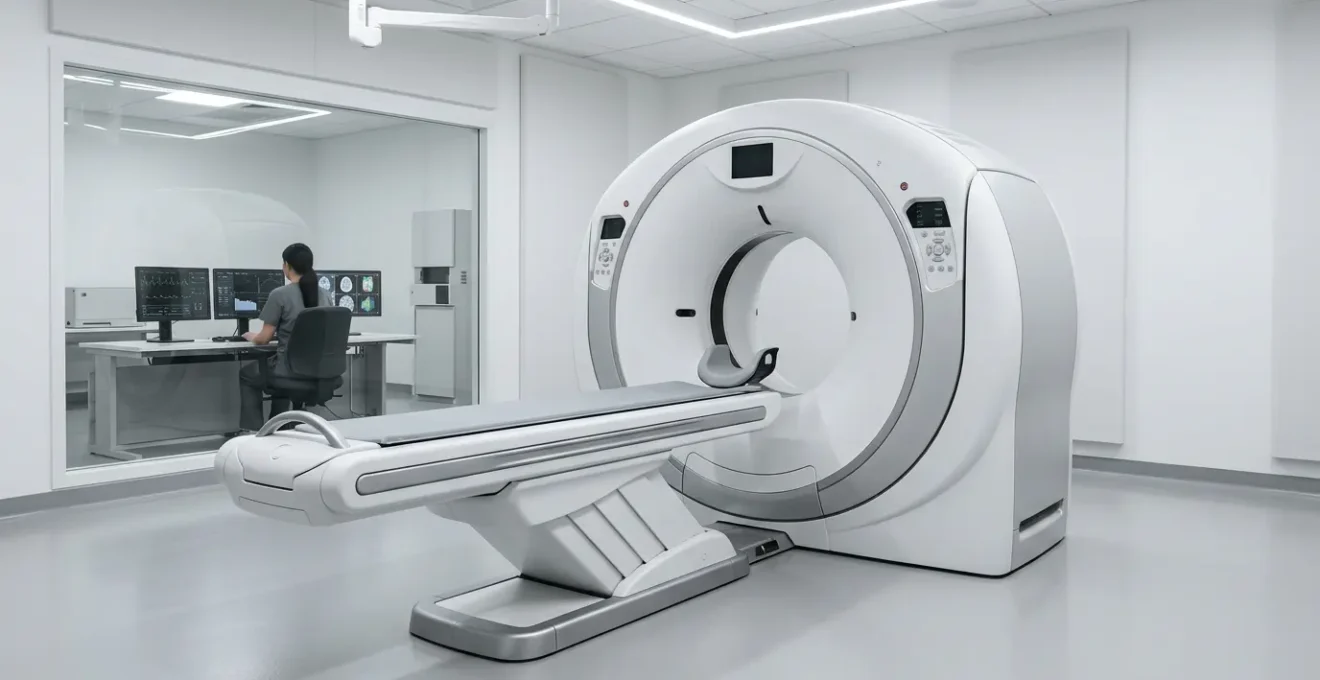
The optimal CT scanner isn’t the one with the most slices, but the one that delivers diagnostic confidence at the lowest dose and a sustainable total cost of ownership (TCO).
- Advanced reconstruction algorithms (IR/DLR) are non-negotiable, capable of reducing patient dose by over 50% without compromising image quality.
- Long-term viability is determined by TCO—including tube replacement, service contracts, and cooling system reliability—not the initial purchase price.
Recommendation: Prioritize systems with proven, efficient iterative reconstruction and conduct a full 10-year TCO analysis before any capital investment.
Every radiology department head and procurement committee grapples with the fundamental trilemma of diagnostic imaging: achieving pristine image quality, adhering to the ALARA (As Low As Reasonably Achievable) principle for patient safety, and managing ever-tighter operational budgets. The common approach to resolving this often gravitates toward a « slice race »—equating a higher slice count with superior performance—or focuses narrowly on the initial capital outlay of the equipment. This perspective, while understandable, is dangerously incomplete.
From a medical physics standpoint, the true value and long-term viability of a CT scanner are not defined by its raw specifications. Instead, they are a function of its integrated ecosystem. This includes how advanced software like iterative reconstruction mitigates dose, how hardware components like the X-ray tube and cooling system dictate reliability and operational uptime, and how efficiently the entire system integrates into the department’s workflow. Viewing the scanner as a strategic asset to be managed over a decade, rather than a one-time purchase, is the critical shift in mindset required.
This guide deconstructs the key technical, operational, and financial factors that must be evaluated. It moves beyond marketing claims to provide a physics-based framework for making informed, evidence-based decisions that balance diagnostic confidence with patient safety and long-term financial sustainability.
This article provides a detailed analysis of the critical factors in CT technology selection and management. The following summary outlines the key areas we will explore to build a comprehensive evaluation framework.
Summary: A Strategic Framework for CT Technology Evaluation
- Why Iterative Reconstruction Techniques Lower Patient Dose by Up to 50%?
- How to Estimate the Tube Replacement Costs Over a 10-Year CT Scanner Lifespan?
- 64-Slice vs. 128-Slice Scanners: Is the Upgrade Necessary for General Hospitals?
- The Cooling System Neglect That Causes Sudden CT Tube Failure
- How to Structure CT Appointment Slots to Scan 5 More Patients Daily?
- Why Ceiling-Mounted Angiography Systems Save Vital Floor Space in Hybrid ORs?
- How to Convert CT Scans into Printable STL Files Without Losing Detail?
- How Advanced MRI Technology Reducing Scan Times by 30% for Claustrophobic Patients?
Why Iterative Reconstruction Techniques Lower Patient Dose by Up to 50%?
The transition from traditional Filtered Back Projection (FBP) to Iterative Reconstruction (IR) and, more recently, Deep Learning Reconstruction (DLR), represents the single most significant advancement in CT dose management. FBP is a computationally fast but imperfect algorithm that amplifies image noise, forcing technologists to use higher radiation doses to achieve a clean, diagnostic image. In contrast, IR algorithms use a sophisticated cyclic process. They create an initial image, compare it to the raw scan data, identify statistical noise and inconsistencies, and then correct the image over multiple iterations. This process allows for the creation of high-quality images from « noisy, » lower-dose acquisitions.
The clinical impact is profound. A 2025 systematic review confirms that these techniques are not just marginally better; they are transformative. The analysis found that facilities implementing these technologies achieved a 58% average dose reduction with DLR and 45% with IR compared to FBP, all while maintaining or even improving diagnostic image quality. For procurement committees, this means that the specific reconstruction algorithm a vendor offers is a more critical factor for patient safety than many hardware specifications. For instance, the Mayo Clinic’s implementation of GE’s ASiR algorithm resulted in dose reductions between 22% and 66% for routine body scans, a crucial benefit for patients with chronic conditions like Crohn’s Disease who require frequent imaging.
While the dose-saving potential is significant across all major vendors, the specific algorithms, reconstruction speeds, and level of dose reduction vary. Understanding these differences is key to selecting the right system for a specific clinical need.
| Vendor | Algorithm | Dose Reduction | Reconstruction Speed |
|---|---|---|---|
| GE Healthcare | ASiR/ASiR-V | 25-40% | 6-8 images/sec |
| Siemens | SAFIRE/ADMIRE | 50-60% | Moderate |
| Philips | iDose4/IMR | 50-80% | Slower for IMR |
| Canon | AIDR 3D | 30-50% | Fast |
How to Estimate the Tube Replacement Costs Over a 10-Year CT Scanner Lifespan?
The initial purchase price of a CT scanner is merely the tip of the iceberg. A strategic financial assessment must focus on the Total Cost of Ownership (TCO) over a typical 10-year operational lifespan, with X-ray tube replacement being a primary driver of that cost. A single CT tube can cost anywhere from $75,000 to over $250,000, and its longevity is finite, measured in scan seconds or milliampere-seconds (mAs). Neglecting to forecast this expense can lead to severe, unplanned budgetary shocks. Furthermore, the associated service contracts are a major operational expenditure; a full-service maintenance contract for a single CT scanner can cost over $100,000 annually.
Estimating TCO requires a meticulous, data-driven approach that goes far beyond the tube itself. It involves calculating replacement frequency based on projected usage, but also incorporating other often-overlooked costs. These include detector degradation, annual software license renewals, power consumption, and the significant hidden costs of downtime during unscheduled maintenance. The technician’s expertise is vital, but so is the planning that keeps them performing scheduled, not emergency, procedures.
A comprehensive TCO calculation is not just a financial exercise; it’s a strategic planning tool. By comparing the projected costs of Original Equipment Manufacturer (OEM) service contracts versus reputable third-party options (which can offer 30-50% savings), and by factoring in the financial impact of each hour of scanner downtime, a department can make a far more informed investment decision. The following components form a robust framework for building this essential calculation.
Action Plan: TCO Calculator Framework Components
- Calculate tube replacement frequency based on your department’s mAs or scan seconds metrics.
- Include detector degradation costs, typically estimated at 10-15% of tube costs over the lifespan.
- Factor in all annual software license renewals, which can range from $15,000 to $30,000 per year.
- Add power consumption and HVAC requirements for the cooling system, a significant and variable operating expense.
- Compare the long-term costs of OEM versus qualified third-party service contracts.
64-Slice vs. 128-Slice Scanners: Is the Upgrade Necessary for General Hospitals?
The « slice wars » have long dominated marketing conversations, creating a perception that more detector rows are inherently better. While higher slice counts are indispensable for advanced applications like cardiac CTA and whole-organ perfusion studies, a 128-slice (or higher) system is not always a necessary or financially prudent upgrade for a general hospital. For a significant portion of the daily workload—including routine chest, abdomen, and pelvis (CAP) scans, as well as most emergency and trauma cases—a modern 64-slice scanner performs exceptionally well. The marginal benefit of a higher slice count for these common procedures is often minimal.
The decision to upgrade must be driven by clinical need, not marketing pressure. A 128-slice scanner’s primary advantage lies in its superior temporal resolution and wider volumetric coverage per rotation. This is critical for cardiac imaging, where it can freeze the motion of the heart, and for perfusion studies, where it can capture the dynamics of contrast agent through an entire organ in a single pass. It can also reduce the need for sedation in pediatric patients due to faster scan times. However, if a facility does not have a high volume of these specialized cases, the significant capital investment may not yield a proportional return.
Given that well-maintained CT systems can last for over 20+ years, a robust 64-slice machine can serve as a departmental workhorse for a very long time. The key is to match the technology to the patient population and clinical service lines.
| Clinical Application | 64-Slice Performance | 128-Slice Advantage |
|---|---|---|
| Emergency/Trauma | Adequate | Faster scan times |
| Routine Chest/Abdomen | Excellent | Minimal benefit |
| Cardiac CTA | Good with ECG gating | Superior temporal resolution |
| Whole-organ perfusion | Limited coverage | Single-rotation coverage |
| Pediatric imaging | Sufficient | Reduced sedation needs |
The Cooling System Neglect That Causes Sudden CT Tube Failure
While the X-ray tube receives most of the attention, its performance and longevity are inextricably linked to a frequently overlooked component: the cooling system. During operation, less than 1% of the energy in the electron beam is converted to X-rays; the other 99% becomes waste heat. This enormous thermal load, often dissipating 50-70 kW of heat, must be managed effectively. Failure to do so leads to elevated tube temperatures, which can cause tungsten to vaporize from the filament and coat the inside of the tube insert. This can trigger tube arcing, a catastrophic failure mode that results in immediate, unscheduled downtime and a costly replacement.
Proactive management of the cooling system is therefore a cornerstone of reliable CT operation. This extends beyond simple maintenance checks to a holistic site-readiness and monitoring strategy. A department’s HVAC system must be specified to handle the heat load, ambient temperature and humidity must be tightly controlled (ideally 18-22°C and 40-60% RH), and for liquid-cooled systems, water quality must be regularly assessed. As demonstrated in a key study, a proactive strategy is essential. Implementation of CT system error log monitoring and temperature trend analysis allows clinical engineering teams to anticipate cooling system degradation. This predictive maintenance approach enables scheduled service, transforming a potential catastrophe into a manageable event and maximizing operational uptime.
Ensuring the longevity of a multi-million dollar asset begins before it is even installed. A thorough site readiness assessment is a non-negotiable prerequisite for any new CT system, as it lays the groundwork for stable and reliable long-term operation.
Your Pre-Purchase Site Readiness Checklist: Cooling and Environment
- Verify HVAC capacity can handle the specified heat load (typically 50-70 kW).
- Confirm ambient temperature control systems can maintain a stable 18-22°C.
- Evaluate humidity control systems to ensure a range of 40-60% Relative Humidity.
- For liquid-cooled systems, establish a protocol for monitoring cooling water quality and flow rates.
- Plan for uninterruptible power supply (UPS) and emergency backup systems for both the scanner and its cooling unit.
How to Structure CT Appointment Slots to Scan 5 More Patients Daily?
Increasing patient throughput is a key objective for any radiology department, as it directly impacts revenue, patient access, and operational efficiency. While faster scan times from new hardware contribute, the most significant gains are often realized through workflow optimization. The « serial » model—where a patient is prepped, scanned, and recovered in the same room while the scanner sits idle—is inherently inefficient. The solution lies in implementing a parallel processing workflow, which decouples tasks to maximize scanner utilization.
This model redesigns the CT suite into distinct functional zones. While one patient is actively being scanned (Station 2), the next patient is simultaneously undergoing pre-scan preparation (e.g., IV placement, instructions) in a separate prep area (Station 1). Concurrently, the previous patient is in a post-scan recovery or post-processing area (Station 3). This creates a continuous flow of patients to the scanner, dramatically reducing the « time between scans » and maximizing the asset’s « on » time. This orchestrated movement is key to unlocking latent capacity.
Implementing such a system requires more than just physical space; it demands standardized protocols for high-volume exams, clear communication with « hot seat » handoffs between technologists, and potentially leveraging technology like automated patient positioning systems. By focusing on the entire patient journey rather than just the scan itself, departments can often add five or more slots to their daily schedule without extending operating hours or requiring new hardware, delivering a substantial return on investment through process improvement alone.
Action Plan: Implementing a Parallel Processing Workflow
- Designate separate pre-scan prep and post-scan recovery stations adjacent to the scan room.
- Standardize protocols for your top 5 high-volume exams to ensure consistency and speed.
- Implement a « hot seat » handoff procedure for technologists to ensure seamless transitions between patients.
- Create « express lanes » in the schedule for simple, non-contrast studies that require minimal prep.
- Train staff on the principles of parallel processing to foster a culture of efficiency and teamwork.
Why Ceiling-Mounted Angiography Systems Save Vital Floor Space in Hybrid ORs?
The development of hybrid operating rooms (ORs)—which combine a traditional surgical suite with an advanced imaging system—has revolutionized complex procedures in vascular, cardiac, and neurological surgery. However, integrating a bulky imaging system like a CT scanner or a C-arm into a sterile OR environment presents significant logistical challenges, the most critical of which is floor space. Anesthesiologists, perfusionists, surgeons, nurses, and technologists all require unimpeded access to the patient, and floor-based equipment creates obstacles that can compromise both efficiency and safety.
This is where ceiling-mounted angiography systems offer a distinct advantage. By suspending the C-arm from a rail system on the ceiling, the floor remains clear of equipment and cables. The system can be precisely positioned for imaging when needed and then moved completely out of the way, « parking » at the periphery of the room during the surgical portion of the procedure. This provides maximum flexibility for the clinical team and allows for easier cleaning and maintenance of the sterile field. While a rail-mounted intraoperative CT may offer superior image quality, its larger footprint and higher cost must be weighed against the workflow benefits of a ceiling-mounted system.
However, the integration is not without its own complexities. As highlighted by an analysis in RadioGraphics, integrating CT and angiography systems in hybrid ORs requires addressing combined radiation shielding requirements, coordinating complex workflows between surgical and radiology teams, and ensuring seamless data integration between modalities. The choice of system is therefore not just about space, but about a facility’s ability to manage these multi-disciplinary challenges.
| Configuration | Initial Cost | Floor Space Required | Workflow Flexibility |
|---|---|---|---|
| Rail-mounted CT | $3-4 million | 600 sq ft | Excellent |
| High-end C-arm with CT-like | $2-3 million | 450 sq ft | Good |
| Portable intraoperative CT | $1-2 million | 400 sq ft | Limited |
| Ceiling-mounted angiography | $1.5-2.5 million | 350 sq ft | Very Good |
How to Convert CT Scans into Printable STL Files Without Losing Detail?
The ability to create patient-specific, 3D-printed anatomical models has moved from a research novelty to a powerful clinical tool for surgical planning, education, and implant design. The fidelity of these models, however, is entirely dependent on the quality of the source CT data and the integrity of the conversion process. To convert DICOM (Digital Imaging and Communications in Medicine) data into a printable STL (stereolithography) file without losing critical detail, a complete « scanner-to-printer » ecosystem must be established.
The process begins at the scanner. The optimal CT resolution for 3D printing requires 0.5mm isotropic voxels or smaller. Isotropic voxels—which have the same spatial resolution in all three dimensions (x, y, z)—are essential for creating models that are anatomically accurate from any angle. High spatial resolution (a 512×512 matrix or greater) and an optimized signal-to-noise ratio are also critical for differentiating fine tissue boundaries. Once a high-quality scan is acquired, specialized segmentation software (such as 3D Slicer or Mimics) is used to isolate the anatomy of interest (e.g., a specific bone or vessel) from the surrounding tissue. This step, which requires significant training and anatomical knowledge, is where the DICOM data is converted into a 3D mesh, which is then exported as an STL file.
Establishing this capability requires investment in not just hardware and software, but also in people. Biomedical engineers or highly trained technologists must master the conversion workflow and implement rigorous quality control protocols to validate the accuracy of the final printed model against the original source imaging. Only through this end-to-end quality management can a department ensure its 3D models are a reliable tool for clinical decision-making.
Action Plan: Scanner-to-Printer Ecosystem Requirements
- Acquire a CT scanner with isotropic voxel capability (minimum 0.5mm slice thickness).
- Invest in dedicated segmentation software (e.g., 3D Slicer, Mimics) for converting DICOM to STL.
- Train biomedical engineers or technologists in advanced segmentation and 3D modeling techniques.
- Establish a formal quality control protocol to validate the dimensional accuracy of every printed model.
- Partner with clinical departments to integrate 3D models into surgical planning workflows.
Key Takeaways
- Advanced reconstruction algorithms (IR/DLR) are the single most impactful technology for reducing patient radiation dose while maintaining diagnostic image quality.
- Total Cost of Ownership (TCO), which includes tube life, service contracts, and cooling system reliability, is a far more critical financial metric than the initial purchase price.
- Operational efficiency, achieved through workflow optimization like parallel processing and strategic modality use (e.g., CT to offload MRI), unlocks a scanner’s full financial and clinical value.
How Advanced MRI Technology Reducing Scan Times by 30% for Claustrophobic Patients?
While this guide focuses on CT technology, a truly strategic approach to departmental asset management requires viewing CT as part of a larger imaging portfolio that includes MRI. The decision to upgrade a CT scanner is often linked to the capabilities and limitations of a facility’s MRI resources. As the quote from the Healthcare Technology Management Best Practices framework highlights, the two modalities have a symbiotic relationship:
New high-throughput CT can be used to offload certain diagnostic tasks, thereby freeing up limited and valuable MRI scanner time for complex cases that absolutely require it.
– Radiology Department Strategy Framework, Healthcare Technology Management Best Practices
This principle of « offloading » is a powerful strategic lever. For instance, while MRI is superior for detailed soft tissue evaluation in neurological and specific oncology cases, a modern, fast, low-dose CT is often faster and more cost-effective for emergency/trauma cases and initial cancer staging. Investing in a high-throughput CT can therefore increase the availability of the MRI scanner for the complex cases where its diagnostic superiority is non-negotiable, such as functional cardiac assessments or detailed brain tumor follow-ups. The recent advances in MRI, such as compressed sensing and AI-powered reconstruction that can reduce scan times by 30% or more, further increase the value of each available MRI time slot, making the offloading strategy even more impactful.
The choice is not simply « CT or MRI, » but rather how to invest in each modality to create a balanced, efficient, and clinically comprehensive service line. The decision to upgrade a CT should always be made with a clear understanding of its role relative to the MRI capacity and clinical priorities of the department.
| Clinical Priority | Favor CT Upgrade | Favor MRI Upgrade |
|---|---|---|
| Emergency/Trauma | ✓ Speed critical | Limited application |
| Cardiac Imaging | ✓ Coronary CTA | ✓ Function/Viability |
| Neurological | Acute stroke | ✓ Soft tissue detail |
| Oncology Staging | ✓ Whole body | ✓ Specific organs |
| Patient Experience | ✓ Fast, low dose | ✓ No radiation |
Ultimately, selecting and managing CT technology is an exercise in strategic asset management. By moving beyond a narrow focus on purchase price or slice count and adopting a holistic, physics-based evaluation of dose efficiency, total cost of ownership, and workflow integration, department leaders can ensure their investments enhance patient safety, improve diagnostic confidence, and secure the long-term financial health of their operations. To apply these principles effectively, the next step is to initiate a comprehensive TCO and workflow analysis tailored to your department’s specific clinical volume and case mix.