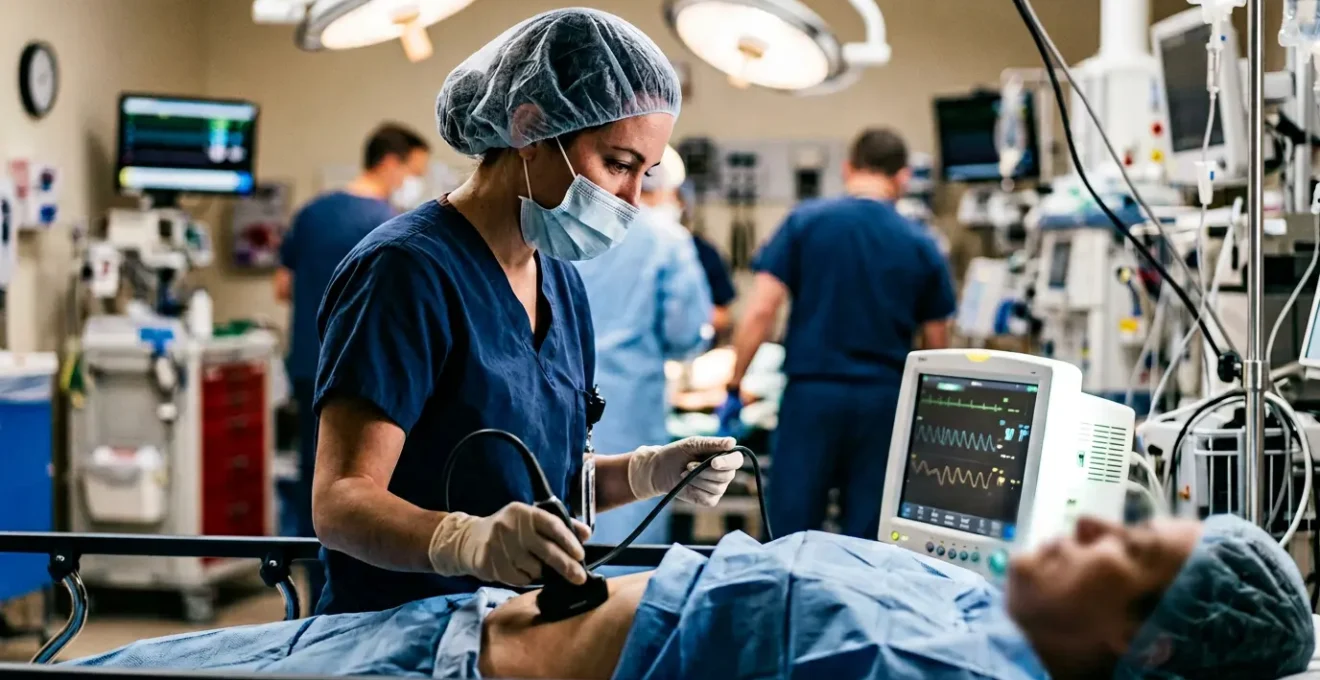
Point-of-Care Ultrasound (POCUS) is not just another imaging tool; it’s a cognitive-procedural shift that transforms the physical exam from a subjective art into a real-time, data-driven science.
- It forces immediate, life-altering decisions by providing definitive answers (e.g., fluid in trauma) without waiting for radiology.
- It elevates procedural safety to near-perfect levels by turning blind insertions into precision-guided actions.
Recommendation: Stop viewing POCUS as a ‘quick look’ and start integrating it as the new standard for the physical examination to reduce diagnostic uncertainty and accelerate care.
In the controlled chaos of an emergency department, the most valuable commodity is certainty. For decades, the clinician’s primary tools were the physical exam—a subjective art of palpation and auscultation—and the telephone to request formal imaging from radiology, a process that introduces critical delays. This paradigm forces a trade-off between speed and information, often leaving physicians to act on incomplete data while the clock is ticking. The conventional wisdom is to stabilize, assess, and then send the patient for a CT scan or a formal echo, treating the bedside exam and definitive imaging as separate, sequential events.
But what if that entire framework is obsolete? The rise of Point-of-Care Ultrasound (POCUS) is not merely about having a portable imaging device. It represents a fundamental cognitive shift. It’s about merging the physical exam with real-time imaging, transforming subjective findings into objective, quantifiable data directly at the bedside. This isn’t just about finding a pneumothorax faster; it’s about reinventing the clinical encounter itself, turning « I think » into « I see. » This approach empowers the clinician to answer specific, high-stakes questions immediately, bypassing traditional workflows and accelerating the path from presentation to definitive treatment.
This guide moves beyond the basics of « what POCUS can do » to explore *how* it fundamentally re-engineers the decision-making process in critical care. We will dissect the protocols that are replacing slower, riskier standards, evaluate the technology choices that enable this shift, and examine the new skills required to turn this potential into life-saving practice. We will explore how POCUS is not a supplement to the physical exam but its evolution, a powerful tool for achieving diagnostic certainty when minutes matter most.
To navigate this transformation, this article breaks down the core components of the POCUS revolution in the emergency setting. The following sections provide a detailed analysis of the specific applications, challenges, and philosophies that are defining the new standard of care at the bedside.
Summary: How Diagnostic Ultrasound at the Bedside Changes Emergency Treatment Plans?
- Why the E-FAST Protocol Is Replacing CT Scans for Unstable Trauma Patients?
- How to Use Ultrasound Guidance to Reduce Central Line Complications to Near Zero?
- Handheld vs. Cart-Based Ultrasound: Which Fits Better in a Busy ER?
- The « Comet Tail » Artifact Misinterpretation That Leads to Wrong Lung Diagnoses
- How to Achieve Competency in Cardiac POCUS with a 2-Day Intensive Course?
- Systolic vs. Diastolic Murmurs: Which Bedside Maneuvers Clarify the Diagnosis?
- Why Ceiling-Mounted Angiography Systems Save Vital Floor Space in Hybrid ORs?
- How to Conduct a Precise Clinical Examination That Catches What Labs Miss?
Why the E-FAST Protocol Is Replacing CT Scans for Unstable Trauma Patients?
In the golden hour of trauma, the single most critical question is: « Is there internal bleeding? » The traditional answer involved a physical exam, chest X-ray, and a trip to the CT scanner for the hemodynamically unstable patient—a logistical gamble that consumes precious time. The Extended Focused Assessment with Sonography for Trauma (E-FAST) protocol shatters this workflow. It’s not just a faster alternative; it’s a superior decision-making tool for the unstable patient. The goal is no longer to get a pretty picture, but to get a binary, life-or-death answer in under five minutes.
The power of E-FAST lies in its high sensitivity for detecting free fluid (hemoperitoneum) and air (pneumothorax). With ultrasound detection of hemothorax showing sensitivities between 92-100%, a positive finding in a hypotensive patient is not a suggestion—it’s a verdict. The diagnostic pathway is immediately rerouted. Instead of the CT scanner, the patient goes directly to the operating room. This isn’t just saving time; it’s preventing the irreversible slide into shock that can occur in a radiology suite far from the resuscitation bay. The addition of bilateral lung views (the « E » in E-FAST) to the four standard abdominal and pelvic views allows for the rapid identification of a pneumothorax, another condition demanding immediate intervention, not a delayed diagnosis from a chest X-ray.
Case Study: Prehospital E-FAST by Helicopter EMS
A retrospective analysis of helicopter EMS crews demonstrated how prehospital E-FAST fundamentally alters clinical care. In three critical trauma cases involving young adults with normal vital signs but persistent tachycardia, the E-FAST exam identified internal hemorrhage that would have otherwise been missed in the field. This finding triggered an immediate decision to initiate blood product transfusions en route, a crucial intervention that would have been delayed until hospital arrival. Furthermore, the study highlighted how E-FAST prevented iatrogenic harm; in two separate cases, it confirmed lung sliding, ruling out a suspected pneumothorax and averting unnecessary needle thoracostomy procedures and their associated complications.
The philosophy of E-FAST is fundamentally different from that of comprehensive imaging. It’s about ruling in a catastrophic, surgically correctable problem with a high degree of certainty. A negative exam in a stable patient provides reassurance, while a negative exam in an unstable one prompts serial exams or further investigation. But a positive E-FAST in an unstable patient ends the diagnostic phase and initiates the therapeutic one. It is the ultimate expression of POCUS as a tool for decisive action.
How to Use Ultrasound Guidance to Reduce Central Line Complications to Near Zero?
Placing a central venous catheter (CVC) has long been a landmark-based procedure, a blend of anatomical knowledge, experience, and a degree of blind faith. This approach, while standard for decades, carries inherent risks: arterial puncture, hematoma, pneumothorax, and failure to cannulate. Real-time ultrasound guidance doesn’t just assist with this procedure; it transforms it from an art of approximation into a science of precision, dramatically improving safety and efficacy. It’s the difference between navigating in the dark and having a live GPS map of the vessel you need to target.
By providing direct visualization of the target vein, its surrounding structures (like the carotid artery), and the needle tip itself, ultrasound eliminates the guesswork. The operator can confirm vein patency, choose the optimal insertion site, and guide the needle’s trajectory with millimeter accuracy. This direct visualization is the mechanism behind the staggering improvements in key performance metrics. As a recent meta-analysis on central venous access shows, the data is unequivocal.
| Outcome Measure | Landmark Technique | Ultrasound-Guided | Relative Improvement |
|---|---|---|---|
| Overall Success Rate | 91.7% | 97.6% | RR: 1.12 |
| First Attempt Success | 50.1% | 82.2% | RR: 1.57 |
| Complication Rate | 13.5% | 3.4% | RR: 0.29 |
| Arterial Puncture | 9.4% | 2.0% | RR: 0.28 |
This table illustrates a powerful narrative: ultrasound guidance results in a nearly three-fold increase in first-attempt success and a greater than 70% reduction in overall complications. The risk of accidental arterial puncture, one of the most feared complications, plummets from nearly 1 in 10 to 1 in 50.
This level of risk reduction is so significant that landmark-based CVC insertion is becoming indefensible in settings where ultrasound is available. The « in-plane » or « out-of-plane » approach allows the operator to constantly track the needle tip, ensuring it enters the vein and not an adjacent structure. For any emergency physician, intensivist, or paramedic, mastering this skill is no longer an advanced technique but a core competency for patient safety. It’s a clear-cut case where technology provides a superior, safer, and more reliable method that should be the standard of care.
Handheld vs. Cart-Based Ultrasound: Which Fits Better in a Busy ER?
The democratization of ultrasound has led to an explosion of form factors, from large, feature-rich cart-based systems to ultra-portable handheld devices that connect to a smartphone. The question for a busy emergency department is no longer *if* you should use POCUS, but *which* tool is right for the job. This isn’t a simple « good vs. better » comparison; it’s about matching the technology to the clinical question at hand. The choice between a handheld and a cart-based system is a strategic decision balancing portability, image quality, and diagnostic capability.
Handheld devices offer unparalleled speed and availability. Their strength lies in answering simple, binary questions immediately at the bedside: Is there a pneumothorax? Is there a large pericardial effusion? Is the bladder full? For procedural guidance like peripheral IV access or central line placement, their portability is a massive advantage, allowing the operator to maneuver freely. They represent the ultimate « ultrasound stethoscope, » always available for a quick look.
Cart-based systems, conversely, provide superior image quality, advanced features like Doppler and tissue harmonics, and more robust measurement packages. For complex diagnostic questions—such as assessing diastolic dysfunction, quantifying valvular regurgitation, or performing a detailed cardiac function assessment—the cart is indispensable. A recent study of POCUS in internal medicine found that while POCUS exams prevented the need for subsequent departmental imaging in over 71.9% of cases, the more complex questions often required the advanced capabilities that cart-based systems provide. The following matrix, based on findings from a study comparing use cases, clarifies the optimal tool for the clinical question.
| Clinical Question | Ideal Device Type | Key Advantage | Time to Result |
|---|---|---|---|
| Pneumothorax (Yes/No) | Handheld | Immediate bedside availability | <1 minute |
| FAST Exam | Either | Speed vs image quality trade-off | 2-5 minutes |
| Cardiac Function Assessment | Cart-based | Superior Doppler capabilities | 10-15 minutes |
| Central Line Guidance | Handheld | Portability during procedure | Real-time |
| Diastolic Dysfunction | Cart-based | Advanced measurement tools | 15-20 minutes |
The ideal ER strategy is not an « either/or » approach but a tiered one. A fleet of handheld devices can be deployed for initial triage, procedural guidance, and answering simple questions across the department. Cart-based systems serve as the « heavy artillery, » reserved for the diagnostically challenging cases that require deeper investigation. This hybrid model ensures the right level of technology is available at the right time, maximizing both efficiency and diagnostic accuracy.
The « Comet Tail » Artifact Misinterpretation That Leads to Wrong Lung Diagnoses
Lung ultrasound is a game-changer, but its power is rooted in interpreting artifacts, not anatomical images. The aerated lung is largely impenetrable to ultrasound, creating a series of reverberations and patterns that must be correctly deciphered. One of the most common and dangerous pitfalls is the misinterpretation of artifacts, particularly confusing benign « comet-tail » artifacts or Z-lines with pathological B-lines, which indicate interstitial fluid. This is more than an academic error; it can lead to a wrongful diagnosis of pulmonary edema and inappropriate administration of diuretics.
True B-lines are laser-like, well-defined vertical artifacts that arise from the pleural line, extend to the bottom of the screen without fading, and move with lung sliding. They signify thickened interlobular septa, most commonly from fluid. In contrast, Z-lines are also vertical but are ill-defined, fade with depth, and do not erase A-lines (the normal horizontal reverberation lines). Misidentifying Z-lines as B-lines is a frequent novice error. Even more critical is correctly identifying the absence of normal artifacts. The lack of lung sliding combined with the presence of only A-lines is highly suggestive of a pneumothorax. When switching to M-mode, this appears as the « stratosphere » or « barcode » sign, confirming the absence of pleural movement.
Interpreting these signs requires a systematic, protocol-driven approach to differentiate true pathology from noise. Simply finding a vertical line is not enough. The operator must actively work to confirm or bust the artifact. This involves changing the probe angle, moving between intercostal spaces, and using different modes to build a confident diagnosis. Without this rigor, lung POCUS can be dangerously misleading. A disciplined protocol is not optional; it is the only way to harness the diagnostic power of lung ultrasound safely.
Your Action Plan: Artifact-Busting Protocol for Lung Ultrasound
- Change Probe Angle: Tilt the probe by 10-15 degrees. True B-lines will persist, while many reverberation artifacts will disappear or change.
- Scan Adjacent Spaces: Move the probe to an adjacent intercostal space and compare findings. True interstitial pathology is rarely confined to a single, narrow spot.
- Switch to M-Mode: Analyze the pattern over time. The « seashore sign » (sandy beach below the waves) confirms lung sliding. A « stratosphere » or « barcode » sign indicates its absence, a key finding in pneumothorax.
- Assess Lung Sliding: Before interpreting any vertical artifacts, confirm the presence or absence of shimmering pleural movement. Its absence is a critical red flag.
- Correlate Clinically: A patient with B-lines should have other signs of fluid overload. A finding that exists in a clinical vacuum should be questioned.
This disciplined approach transforms lung ultrasound from a potentially confusing tool into a highly specific diagnostic weapon. It’s about being a detective, not just a picture-taker, and understanding the physics behind the image to avoid critical diagnostic errors.
How to Achieve Competency in Cardiac POCUS with a 2-Day Intensive Course?
Achieving competency in cardiac POCUS is not about completing a single course; it’s about committing to a process of deliberate practice and lifelong learning. A two-day intensive course is an excellent accelerator—it provides the foundational knowledge of cardiac views, basic measurements, and pathology recognition. However, it is merely the first step. True competency is forged in the weeks and months that follow, by performing and reviewing hundreds of scans on real patients. The goal is to move from simply acquiring an image to interpreting it accurately and integrating it into clinical decision-making under pressure.
The initial hurdle is psychomotor: learning to manipulate the probe to obtain the five core cardiac views (parasternal long, parasternal short, apical four-chamber, subcostal, and IVC). A weekend course provides hands-on practice to overcome this initial clumsiness. The next, more challenging phase is cognitive. This involves building a mental library of normal and abnormal findings, learning to estimate left ventricular (LV) function, identify large pericardial effusions, and assess for signs of right heart strain. This is where volume is key. Professional societies have established clear guidelines for skill maintenance, with some, like the American Institute of Ultrasound in Medicine, recommending that physicians perform at least 50 procedures annually to maintain their skills.
A structured post-course pathway is critical for translating theoretical knowledge into practical expertise. This involves a commitment to performing a set number of scans per shift, actively seeking out both normal and pathological cases. Building a portfolio of high-quality images for review by a mentor or through a peer-review process is one of the most effective ways to refine skills and correct errors. Credentialing bodies often require a portfolio of 50-100 documented scans, reviewed for quality and interpretation accuracy. This isn’t bureaucratic red tape; it’s a structured framework for ensuring a practitioner has the experience necessary to make high-stakes decisions based on their POCUS findings. The journey from novice to expert is a marathon, not a sprint, and the two-day course is just the starting gun.
Systolic vs. Diastolic Murmurs: Which Bedside Maneuvers Clarify the Diagnosis?
For generations, the differentiation of cardiac murmurs has been the domain of the skilled auscultator, relying on subtle changes in sound with maneuvers like handgrips or Valsalva. While these skills remain valuable, they are subjective and often difficult to interpret in a noisy ER. POCUS fundamentally changes this diagnostic challenge by creating an « augmented physical exam. » It allows the clinician to not only hear the murmur but to simultaneously see the underlying structural and hemodynamic cause in real-time.
This concept is powerfully demonstrated by programs like Stanford Medicine’s bedside ultrasound initiative. Clinicians are taught to place a probe on the chest while auscultating, creating a direct audio-visual correlation. Is that harsh systolic murmur aortic stenosis or mitral regurgitation? Instead of relying solely on where the murmur radiates, the clinician can place the probe in a parasternal long-axis view and see the turbulent flow with color Doppler. A jet of turbulence across a thickened, poorly mobile aortic valve confirms stenosis. A jet shooting back into the left atrium confirms regurgitation. The ambiguity is resolved in seconds.
The Augmented Physical Exam: Real-time Murmur Correlation
In teaching scenarios at Stanford, physicians use this « augmented physical exam » to transform murmur assessment. A 60-second scan provides objective data that was previously unobtainable at the bedside, such as a gross estimation of ejection fraction and the identification of severe valve calcification. This allows for immediate risk stratification. A patient with a new murmur and signs of heart failure can be instantly assessed for poor LV function or a critical stenosis, directly informing the decision of whether an emergent cardiology consultation is needed, or if the patient can be managed more conservatively. This moves the diagnosis from a suspicion to a visually-confirmed reality.
This approach doesn’t replace auscultation; it enhances it. It provides an objective layer of data that validates or refutes the physical finding. As experts from the Stanford Medicine 25 program emphasize, this allows an intensivist to answer a specific, critical question without the delay of a formal echocardiogram.
An intensivist is able to answer a specific question in a timely fashion without ordering a complete echocardiogram, using bedside ultrasound to estimate left ventricular function, an estimation not easily assessed by other physical exam maneuvers.
– Dr. John Kugler, Stanford Medicine 25 Bedside Ultrasound Program
The question is no longer just « systolic or diastolic? » but « what is the hemodynamic consequence, and how sick is this patient right now? » POCUS provides the answer.
Key Takeaways
- Accelerated Decisions: Protocols like E-FAST provide definitive answers in minutes, allowing clinicians to bypass traditional, slower imaging pathways for unstable patients and proceed directly to intervention.
- Enhanced Safety: Real-time ultrasound guidance for procedures like central line placement transforms them from blind, landmark-based attempts into precise, visually-guided actions, reducing complication rates by over 70%.
- Evolved Physical Exam: POCUS is not a separate imaging modality but an extension of the physical exam itself, allowing clinicians to visually confirm and quantify findings (like cardiac murmurs) in real-time at the bedside.
Why Ceiling-Mounted Angiography Systems Save Vital Floor Space in Hybrid ORs?
Ceiling-mounted angiography systems are marvels of medical engineering, providing unparalleled image quality for complex interventional procedures. In a hybrid operating room, their ability to retract to the ceiling saves critical floor space, allowing the room to be converted from an interventional suite to a traditional open surgical theater in moments. This flexibility is their key design advantage. However, it’s crucial to understand that these systems represent a completely different philosophy from Point-of-Care Ultrasound. They are the epitome of « bringing the patient to the imaging »—a centralized, high-investment, specialist-operated resource.
The POCUS revolution is built on the opposite principle: bringing the imaging to the patient. While a hybrid OR represents a multi-million dollar investment confined to a single room, a fleet of POCUS devices democratizes imaging, making it accessible at every bedside for a fraction of the cost. The contrast in philosophy, cost, and application is stark, as a comparative analysis of these imaging philosophies highlights.
| Aspect | Ceiling-Mounted Hybrid OR | POCUS Fleet Deployment | Cost Differential |
|---|---|---|---|
| Initial Investment | $1-3 million per room | $2,000-50,000 per device | 20-100x less for POCUS |
| Patient Movement | Bring patient to imaging | Bring imaging to patient | Reduced transport risks |
| Time to Imaging | 15-30 min transfer time | Immediate bedside | 93% time reduction |
| Department Coverage | Single OR location | Every bedside accessible | Unlimited reach |
| Training Required | Specialized team only | All physicians capable | Democratized access |
This is not a competition. A ceiling-mounted system is the right tool for a scheduled endovascular repair. A handheld POCUS device is the right tool for a hypotensive trauma patient in the resuscitation bay. The ubiquity of POCUS is a testament to its value; it’s estimated that over 96% of level 1 trauma centers now rely on cart-based or handheld ultrasound. The space saved by a ceiling-mounted system in a hybrid OR is vital for its specific, high-acuity purpose. But the true revolution in emergency care is not happening in that specialized room; it’s happening at every bedside, powered by portable, accessible, and decisive POCUS.
How to Conduct a Precise Clinical Examination That Catches What Labs Miss?
The modern clinical examination is being redefined by POCUS. It’s no longer limited to what can be felt, heard, or inferred. It is now a POCUS-integrated examination that allows for a new level of precision, catching pathologies that are invisible to both traditional physical exam maneuvers and standard lab tests. This is not about replacing the old skills but augmenting them with a layer of objective, visual data. It’s about turning a suspicion into a certainty, right at the bedside.
Consider the assessment of jugular venous distention (JVD), a notoriously subjective and often inaccurate sign of fluid status. With POCUS, this estimation is replaced by a precise measurement of the inferior vena cava (IVC) diameter and its respiratory variation—a quantifiable and far more reliable indicator of right atrial pressure. This is « visual JVD assessment. » Similarly, instead of just palpating for an enlarged spleen, the clinician can use the probe for « visual palpation, » measuring the spleen’s exact size and confirming splenomegaly. Percussing for pleural fluid is replaced by « visual percussion, » where the probe can quantify the fluid depth in millimeters.
This integration creates a powerful feedback loop. You hear a crackle in the lungs, and you immediately use the probe to look for B-lines. You feel pitting edema, and a quick scan of the IVC and heart can help differentiate a cardiac from a renal or hepatic etiology. This POCUS-integrated physical exam provides answers, not just clues. It can reveal a large pericardial effusion in a patient with unexplained tachycardia, or severe LV dysfunction in a patient whose only complaint is weakness—diagnoses that labs alone would miss. This paradigm shift is not a future concept; it’s a global reality. Today, POCUS certifications are now recognized and relied upon by clinicians across 124 countries, solidifying its role as a new pillar of the clinical examination.
By merging the art of the physical exam with the science of ultrasound, clinicians can achieve a level of diagnostic precision that was previously unimaginable at the point of care. It’s about seeing the pathology, not just suspecting it, and making a definitive plan based on what you see, not just what you think.
To implement these transformative changes in your practice, the next logical step is to master the core POCUS protocols and integrate them systematically into your daily clinical examinations.