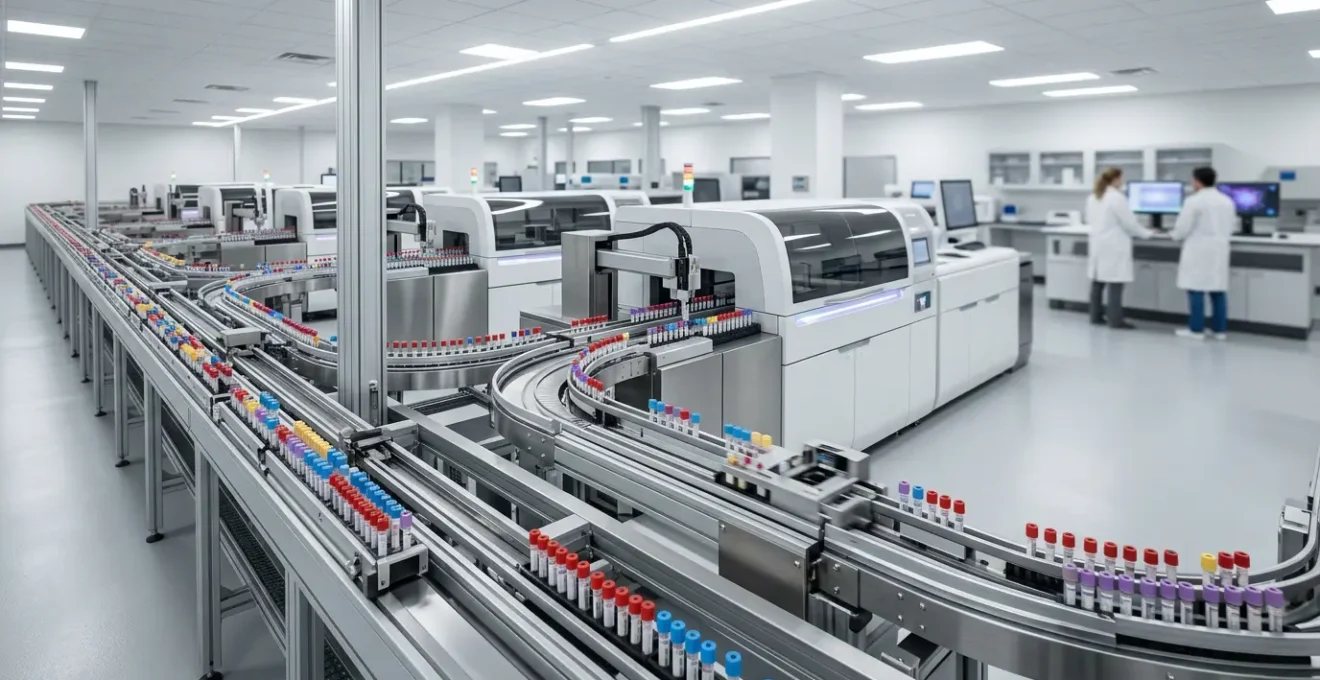
The integration of laboratory automation is not merely a strategy for efficiency; it is a fundamental shift in quality management, moving the focus from policing individual human mistakes to auditing systemic failure points within automated processes.
- The vast majority of lab errors originate in the pre-analytical phase, making this the highest-impact area for automation intervention.
- While automation drastically reduces error rates, it introduces subtle risks like QC drift and process blind spots that require advanced, system-level oversight.
Recommendation: Your immediate priority should be to develop and implement standard operating procedures (SOPs) for auditing your automated systems, including algorithmic governance rules and mechanical points of failure.
For any Quality Assurance Director in a clinical laboratory, the mandate is clear: ensure accuracy, repeatability, and efficiency. The greatest threat to this mandate has consistently been the pre-analytical phase, a segment of the workflow fraught with potential for human error. It is a well-established principle that automation is the primary countermeasure. However, the common discourse often stops at the superficial benefits of improved turnaround times (TAT) and reduced manual handling, as seen in cases like Penn State Health’s 11-minute reduction in cardiac troponin test TAT.
This perspective is incomplete. Viewing automation as a simple « set-it-and-forget-it » solution is a critical oversight. The implementation of automated lines and middleware introduces a new class of systemic risks. The challenge for modern quality management is no longer just about preventing an individual from mislabeling a tube; it is about ensuring the integrity of the entire automated ecosystem. This requires a paradigm shift from managing people to governing processes.
This document moves beyond the rudimentary benefits. It provides a systematic framework for understanding and mitigating the inherent risks of an automated laboratory environment. We will dissect the failure points, from subtle QC drift that automated systems can mask to the algorithmic governance required for reflex testing and auto-verification. The objective is to equip you with the strategic oversight needed to transform your automated laboratory from merely efficient to truly resilient.
To navigate this complex topic with the necessary rigor, this guide is structured to address the critical control points in your automated workflow. The following sections provide a detailed examination of each key area of risk and opportunity.
Summary: A Systematic Review of Automation in Quality Management
- Why 80% of Lab Errors Occur Before the Sample Hits the Analyzer?
- How to Use Middleware to Auto-Verify Normal Results and Speed Up Turnaround?
- Total Lab Automation vs. Modular Workcells: Which Fits Mid-Sized Hospitals?
- The Sample Handling Habit That Causes Cross-Contamination in Automated Lines
- When to Automate Reflex Testing Protocols: Triggers for Thyroid Panels
- The Quality Control Mistake That Invalidates a Whole Batch of CBC Results
- How to Map SNOMED CT Codes Across Different EMR Vendors?
- Why 50% of Pre-Clinical Studies Cannot Be Replicated by Other Labs?
Why 80% of Lab Errors Occur Before the Sample Hits the Analyzer?
The analytical phase of laboratory testing, with its highly controlled instrumentation, is a bastion of precision. The true vulnerability lies in the chaotic journey a sample takes before it even reaches an analyzer. The pre-analytical phase—encompassing patient identification, sample collection, labeling, transport, and accessioning—is where process integrity is most often compromised. A recent 2025 study published in PubMed reveals that pre-analytical errors comprise up to 98.4% of total laboratory errors, a figure that demands a strategic, not just tactical, response.
The primary causes of these errors are fundamentally human and logistical. They include, but are not limited to:
- Improper Patient Identification: The foundational error from which no downstream process can recover.
- Incorrect Tube Type or Draw Volume: Leads to incorrect additive-to-blood ratios, directly impacting test results.
- Labeling Errors: Mismatched labels, illegible handwriting, or incorrect placement that automated readers cannot process.
- Compromised Sample Integrity: Issues such as hemolysis, clotting, or improper transport temperatures that render a sample unfit for analysis.
These are not isolated incidents; they are systemic failure points in a manual workflow. Automation directly addresses these by enforcing process standardization. Barcode scanners eliminate identification errors, automated sorters ensure samples are routed correctly, and integrated pre-analytical systems can flag improperly labeled or filled tubes before they consume valuable analyzer time. By removing subjective human actions from these critical checkpoints, automation fundamentally redesigns the workflow to be inherently less error-prone.
How to Use Middleware to Auto-Verify Normal Results and Speed Up Turnaround?
Middleware is the central nervous system of the automated laboratory, acting as an intelligent bridge between the Laboratory Information System (LIS) and the analytical instruments. Its primary function in quality management is to enable algorithmic governance—the use of pre-defined rules to manage data flow and decision-making without human intervention. The most powerful application of this is auto-verification.
Auto-verification protocols allow the middleware to automatically review and release results that fall within established parameters, bypassing manual review by a technologist. The benefits are twofold: a dramatic reduction in Turnaround Time (TAT) for the majority of normal results, and the redirection of skilled staff’s attention to the abnormal or critical results that truly require their expertise. In fact, research from Roche Diagnostics demonstrates that automated systems have helped minimize human errors by more than 70%, a significant portion of which is attributable to reducing manual data handling.
The implementation of auto-verification is a rigorous process. It requires the QA department to work with pathologists to define and validate the rules engine. This includes setting instrument-specific normal ranges, delta checks (comparing a result to the patient’s previous results), and critical value flags. The system must be failsafe, designed to hold any result that deviates even slightly from the defined rules for manual inspection. This transforms the quality process from a review of every single data point to an audit of the exceptions and the rules that govern them.
Total Lab Automation vs. Modular Workcells: Which Fits Mid-Sized Hospitals?
The decision to automate is not a single choice but a strategic one between two primary architectures: Total Lab Automation (TLA) and Modular Automation. TLA involves a comprehensive, track-based system connecting pre-analytical, analytical, and post-analytical modules into one seamless line, epitomized by large-scale operations like UCLA Health’s facility that handles 20 million tests annually. Modular automation, or « workcell » automation, involves connecting specific instruments within a single discipline (e.g., chemistry or immunochemistry) to create focused, high-efficiency islands.
For a Quality Manager in a mid-sized hospital, the choice is not about which is « better, » but which is appropriate for the institution’s specific volume, budget, and physical space. A TLA system offers unparalleled throughput and reduced manual touchpoints but comes with a massive footprint and initial investment. Modular workcells offer a scalable, more affordable entry point to automation that can be targeted to the highest-volume testing areas first. The following table breaks down the key decision-making factors.
| Aspect | Total Lab Automation (TLA) | Modular Workcells |
|---|---|---|
| Initial Investment | High ($2-5 million) | Moderate ($500K-1.5 million) |
| Throughput Capacity | 5,000-10,000 samples/day | 1,000-3,000 samples/day |
| Space Requirements | Large (3,000+ sq ft) | Flexible (500-1,500 sq ft) |
| Scalability | Limited after installation | Highly scalable |
| Implementation Time | 12-18 months | 3-6 months |
| Staff Training | Extensive | Moderate |
From a quality perspective, TLA provides end-to-end traceability but can be a single point of failure. Modular workcells create redundancy and are easier to manage from a QC perspective, but may require more manual steps to move samples between different workcells. The right strategy for a mid-sized facility often involves a phased approach, beginning with modular workcells in core disciplines and developing a long-term plan for potential TLA integration as volume grows.
The Sample Handling Habit That Causes Cross-Contamination in Automated Lines
Automated pre-analytical systems are exceptionally effective at reducing errors related to sorting, centrifuging, and aliquoting. Indeed, one study found that an automated pre-analytical system reduced error rates by around 95%. However, this precision can create a dangerous « process blind spot » regarding a subtle but critical risk: cross-contamination from aerosol generation, particularly during automated decapping. While a human might uncap a tube with care, a robotic gripper operates with mechanical force and speed.
This automated action, repeated thousands of times a day, can generate micro-aerosols from the sample. These invisible particles can drift and settle on adjacent tubes in the rack or on the surfaces of the robotic system itself. If a high-titer sample (e.g., a viral load or hormone test) is decapped, it can contaminate a negative sample nearby, leading to a catastrophic false positive. This is a systemic risk, not an individual mistake, and it is invisible to the naked eye.
Mitigating this risk requires a specific quality control strategy. This includes a rigorous and frequent cleaning protocol for the automated line, particularly around decapping stations. More advanced labs may implement periodic « wipe tests » in the area to screen for specific analytes. Furthermore, it’s crucial to work with the vendor to understand the engineering controls within the system, such as localized ventilation or specific decapping mechanics designed to minimize aerosolization. The assumption that automation equals sterility is a flawed one; it simply changes the nature of the contamination risk.
When to Automate Reflex Testing Protocols: Triggers for Thyroid Panels
Reflex testing is the process where an initial test result automatically triggers one or more subsequent follow-up tests without a new physician order. A classic example is the thyroid panel: an abnormal TSH (Thyroid-Stimulating Hormone) result can automatically reflex to a Free T4 test. In a manual system, this requires a technologist to flag the result, hold the sample, and process a new test. In an automated system, this becomes a function of algorithmic governance within the middleware.
Automating reflex protocols offers significant clinical and operational advantages. It ensures adherence to clinical best practices, reduces the time to a complete diagnostic picture, and minimizes the need to call back patients for a second blood draw. However, the decision to automate these protocols cannot be taken lightly. It requires a formal, documented process led by the quality department in collaboration with the clinical staff. The rules must be precise, evidence-based, and financially sound, as each reflex test incurs a cost.
The triggers for automation should be based on clear clinical guidelines and high-volume test patterns. Thyroid panels, lipid panels with reflex to direct LDL, and urinalysis with reflex to urine culture are common candidates. The implementation is not just a technical configuration; it is the codification of clinical judgment into the LIS. As such, it demands rigorous validation and continuous monitoring.
Your Action Plan: Implementing Automated Reflex Testing
- Identify Candidates: Analyze test ordering patterns and clinical pathways to identify high-volume tests with clear, evidence-based follow-up steps.
- Establish Algorithmic Rules: Work with pathologists and clinicians to define the precise trigger thresholds and the corresponding reflex tests to be ordered.
- Configure and Validate Middleware: Program the established rules into the middleware and run a thorough validation study using historical data and mock samples to ensure accuracy.
- Align with Clinical Guidelines: Implement a formal protocol to ensure the automated reflex algorithms are reviewed and updated in line with any changes to official clinical guidelines.
- Monitor and Optimize: Conduct quarterly audits of reflex testing patterns to track utilization, confirm clinical appropriateness, and identify opportunities for cost savings or rule optimization.
The Quality Control Mistake That Invalidates a Whole Batch of CBC Results
A common quality control (QC) mistake in any lab is the failure to properly investigate an out-of-range QC result, potentially leading to the release of erroneous patient data. However, in an automated environment, a more insidious error can occur: the failure to detect gradual QC drift. Hematology analyzers, for example, can experience minor shifts in calibration over time. A single QC point might still fall within the acceptable +/- 2 standard deviation range, but a trend of six consecutive points on one side of the mean (a Westgard rule violation) indicates a systemic bias that is developing.
This is a critical failure point. While automation excels at flagging dramatic failures, it can mask these slow, creeping declines in performance. An experienced technologist might notice the trend visually, but an automated system simply processing pass/fail data might not. This can lead to a whole batch of Complete Blood Count (CBC) results being slightly but consistently skewed, impacting clinical decisions for dozens of patients before a hard QC failure occurs. This also applies to sample quality issues that QC must catch; for example, literature reviews conclude that hemolyzed samples are the primary source of poor blood sample quality, accounting for 40-70% of issues that can invalidate results if not flagged.
As one expert on the topic notes, this is a known vulnerability that requires a higher level of statistical oversight.
Automation systems can mask gradual QC drift that experienced technicians would spot, requiring implementation of advanced statistical process control tools beyond simple Westgard rules.
– Robin Felder, PhD, Advances in Clinical Laboratory Automation
The mitigation strategy is to move beyond simple QC checks. It requires leveraging advanced features in your LIS or middleware for statistical process control. This includes tracking moving averages, implementing the full set of Westgard rules automatically, and setting up alerts for trends, not just for outright failures. The QA Director’s role is to ensure these advanced statistical tools are not just available, but actively used and audited.
How to Map SNOMED CT Codes Across Different EMR Vendors?
True laboratory quality extends beyond the four walls of the lab. It requires ensuring that the data produced is usable and correctly interpreted by the Electronic Medical Record (EMR) systems that clinicians use. This is the challenge of interoperability, and its cornerstone is standardized terminology, with SNOMED CT (Systematized Nomenclature of Medicine – Clinical Terms) being the global standard for clinical healthcare terminology.
The problem is that different EMR vendors may implement or represent SNOMED CT codes in slightly different ways. Furthermore, a laboratory’s internal LIS might use proprietary local codes that need to be accurately mapped to the universal SNOMED CT standard before results are transmitted. A failure in this mapping process can lead to a result being misinterpreted, filed incorrectly in the patient’s chart, or missed entirely by clinical decision support systems.
Developing a robust mapping strategy is a critical quality function. It is not a one-time IT project but an ongoing governance process. The process involves:
- Creating a Concept Map: Identifying all local test codes within the LIS and finding the exact corresponding SNOMED CT concept. This must account for specimen type, method (if relevant), and units.
- Validation by Experts: The proposed map must be reviewed and signed off by laboratory and clinical experts (e.g., pathologists) to ensure semantic accuracy. For example, ensuring « Serum Potassium » and « Plasma Potassium » are mapped to their distinct codes.
- Technical Implementation and Testing: The map is then programmed into the interface engine or middleware. Rigorous testing is required to confirm that data flows correctly to the target EMR systems.
- Change Management: A formal process must be in place to update the map whenever a new test is added or a SNOMED CT code is updated or retired.
This data governance ensures that the precision achieved inside the lab is not lost in translation. It is the final link in the chain of quality, guaranteeing that an accurate result is also a meaningful and actionable one.
Key Takeaways
- The overwhelming majority of laboratory errors are pre-analytical; automation is the most effective control but introduces new, systemic risks.
- Effective quality management in an automated lab shifts from policing individual actions to auditing system-level processes, including middleware rules and mechanical failure points.
- Subtle issues like gradual QC drift and aerosol-based cross-contamination are significant risks in automated lines that require advanced statistical process control and specific cleaning protocols.
Why 50% of Pre-Clinical Studies Cannot Be Replicated by Other Labs?
The « reproducibility crisis » is a well-documented issue in scientific research, where findings from one laboratory cannot be consistently replicated by others. While many factors contribute to this, a significant one is the lack of standardization in pre-clinical and research laboratory processes. Inconsistent sample handling, variability in assay execution, and poor documentation create a cascade of minor deviations that, in aggregate, can make results impossible to reproduce. This is precisely the problem that clinical laboratory automation was designed to solve.
The principles that underpin clinical lab automation—rigorous sample tracking, standardized processing, and immutable electronic documentation—are directly applicable to addressing this crisis. By adopting these principles, research labs can eliminate significant sources of variability. When every sample is handled identically by a robotic system, and every data point is captured electronically without transcription, the method becomes far more robust and repeatable. As technology advances, these systems become even more powerful; for instance, a study by Stasevych (2023) demonstrates how AI-driven predictive analytics reduced discrepancies in laboratory results by 30%.
For a Quality Assurance Director, this broader context is vital. The work done to ensure quality and standardization within the clinical lab is not just about passing inspections or ensuring accurate patient results for today. It is about contributing to a culture of rigor and reproducibility that has implications for the entire scientific and medical enterprise. The systems and processes you build and govern are the gold standard, demonstrating how to generate data that is not just accurate, but trustworthy and replicable over time and across institutions. The adoption of clinical automation principles is a direct antidote to the reproducibility crisis.
The next logical step is to conduct a systemic risk audit of your current automated workflows. Identify your potential process blind spots, review your algorithmic governance for QC and reflex testing, and ensure your documentation provides end-to-end traceability. True quality assurance in the modern lab is proactive, not reactive.