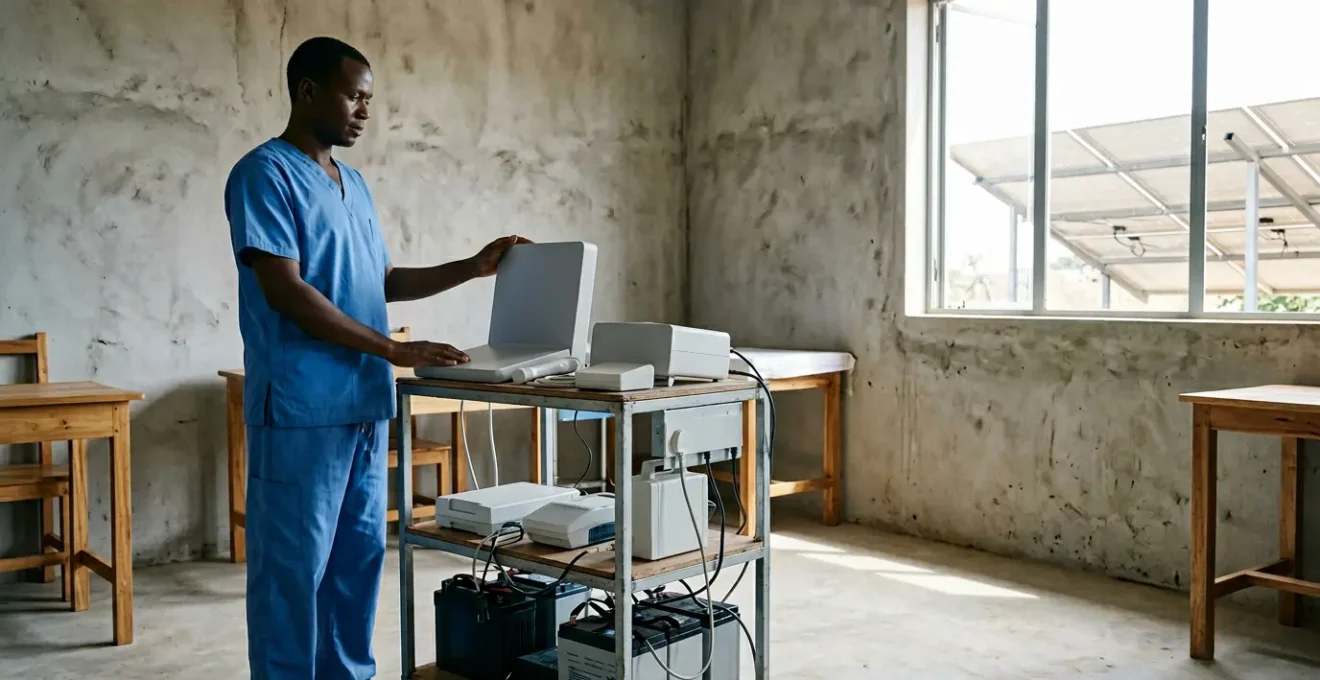
The success of medical technology in rural settings depends less on its sophistication and more on its resilience to real-world failure points.
- True adaptation goes beyond cost-reduction; it requires designing for environmental hostility (humidity, dust, unstable power) and supply chain fragility.
- Simplifying user interfaces to reduce cognitive load on non-specialist workers is more critical for accuracy than adding complex features.
Recommendation: Prioritize modularity, local repairability, and compatibility with non-proprietary consumables from the very beginning of the design process.
The image is a familiar one for any global health engineer: a state-of-the-art diagnostic machine, a marvel of modern science, sitting dormant in the corner of a rural clinic, shrouded in dust. It was deployed with the best of intentions, yet rendered useless by a power surge, a humid climate, or a single, irreplaceable broken part. The common advice often circles around making devices cheaper, more portable, or adding a solar panel. While not wrong, these are superficial fixes to a much deeper problem.
The real challenge of adapting high-end innovations for resource-limited settings isn’t about stripping features away. It’s about a radical shift in engineering philosophy. It’s about designing for a world of constraints, where the environment is hostile, supply chains are fragile, and the user is often a multitasking, non-specialist health worker under immense pressure. This is the essence of frugal innovation: not just making things cheaper, but making them smarter, more robust, and fundamentally more resilient.
This guide moves beyond the platitudes to address the core failure points of MedTech in the field. We will explore how to engineer for environmental hostility, overcome supply chain fragility, and reduce cognitive load. By focusing on these principles, we can create technology that doesn’t just get deployed, but that endures, functions, and ultimately saves lives where it’s needed most.
To navigate these complex challenges, this article breaks down the essential strategies for successful MedTech adaptation. The following sections provide a practical framework for engineers and administrators aiming to bridge the gap between advanced science and rural healthcare reality.
Summary: Frugal MedTech: How to Adapt High-End Innovations for Rural Clinics
- Why Battery-Operated Diagnostic Devices Are Critical for Off-Grid Clinics?
- How to Redesign Lab Equipment Interfaces for Non-Specialist Health Workers?
- Ruggedized Tech vs. Standard Consumer Grade: What Survives Tropical Humid Climates?
- The Consumable Design Error That Renders Devices Useless in Remote Areas
- How to Train Local Technicians to Repair Complex MedTech Using Basic Tools?
- How to Outfit a Bus for Primary Care Visits in Rural Zones?
- Bluetooth vs. Cellular Transmission: Which is More Reliable for Rural Cardiac Patients?
- How to Improve Accessibility of Healthcare for Patients Without Cars?
Why Battery-Operated Diagnostic Devices Are Critical for Off-Grid Clinics?
In many rural and remote areas, the electrical grid is not a given. It can be unreliable, subject to frequent outages, or entirely nonexistent. For a medical clinic, this reality makes mains-powered equipment a high-risk liability. The ability to perform a critical blood test or monitor vital signs cannot depend on an unpredictable power source. This is where battery-operated devices transition from a convenience to an absolute necessity, ensuring continuity of care when the grid fails. This growing need is reflected in market trends, as a recent market analysis shows the medical batteries market will grow from $2.0 billion to $2.7 billion by 2029.
However, simply adding a battery is not enough. True frugal engineering thinks about the entire energy lifecycle. This means prioritizing devices with ultra-low power consumption to maximize operational time between charges. Smart firmware that enables aggressive, usage-based sleep modes can extend battery life from hours to days. The design must also account for the local energy ecosystem. Can the device be charged via a small, portable solar panel? Can it be powered by a hand-crank dynamo in an emergency? Some of the most successful designs even incorporate compatibility with widely available power sources, such as motorcycle batteries, turning a common local commodity into a lifeline for the clinic.
Furthermore, the concept of lifecycle resilience applies directly to power. Batteries have a finite lifespan. A device that requires a proprietary battery, which can only be sourced from a manufacturer thousands of miles away, is a ticking time bomb. The most robust systems are designed with modular, easily replaceable batteries that can be swapped in the field by a local technician without service interruption. This focus on energy independence and supply chain resilience is the first and most fundamental step in adapting technology for off-grid environments.
How to Redesign Lab Equipment Interfaces for Non-Specialist Health Workers?
In a bustling urban hospital, a lab technician may be a highly specialized professional. In a rural clinic, that same role might be filled by a general nurse or community health worker who is juggling a dozen other responsibilities. Presenting them with a complex interface, crowded with menus, sub-menus, and technical jargon, is a recipe for disaster. The American Medical Association highlights this risk, noting that up to 87% of medical errors can stem from cognitive overload. Reducing this mental burden is not a « dumbing down » of technology; it is a critical design feature for ensuring accuracy and patient safety.
The goal is to create an interface that is so intuitive it requires minimal training and is virtually impossible to use incorrectly. This often means moving away from complex touchscreens and returning to the robust simplicity of physical controls. Large, tactile buttons that provide clear haptic feedback can be easily operated with gloved hands. Instead of text-based readouts, a system of simple, color-coded LED indicators can convey status (e.g., green for « ready, » yellow for « processing, » red for « error ») at a glance, even in low-light conditions.
This design philosophy prioritizes clarity over complexity. The entire workflow should be guided and linear. For example, a diagnostic device could have three numbered buttons: 1) « Insert Sample, » 2) « Run Test, » and 3) « Read Result. » The device would only allow the next step to be initiated once the previous one is complete, eliminating guesswork and procedural errors. By radically simplifying the human-machine interaction, we design for the high-stress, multitasking reality of a rural health worker, ensuring the focus remains on the patient, not on deciphering a complicated piece of equipment.
Ruggedized Tech vs. Standard Consumer Grade: What Survives Tropical Humid Climates?
A standard piece of lab equipment is designed for a climate-controlled, air-conditioned room. A rural clinic in a tropical region is an entirely different world. Here, the air is thick with moisture, dust is a constant presence, and temperatures can swing wildly. This is the domain of environmental hostility, and consumer-grade electronics are simply not built to survive it. Humidity corrodes circuit boards, dust clogs cooling fans, and high heat can cause components to fail prematurely. Investing in « ruggedized » technology is not an extravagance; it is a baseline requirement for long-term functionality.
Ruggedization is a specific set of design choices that protect a device from its environment. This is often quantified by an Ingress Protection (IP) rating, where a standard device might be IP54 (protected from limited dust and water spray), while a ruggedized one will be IP67 or IP68, meaning it is fully dust-tight and can be submerged in water. These devices are built with sealed casings, corrosion-resistant materials, and can operate in a much wider range of temperatures and humidity levels.
This table from a study on sustainable medical devices clearly illustrates the difference in durability features:
| Feature | Standard Consumer Grade | Ruggedized Medical Grade |
|---|---|---|
| IP Rating | IP54 typical | IP67-IP68 |
| Operating Temperature | 0-40°C | -20 to 60°C |
| Humidity Resistance | Up to 80% RH | 95% RH condensing |
| Field Serviceability | Limited/None | Modular components, replaceable seals |
| Typical Lifespan | 2-3 years | 5-7 years |
Perhaps the most critical feature noted in this analysis of device sustainability is « field serviceability. » A truly rugged device is not just tough; it’s repairable. It uses modular components and replaceable seals, allowing a trained local technician to perform maintenance. This principle has been powerfully demonstrated in rural Kenya, where local technicians are using 3D printing to create spare parts for older medical equipment, keeping vital tools functional long past their intended lifespan and embodying the ultimate form of lifecycle resilience.
The Consumable Design Error That Renders Devices Useless in Remote Areas
One of the most insidious failure points for MedTech in rural areas has nothing to do with electronics or durability. It’s the dependence on proprietary consumables. A diagnostic device may be perfectly functional, but if it requires a specific test strip, reagent cartridge, or battery that can only be purchased from one manufacturer, it is living on borrowed time. This creates a fragile dependency on a long and often unreliable supply chain. A single disruption—a customs issue, a shipping delay, or the manufacturer discontinuing the item—can render the entire piece of equipment a useless brick. This is a critical issue across the industry, where analysis reveals that over 60% of certain implantable medical devices require proprietary batteries with limited lifespans, locking institutions into a cycle of replacement.
This « razor-and-blades » business model, while profitable in developed markets, is catastrophic for resource-limited settings. Frugal innovation demands that we design for supply chain independence. This means actively engineering devices to be compatible with consumables from multiple manufacturers or, better yet, with locally available alternatives. It means prioritizing reagents with an ultra-long shelf life that do not require a constant cold chain for transportation and storage. It involves a shift from single-use disposables to multi-test cartridges that reduce waste and logistical burden.
The ultimate goal is to move towards consumable-free diagnostics where possible, leveraging advances in AI and optical analysis to derive results without the need for chemical reagents. For devices that still require them, designing for resilience is paramount. The following checklist outlines key strategies to break free from the proprietary consumable trap and ensure a device’s long-term utility.
Action Plan: Designing Consumable-Resilient Medical Devices
- Embrace Open Standards: Design devices to accept consumables from multiple, competing manufacturers, avoiding proprietary lock-in.
- Prioritize Shelf Life: Select or develop reagents and cartridges that have an ultra-long shelf life and do not require refrigeration.
- Consolidate Tests: Implement multi-test cartridges instead of single-use consumables to reduce waste and simplify inventory management.
- Enable Local Calibration: Build in firmware that allows the device to be calibrated for locally sourced or alternative reagents.
- Explore Consumable-Free Methods: Investigate and integrate diagnostic methods based on AI, optical analysis, or other technologies that minimize or eliminate the need for physical consumables.
How to Train Local Technicians to Repair Complex MedTech Using Basic Tools?
The traditional model of MedTech service involves flying in a specialized engineer from a regional hub, an approach that is both prohibitively expensive and slow for remote clinics. A truly sustainable system is one where maintenance and repair are handled locally. The challenge is not a lack of local talent, but a lack of access to the necessary tools, parts, and, most importantly, knowledge. The solution lies in designing devices for local repairability from the ground up and democratizing the knowledge required to fix them.
This starts with a commitment to open-source principles. As one case study on community-led manufacturing highlights, developing a medical device as an open-source project allows for the distribution of source files—schematics, software code, and 3D models—to diverse communities. This empowers local technicians to manufacture or repair the device using local resources, drastically lowering costs and increasing access. This approach transforms a clinic from a passive consumer into an active participant in its own technological ecosystem.
The design itself must facilitate this. This means using modular components that can be easily swapped out, avoiding specialized screws in favor of standard ones, and providing clear, visual repair manuals with step-by-step instructions. Training should be practical and hands-on, focusing on diagnosing common faults and performing repairs with a basic toolkit. This builds a local pool of expertise and creates a sense of ownership. When a local technician can bring a vital piece of equipment back to life with their own hands, it fosters a powerful cycle of empowerment and technological self-sufficiency, ensuring the long-term lifecycle resilience of the clinic’s tools.
How to Outfit a Bus for Primary Care Visits in Rural Zones?
When patients cannot get to the clinic, the clinic must go to the patients. This is the driving logic behind mobile health clinics (MHCs), which are becoming a critical piece of healthcare infrastructure, especially in contexts where brick-and-mortar facilities are struggling. With recent data showing that nearly 30% of rural hospitals in the U.S. were at risk for closure, MHCs are no longer a temporary fix but a strategic, long-term solution for delivering primary care. The Mayo Clinic has even developed a comprehensive 9-step framework for implementing digitally-enabled MHCs, demonstrating a systematic approach to redesigning healthcare delivery for vulnerable rural populations.
However, « outfitting a bus » is a complex task that requires balancing cost, capability, and context. The ideal platform is not always the largest or most expensive. Frugal ingenuity means selecting the right tool for the job. A large, retrofitted bus may offer ample space for multiple consultation rooms but be restricted to paved roads. A rugged 4×4 truck-based clinic might be more agile and capable of reaching remote villages on rough terrain, and it can often be serviced by local mechanics. For navigating narrow paths or densely populated areas, an even smaller three-wheeled vehicle could be the most effective platform.
This decision must be informed by the specific geographic and economic realities of the region. The following table provides a high-level comparison of common MHC platforms, highlighting the trade-offs involved.
| Platform Type | Initial Cost | Terrain Capability | Maintenance Requirements |
|---|---|---|---|
| Standard Bus | $150,000-250,000 | Paved roads only | Specialized mechanics needed |
| 4×4 Truck | $100,000-180,000 | All terrain | Local mechanics capable |
| Three-wheeled vehicle | $30,000-60,000 | Rural paths | Basic maintenance |
| Boat clinic | $80,000-150,000 | Riverine regions | Marine specialist needed |
Once the platform is chosen, the interior must be outfitted with the resilient, low-power, and easy-to-use medical devices discussed in previous sections. The vehicle itself becomes a microcosm of the rural clinic, requiring its own independent power system (solar panels and battery banks), durable equipment, and a workflow optimized for a compact space. The MHC is not just a vehicle; it is a fully integrated healthcare delivery system on wheels.
Bluetooth vs. Cellular Transmission: Which is More Reliable for Rural Cardiac Patients?
The rise of telemedicine, which saw a staggering 154% increase in adoption in the U.S. during the pandemic, has opened new possibilities for remote patient monitoring. For a cardiac patient in a rural area, a wearable monitor that can transmit data to a specialist hundreds of miles away can be a lifesaver. But this hinges on a reliable connection, and in rural settings, connectivity is often patchy and unpredictable. The choice between transmission technologies like Bluetooth and cellular is not an « either/or » question; the most reliable systems use an adaptive strategy that leverages the strengths of both.
Bluetooth is a low-energy, short-range technology. It is excellent for connecting a wearable sensor to a local « gateway » device, such as a patient’s smartphone or a dedicated hub in their home. This connection is generally very stable and consumes minimal power. However, it relies on that gateway device having its own connection to the internet (via Wi-Fi or a cellular network) to transmit the data to the clinic. If the patient’s phone is off or has no signal, the data goes nowhere.
Direct cellular transmission (using IoT protocols like MQTT) embeds a SIM card directly into the medical device, allowing it to connect to the network independently. This removes the reliance on a separate gateway device. However, it is more power-intensive and depends entirely on the availability of a cellular signal, which can be inconsistent in remote regions. The most robust solution is an adaptive transmission strategy. The device defaults to a « store-and-forward » paradigm, collecting and storing days or even weeks of data locally. Its firmware constantly assesses network availability. When the patient’s phone (the Bluetooth gateway) has a signal, it transmits the data. If not, the device can attempt a direct cellular connection using a low-bandwidth protocol. By creating these redundant data pathways, the system maximizes the chances of a successful transmission, ensuring a patient’s vital data reaches their doctor, regardless of intermittent connectivity.
Key Takeaways
- Frugal innovation in MedTech is not about being cheap, but about designing for resilience against environmental hostility, supply chain fragility, and cognitive load.
- The most critical design features are often the simplest: modularity for local repair, intuitive interfaces with physical buttons, and compatibility with non-proprietary consumables.
- A successful rural health strategy integrates resilient devices into appropriate delivery platforms, like well-outfitted mobile clinics, supported by adaptive data transmission systems.
How to Improve Accessibility of Healthcare for Patients Without Cars?
For many people in rural communities, the greatest barrier to healthcare is not the cost or quality of care, but the simple, physical act of getting there. Lack of personal transportation, limited public transit, and vast distances to the nearest clinic create a formidable obstacle. Improving healthcare accessibility for these populations requires a systemic approach that brings care closer to home. This is where the concepts we’ve discussed converge into a cohesive strategy. Mobile health clinics, outfitted with robust and easy-to-use technology, are a direct and powerful answer to this challenge.
These mobile units effectively eliminate the transportation barrier by bringing primary care, diagnostics, and preventative services directly into communities. However, their effectiveness is amplified by the integration of remote monitoring and telehealth technologies. A patient who receives an initial check-up in a mobile clinic can be sent home with a wearable monitor. This device, designed with adaptive transmission logic, can then relay vital data back to the clinic, even in areas where connectivity is poor. As Julius M. Gilayeneh of the GHI notes, this is a significant hurdle, as reports indicate that « more than 60 percent of the rural communities do not have network coverage. » This makes store-and-forward capability essential.
This hybrid model of in-person mobile care and remote digital follow-up creates a continuum of care that is far more accessible than a traditional, centralized clinic. It leverages technology not as a novelty, but as a pragmatic tool to overcome geographic and infrastructural limitations. By embracing a frugal engineering mindset—building resilient devices, empowering local technicians, and deploying care on mobile platforms—we can create a healthcare system that is truly accessible to everyone, regardless of whether they own a car or live next door to a hospital. This is the ultimate promise of adapting innovation for the real world.
The journey from a high-end laboratory to a functional rural clinic is one of thoughtful adaptation and radical pragmatism. Adopting this frugal innovation mindset is the critical next step for any organization, engineer, or administrator committed to bridging the global health divide.