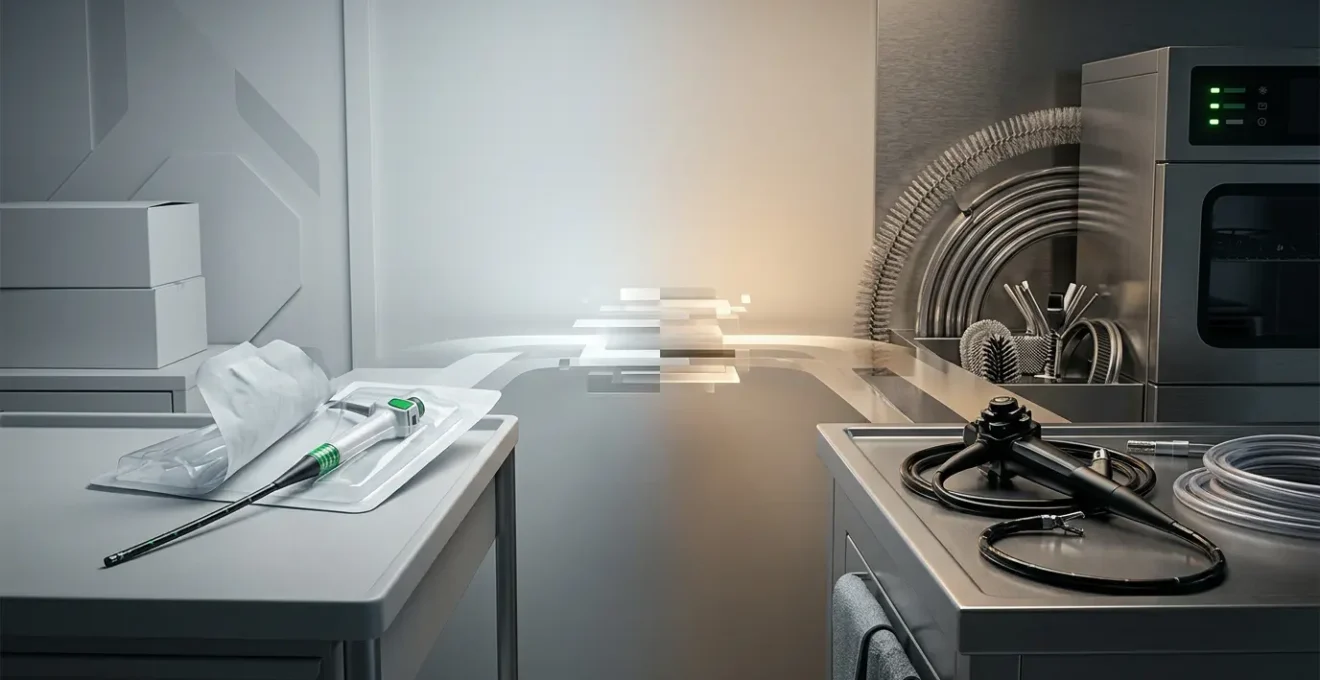
The true financial liability of reusable endoscopes extends far beyond their purchase price, accumulating a significant « risk tax » from unpredictable repair cycles and complex, costly reprocessing failures.
- Reprocessing according to new safety standards can add over $50 to each procedure in hidden labor and material costs.
- Frequent, unpredictable repairs represent a major operational and financial drain, with each scope potentially costing over $8,000 annually.
Recommendation: Procurement officers should model costs based not just on acquisition and projected use, but on the financial volatility and patient safety risks inherent in the reusable scope lifecycle. Single-use scopes offer predictable per-procedure costs and eliminate this risk.
For endoscopy unit managers and procurement officers, the « disposable vs. reusable » debate is a central economic and safety puzzle. The conventional wisdom often frames this as a simple Total Cost of Ownership (TCO) calculation: a high initial investment for reusable scopes versus a cumulative per-procedure cost for single-use alternatives. This approach, however, frequently overlooks the volatile and compounding expenses that define the reusable model. The financial analysis cannot stop at the purchase order; it must account for a web of interconnected, often unpredictable, operational burdens.
These burdens include not just the visible costs of cleaning chemicals and repair invoices, but also the invisible « risk tax » associated with potential patient-to-patient cross-contamination, procedural delays due to equipment unavailability, and the cascading effect of minor handling errors that lead to major repairs. While a reusable scope appears as an asset on a balance sheet, its true cost is a dynamic liability, influenced by human factors, stringent new regulations, and the physical degradation inherent in its complex design.
But what if the key to an accurate financial model is not just tracking expenses, but quantifying risk? This analysis moves beyond surface-level TCO to dissect the hidden cost drivers that inflate the lifetime expense of reusable endoscopes. We will examine the data behind reprocessing, repair cycles, and patient safety to build a more realistic 5-year cost model, enabling healthcare facilities to make decisions based on financial predictability and operational resilience, not just initial price tags.
This article provides a data-driven breakdown of the key financial and operational factors at play. The following sections will explore the specific costs and risks, from reprocessing and biofilm to repairs and handling, to equip you with the insights needed for a comprehensive evaluation.
Summary: A 5-Year Cost Model: Disposable vs. Reusable Endoscopes
- Why the Hidden Costs of Cleaning Reusable Scopes Add $50 Per Procedure?
- How to Eliminate Biofilm Formation in Elevator Channels of Duodenoscopes?
- OEM Repair vs. Third-Party Service: Which Extends Scope Lifespan?
- The Handling Error During Transport That Cracks Fiber Optic Bundles
- When to Use Disposable Scopes: 3 High-Risk Patient Profiles
- The Surface Disinfection Mistake That Spreads Norovirus in 24 Hours
- How to Estimate the Tube Replacement Costs Over a 10-Year CT Scanner Lifespan?
- How to Examine the Body Interior With Minimal Sedation Using Ultra-Thin Scopes?
Why the Hidden Costs of Cleaning Reusable Scopes Add $50 Per Procedure?
The cost of reprocessing a reusable endoscope is far more than the price of detergents and disinfectants. It represents a significant operational expenditure, or « reprocessing debt, » that grows with evolving safety standards. New mandates aimed at enhancing patient safety introduce more rigorous, time-consuming, and expensive protocols. For instance, recent compliance analysis shows that implementing the new AAMI ST91:2021 standards can add a $52.35 to $67.57 increase per procedure. This is not a marginal expense; it’s a fundamental shift in the economic model of reusable scopes.
This surge in cost is driven by multiple factors, each adding a layer of expense. The most significant is the additional time required for drying, which alone can contribute over $38 per procedure. Other substantial costs include environmental monitoring to ensure the reprocessing environment itself is not a source of contamination, and variable expenses for cross-contamination control, which can fluctuate based on perceived infection risk. Even seemingly minor tasks like transport and leak testing add incremental costs that accumulate rapidly over thousands of procedures.
This detailed breakdown reveals that reprocessing is a major, and growing, cost center. For procurement officers, simply amortizing the initial purchase price of a scope is no longer sufficient. A realistic TCO must account for these escalating, protocol-driven operational costs.
| Cost Category | Amount (USD) | Details |
|---|---|---|
| Environmental Monitoring | $11.88 | 5.4 minutes additional time |
| Transport | $0.98 | Equipment movement between areas |
| Leak Testing | $0.17 | 0.5 minutes additional time |
| Cross-contamination Control | $0.38-$15.60 | Variable based on infection risk |
| Drying Process | $38.51 | 10 minutes additional time |
| Storage | $0.43 | Specialized cabinet requirements |
How to Eliminate Biofilm Formation in Elevator Channels of Duodenoscopes?
The most significant risk associated with reusable endoscopes, particularly complex models like duodenoscopes, is the formation of biofilm in hard-to-clean internal channels. The intricate design of the elevator mechanism creates microscopic crevices where organic material can accumulate, shielding bacteria from disinfectants. This persistent contamination risk is the primary driver behind device-related outbreaks and a major concern for patient safety. The only guaranteed way to eliminate this specific risk is to eliminate the source: the reusable device itself.
Single-use duodenoscopes are designed to completely sidestep this problem. By providing a sterile, factory-new device for every procedure, they remove the possibility of patient-to-patient transmission from a contaminated scope. The impact is stark: FDA data shows disposable duodenoscopes reduce contamination from 6% to 0.5%. This isn’t just an incremental improvement; it’s a paradigm shift in infection control. It transforms a high-risk, multi-step manual process into a predictable, standardized, and safe outcome.
The complexity of reprocessing is a well-acknowledged challenge. As one expert in clinical research and education notes, the design of these devices makes proper handling and cleaning incredibly difficult. This inherent complexity is the root cause of the « reprocessing debt »—the persistent risk that, despite best efforts, a scope may not be 100% sterile.
An endoscope’s design is so complex that proper handling and care are very difficult, with a massive number of steps to reprocess them.
– Karen Bush, MSN, FNP, BC, NCRP, HealthTrust Clinical Research & Education
By opting for a disposable model for high-risk procedures, institutions effectively buy an insurance policy against biofilm-related infections, trading the unpredictable risk of reprocessing failure for the certainty of a sterile device.
OEM Repair vs. Third-Party Service: Which Extends Scope Lifespan?
Repairs represent one of the largest and most volatile hidden costs in the reusable endoscope lifecycle, creating a « failure cascade » where one incident leads to a cycle of escalating expenses. The choice between Original Equipment Manufacturer (OEM) and third-party repair services is pivotal in managing this cost. While third-party services may offer lower upfront quotes, OEM repairs often provide greater long-term value by using proprietary parts and factory-calibrated processes that restore the scope closer to its original specifications. This can slow the accumulation of micro-damage that eventually compromises image quality and maneuverability.
The financial impact of repairs is staggering. Comprehensive data from Johns Hopkins reveals that, on average, each colonoscope requires 3.04 repairs per year at an average cost of $8,609.94. This translates to an annual repair liability of over $26,000 per scope. This figure doesn’t account for the procedural downtime and logistical costs of managing a fleet of scopes in various states of repair. A single dropped scope or an unnoticed impact can trigger a repair cycle that ultimately costs more than the device’s initial value over its functional lifespan of approximately six years.
The visual difference between a high-quality repair and a substandard one, especially in critical components like fiber optic bundles, can be subtle but has significant consequences. OEM repairs are designed to maintain the precise alignment of these bundles, ensuring optimal light transmission and image clarity. Sub-par repairs can introduce misalignments, leading to a gradual decline in diagnostic quality and potentially necessitating earlier replacement of the entire device. Therefore, a focus on short-term savings from third-party repairs can accelerate the end of a scope’s functional life, increasing the total cost of ownership.
The Handling Error During Transport That Cracks Fiber Optic Bundles
The journey of a reusable endoscope from the procedure room to the reprocessing area and back is fraught with risk. The most delicate and expensive components, such as the fiber optic bundles and the CCD chip at the distal tip, are highly vulnerable to damage from seemingly minor impacts. A single handling error during transport can lead to a costly repair, contributing directly to the unpredictable « failure cascade » that plagues the reusable model. These are not rare events; they are systemic risks inherent in the manual handling process.
The financial consequences of such damage are significant, with repairs for impact-related issues often costing thousands of dollars. The core of the problem lies in the multiple handoff points where the scope is moved, cleaned, and stored. Each transfer represents a moment of vulnerability. Identifying these critical points is the first step in mitigating a risk that can never be fully eliminated.
Key high-risk moments in the transport and handling cycle include:
- Transfer from procedure room to transport cart: This often occurs in a hurried post-procedure environment, increasing the risk of bumps or drops.
- Movement through doorways and elevators: Navigating confined spaces and dealing with sudden stops can cause the scope to strike hard surfaces.
- Placement into the reprocessing sink: Handling a wet, slippery scope increases the likelihood of it being dropped into the basin, which can damage the distal tip.
- Transfer to the drying cabinet: At the end of a long and complex reprocessing cycle, technician fatigue can lead to careless handling errors.
In contrast, a single-use scope arrives in a sterile, protective package and is disposed of immediately after the procedure. This model entirely removes the risks associated with transport, manual cleaning, and storage, thereby eliminating a major source of unpredictable damage and repair costs from the financial equation.
When to Use Disposable Scopes: 3 High-Risk Patient Profiles
While the economic debate is complex, the decision to use a disposable endoscope often becomes clear when viewed through the lens of patient risk. For certain patient profiles, the guarantee of a sterile instrument is not just a preference but a clinical necessity. The use of single-use scopes in these scenarios provides a critical layer of protection, ensuring operational readiness and eliminating the « reprocessing debt » for the most vulnerable individuals. This is particularly relevant in situations where the risk of infection could have devastating consequences.
Three key patient profiles where disposable scopes offer a definitive advantage are:
- Immunocompromised Patients: Individuals with weakened immune systems (e.g., organ transplant recipients, chemotherapy patients) are highly susceptible to infections from opportunistic pathogens that may survive the reprocessing cycle.
- Emergency or Trauma Patients: In urgent situations, there is no time to wait for a reusable scope to be reprocessed. A single-use scope ensures immediate availability of a sterile device, reducing delays in diagnosis and treatment.
- Patients with Known Multi-Drug Resistant Organisms (MDROs): Using a disposable scope for patients colonized with bacteria like CRE (Carbapenem-resistant Enterobacteriaceae) prevents the potential for cross-contamination of the hospital’s endoscope fleet and environment.
The value of operational readiness is particularly evident in emergency settings. Having a sterile, ready-to-use scope on hand at all times streamlines workflow and can significantly improve patient outcomes by enabling faster medical intervention. This strategic use of disposable technology is not just about cost, but about risk mitigation and quality of care.
Case Study: Emergency Department Adoption
A study highlighted that using single-use endoscopes in emergency departments reduced waiting times and improved patient outcomes. Hospitals have reported that the ability to quickly access sterile endoscopes without waiting for reprocessing has streamlined workflow and enhanced efficiency, demonstrating a clear clinical and operational benefit that justifies the per-procedure cost in high-stakes environments.
The Surface Disinfection Mistake That Spreads Norovirus in 24 Hours
While much attention is focused on the internal channels of endoscopes, the external surfaces of the entire endoscopy system—including the control head, processor tower, and transport cart—can also become reservoirs for pathogens. A single mistake in the surface disinfection protocol can lead to the rapid spread of highly contagious viruses like Norovirus, or other healthcare-associated infections (HAIs). This risk is not confined to the scope itself but extends to the entire ecosystem of equipment surrounding the procedure. The meticulous, multi-step process required to mitigate this risk adds another layer to the operational burden of the reusable model.
Effective surface disinfection is not as simple as wiping down a surface. It requires using the correct disinfectant for the specific pathogen, ensuring a sufficient contact time (the period the surface must remain wet), and meticulously cleaning high-touch, complex areas like buttons, dials, and connector ports. A failure at any step can leave behind viable pathogens, ready to be transferred to the next patient or healthcare worker. This is another facet of the « risk tax »—the constant vigilance and resource allocation required to prevent an outbreak.
Single-use endoscopes inherently reduce this risk. Because the device with the highest bioburden is disposed of immediately, the potential for contaminating the wider procedural environment is significantly lowered. While ancillary equipment still requires cleaning, removing the primary source of contamination simplifies the entire infection control process.
Your Action Plan: Critical Surface Disinfection Audit for Endoscope Systems
- Control Head & Connectors: Verify that control head buttons, dials, and light source connector ports are cleaned with EPA-approved virucidal wipes and specialized brushes, with documented adherence to the required 60-second contact time.
- Processor & Tower Surfaces: Inventory all cleaning agents used for processor towers and touchscreens, ensuring they are certified as electronic-safe disinfectants and effective against common HAIs.
- Transport & Mobility Points: Confront protocol with reality by observing the cleaning of transport cart handles and wheels. Are they consistently disinfected after moving from contaminated (reprocessing) to clean (storage/procedure) areas?
- Protocol Adherence & Documentation: Review cleaning logs for the past 30 days. Is there a clear, consistent record of completion time and technician initials for each major surface cleaned? Gaps in documentation often indicate gaps in practice.
- Integration & Training Plan: Based on the audit, identify weak points and prioritize a plan to replace ineffective agents or implement mandatory re-training on contact times and high-touch area protocols.
How to Estimate the Tube Replacement Costs Over a 10-Year CT Scanner Lifespan?
To contextualize the unpredictable nature of endoscope costs, it is useful to draw an analogy with another piece of high-cost medical equipment: the CT scanner. The most significant replacement cost for a CT scanner is its X-ray tube. However, this cost is highly predictable. Tube lifespan is measured in scan counts, and failure is rarely a surprise. A facility can budget for a tube replacement costing $75,000 to $150,000 every 3-5 years with a high degree of certainty. This predictability is the key difference.
Reusable endoscopes, by contrast, are defined by their cost unpredictability. Unlike a CT tube, the failure of critical endoscope components like the bending section or fiber optic bundle is not tied to a simple usage metric. Instead, failure is largely dependent on random events: handling errors, accidental impacts, and the subtle variations in reprocessing quality. An endoscope’s bending section may fail after one year, while another identical model lasts two, entirely dependent on its handling history. This makes long-term budgeting an exercise in guesswork rather than financial planning.
This fundamental difference in failure predictability is the core of the economic argument for single-use scopes in certain applications. While a reusable scope’s repair costs may surpass its initial purchase price over its lifespan, these costs arrive at irregular, unpredictable intervals. A single-use scope transforms this volatile financial liability into a fixed, predictable per-procedure operational expense. This allows for precise budgeting, eliminating the financial shocks that come with unexpected, high-cost repairs.
The following table, based on a recent comparative analysis, illustrates this crucial distinction in component lifespan and cost predictability.
| Equipment Type | Critical Component | Average Lifespan | Failure Predictability | Replacement Cost |
|---|---|---|---|---|
| CT Scanner | X-ray Tube | 3-5 years | Highly predictable (scan count) | $75,000-$150,000 |
| Reusable Endoscope | Bending Section | 1-2 years | Unpredictable (handling dependent) | $3,000-$5,000 |
| Reusable Endoscope | Fiber Optic Bundle | 2-3 years | Unpredictable (impact damage) | $5,000-$8,000 |
| Reusable Endoscope | Working Channel | 3-4 years | Moderate (usage dependent) | $2,000-$4,000 |
Key Takeaways
- The true cost of reusable endoscopes is inflated by a « risk tax » of unpredictable repairs and increasingly expensive reprocessing mandates.
- Single-use scopes eliminate the risk of patient cross-contamination from biofilm and device-related handling, guaranteeing sterility for every procedure.
- Unlike predictable equipment costs (e.g., CT tubes), endoscope repair costs are volatile and random, making accurate long-term budgeting nearly impossible for reusable models.
How to Examine the Body Interior With Minimal Sedation Using Ultra-Thin Scopes?
The ongoing evolution of the endoscope market is not just about the reusable versus disposable debate, but also about the patient experience. Technological advancements are enabling the development of ultra-thin endoscopes that can be used with minimal or no sedation, significantly reducing patient risk, recovery time, and overall procedural cost. This innovation is largely driven by the same technology that makes single-use scopes economically viable: CMOS « chip-on-tip » imaging.
Traditional fiber-optic scopes are limited in how thin they can be made without sacrificing image quality. CMOS technology replaces bulky fiber bundles with a miniaturized digital camera sensor placed directly at the tip of the endoscope. This allows for the creation of extremely slender, flexible devices that are less invasive and more comfortable for the patient. Procedures like transnasal esophagoscopy can be performed in an office setting, freeing up valuable time and space in the main endoscopy suite.
From a financial perspective, this technology is a game-changer. The mass production of CMOS sensors makes these sophisticated, ultra-thin scopes affordable enough to be disposable. This resolves the central dilemma of reusable micro-endoscopes: their extreme fragility would make repair costs prohibitive. By adopting a single-use model, healthcare providers gain access to the clinical benefits of minimal-sedation endoscopy without taking on the immense financial risk of maintaining a fleet of delicate, expensive devices. This alignment of clinical innovation and economic practicality is reshaping the landscape of diagnostic procedures.
For procurement officers and unit managers, the path forward involves a nuanced, risk-adjusted analysis. The next logical step is to conduct a facility-specific audit, modeling the true TCO of your current reusable fleet against the predictable costs and safety benefits of a hybrid or fully disposable model for high-risk, high-volume procedures. Evaluate your repair invoices, reprocessing labor, and procedural delays from the past year to quantify your institution’s unique « risk tax. »